

On this page
When you cook a pot of rice, the clear water you started with soon turns into a cloudy, thick liquid. This change is not just about the rice getting soft; it is a fundamental chemical process called starch gelatinisation.
Understanding why this happens involves looking closely at the carbohydrates packed inside the grain and how they react when they are exposed to heat and water over time.
What is the chemistry of the rice grain?
A single grain of rice is essentially a compact store of energy in the form of starch. These starch molecules do not float freely; they are arranged tightly inside tiny, semi-crystalline structures called granules.
Starch itself comes in two main structural shapes, which you might recognise if you study biomolecules in chemistry:
Amylose: A straight, linear chain of glucose molecules. Because it is linear, it packs tightly.
Amylopectin: A highly branched chain of glucose molecules. Its bushy shape prevents tight packing and makes it highly water-soluble.
The exact ratio of these two forms of starch determines exactly how the rice behaves in the pot, how quickly it cooks, and what texture it will have when you serve it.
Why does water become thick and starchy when cooking rice?
When you first heat rice in water, the thermal energy begins to disrupt the weak hydrogen bonds that hold the starch granules tightly together.
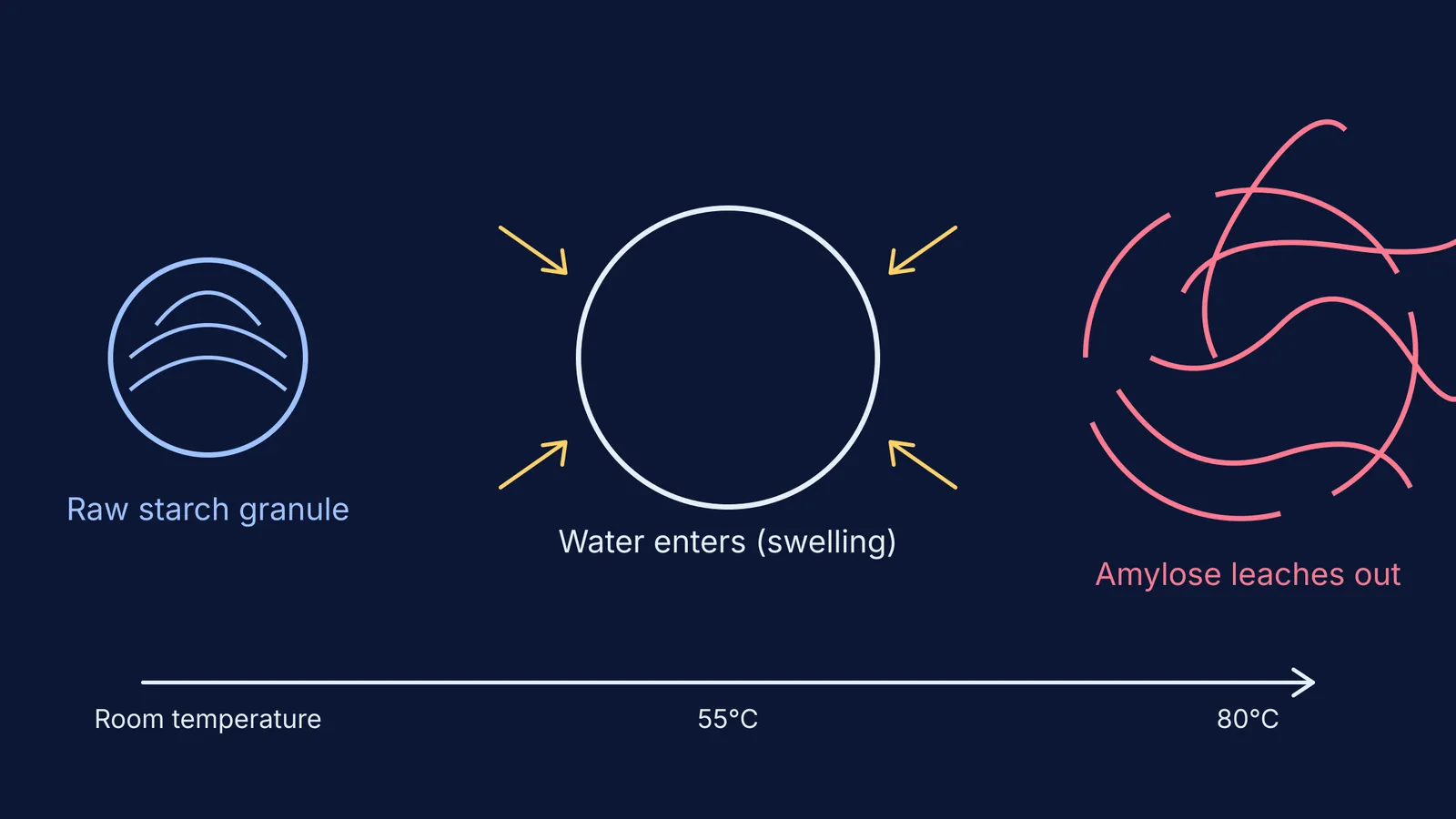
As the water warms, it penetrates the amorphous regions of these granules, causing them to absorb the water and swell significantly. A 1993 report by the Food and Agriculture Organization (FAO) defines the final gelatinisation temperature as the temperature at which at least 90 percent of the starch granules have swelled irreversibly in hot water. For most types of rice, this crucial temperature falls between 55°C and 80°C.
Once the granules reach this temperature range, they rupture. The straight-chain amylose molecules leach out of the broken granules and dissolve into the surrounding cooking water. Once free, these long molecules tangle around each other and trap free water molecules, forming a highly viscous, glue-like network. This molecular entanglement is what transforms thin boiling water into a thick, cloudy liquid.
Does the type of rice change the stickiness?
Different types of rice naturally have different amounts of amylose, which directly changes the temperature at which their granules break down and how much they thicken the water.
Short-grain and waxy rice naturally have lower amylose content and burst at the lower end of the temperature scale, between 55°C and 69.5°C. Their granules burst easily and early in the cooking process, releasing starch that makes the cooked rice extremely sticky and the surrounding water very thick.
Long-grain rice (like basmati or jasmine) has a much higher amylose content. These dense granules require significantly more heat energy to break apart, often needing temperatures closer to 80°C. Because they resist swelling and hold their internal shape better, less amylose leaks out into the pot. This leaves the cooking water noticeably thinner and the cooked rice grains separate and firm.
Research published in PLOS One confirms that rice varieties with high amylose content generally pair with different gelatinisation temperatures and distinct pasting properties, allowing agricultural scientists to breed rice for specific regional textures.
A kitchen checklist for starch gelatinisation
You can observe these chemistry principles directly in your own kitchen by paying close attention to the cooking liquid:
Rinsing the rice: The water turns cloudy immediately because you are washing away loose, powdery surface starch from milling, not because the starch has gelatinised.
Heating to 55°C: The water remains relatively thin as the granules are just beginning to absorb moisture and swell.
Reaching 80°C and boiling: The granules burst, amylose leaches out rapidly, and the liquid visibly thickens into a starchy gel.
Cooling down: As the thick rice water cools, the amylose chains slow down and re-align, forming a rigid structure. This is why leftover rice water turns into a stiff jelly in the fridge.
Seeing carbohydrates at the molecular level
To fully picture why rice water thickens, you have to imagine millions of straight chains spilling out of a ruptured sphere and entangling to trap water molecules.
Visualising how heat breaks hydrogen bonds and alters these complex molecular structures can be difficult from a textbook description alone. If you want to see how these microscopic forces work, you can run interactive simulations to see how heat breaks hydrogen bonds and alters these complex molecular structures in the Simulation Lab. These models make it easier to see how different temperatures and chain lengths physically change the way a substance behaves in water.


