On this page
A hot shower fills the bathroom with water vapour but leaves the mirror near the temperature the room was before you started. You know the pieces from Class 9 states of matter: evaporation turns water into vapour, and condensation turns vapour back into liquid when it loses energy. A fogged mirror is condensation you can watch.
Why does the bathroom mirror fog up after a hot bath?
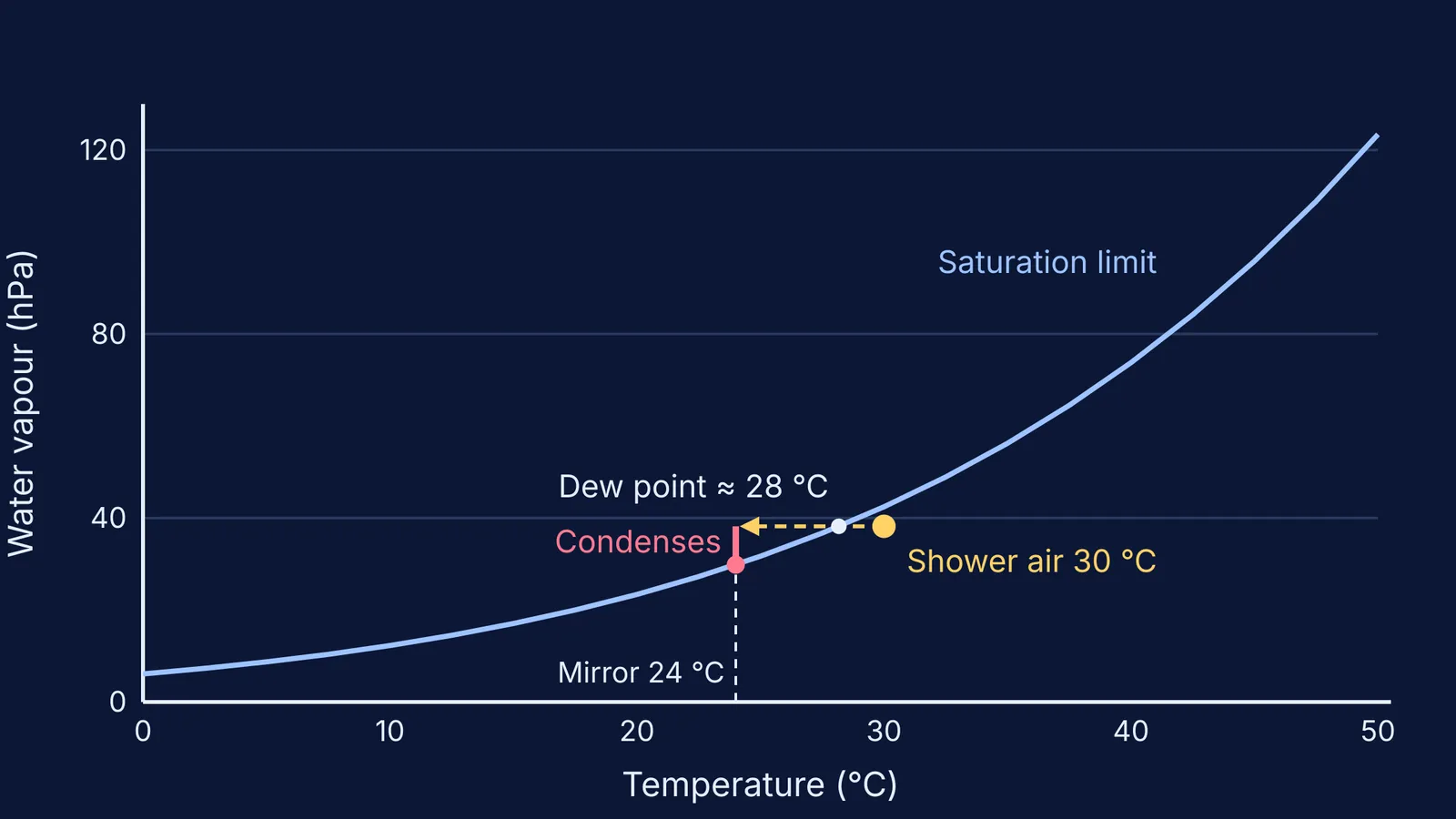
Air can hold only so much water vapour, and that limit rises steeply with temperature. Warm air in a closed bathroom fills with vapour. When it touches the cooler glass, it is chilled past its limit and the extra vapour condenses.
A 2023 review in the Journal of Materials Research and Technology describes fogging as the condensation of humid air into "small discrete water droplets" and lists bathroom mirrors among the surfaces where it happens. Each droplet is a tiny dome that scatters light in many directions, so your reflection blurs.
What is the dew point, and why does it matter here?
The dew point is "the temperature to which air must be cooled in order to reach saturation", according to the US National Weather Service glossary. Glass colder than the dew point of the air touching it fogs; warmer glass stays clear.
Here is a worked example with the vapour-pressure formula published by the National Weather Service: saturated vapour pressure = 6.11 × 10^(7.5T ÷ (237.3 + T)) hPa, with T in °C.
Suppose the bathroom air reaches 30 °C at 90% relative humidity. Saturated air at 30 °C holds vapour at about 42.4 hPa, so this air holds about 38.2 hPa.
Run the formula backwards for 38.2 hPa. The dew point comes out at about 28 °C.
The mirror is still near the room's earlier temperature, say 24 °C. Air at 24 °C can hold only about 29.9 hPa.
The glass is about 4 °C below the dew point, so air touching it carries roughly 8 hPa more vapour than it can keep. That excess ends up on the mirror.
These numbers are illustrative, not measured; your bathroom will differ, but the logic holds.
How do soap, warm air and a fan stop the fog?
The 2023 review sorts anti-fog methods into two kinds: change the environment (temperature, airflow, humidity) or change the surface. The three household fixes fit that split.
Soap film (change the surface). Soap is a surfactant: it makes glass more water-loving, so condensing water spreads into a thin sheet instead of beading. The review says a surface is superhydrophilic when water's contact angle is below 10°, and that such a thin film does not scatter light. Soap hides condensation rather than stopping it, and the review notes that surfactant coatings dissolve in condensed water, so you have to reapply it.
Warm air (warm the glass). A hair dryer lifts the glass above the dew point, about 28 °C in our example. It clears fast, but fog returns as the glass cools if the air is still steamy.
Ventilation (dry the air). A fan or open window swaps humid air for drier air and lowers the dew point. The US EPA advises running the bathroom fan or opening the window when showering, and keeping indoor relative humidity below 60%, ideally 30 to 50%. Slowest, but it also fights damp.
How can you test the three fixes at home?
You need one hot shower, a stopwatch and a parent. Keep the hair dryer away from water. The predictions come from the dew point rule above.
Before the shower, split the mirror into three taped strips: A, B and C.
On strip A, rub a drop of liquid hand soap on with a dry cloth and buff until clear.
Leave B and C untreated. C is your control.
Shower with the door shut and the fan off. Note which strips fog.
Warm strip B with the hair dryer for 30 seconds. Time how long it stays clear.
Switch on the fan or open the window. Time how long strip C takes to clear.
Expect A to stay readable though wet, B to clear fast but maybe re-fog, and C to clear only as the air dries. If not, ask why: a weak fan, or soap wiped off?
Where else does the same physics show up?
A cold glass sweating in summer and a windscreen misting up in monsoon traffic follow the same rule. For more heat and vapour at home, read our test of whether cooking with the lid on saves gas. For when water is solid, liquid or vapour, see the water phase diagram and its triple point. For another heat-balance puzzle, try whether an open fridge door can cool a room.
If dew point still feels abstract, the Fermi Concept Library gives each concept its own lesson, and the Fermi Simulation Lab has interactive simulations for ideas that are easier to see than to read.