On this page
If you have waited for chai water to boil, you have run half of this experiment. The other half is timing it again with a lid. Physics says the lid should win, and a Government of India body has put a number on it.
Does cooking with the lid on really save gas?
Yes, for anything hot and wet. The Petroleum Conservation Research Association (PCRA), under the Ministry of Petroleum and Natural Gas, tested cooking habits with Indian Oil's R&D centre and the Institute of Hotel Management, Catering & Applied Nutrition in New Delhi.
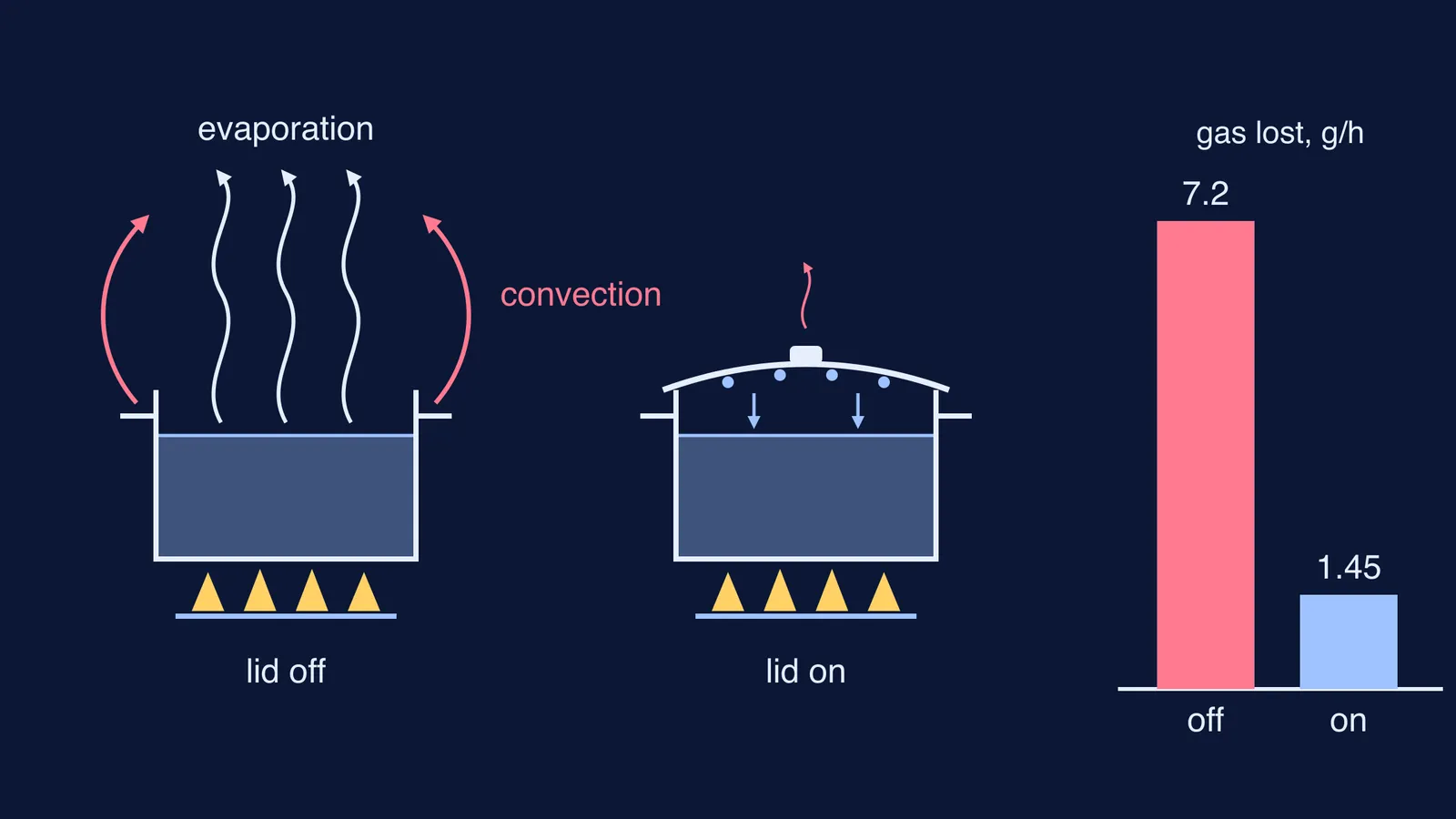
PCRA reports that an open vessel with a 100 sq cm opening, holding water at 96 °C, wastes 7.2 g of gas per hour. With a lid, the loss drops to 1.45 g per hour, about one-fifth. Wind blowing through the kitchen raises the open-pan loss two and a half times, PCRA adds, so a fan blowing across the stove makes things worse.
Where does the heat go from an open pan?
Evaporation. The fastest water molecules escape from the surface and take energy with them. Turning 1 kg of water at 100 °C into steam takes 2256 kJ, according to OpenStax College Physics.
Convection. Air touching the hot surface warms, rises and is replaced by cooler, drier air, which takes more heat and more vapour. That fits PCRA's large wind figure.
Radiation from the surface and the pan's sides, which a lid changes little.
A lid cuts down the first two. Steam hits the cooler lid, condenses into drops and falls back, handing its latent heat to the pan instead of the kitchen. The trapped air stays humid and still, so evaporation slows. It is the same effect that keeps water cool in a clay matka, working against you here.
How much gas does one litre of water need?
Heating. One litre of water is about 1 kg, and water's specific heat is 4186 J/(kg °C) (OpenStax). Warming it from 25 °C to 100 °C needs Q = mcΔT = 1 × 4186 × 75 ≈ 314 kJ.
Boiling off 10%. Losing 100 g as steam needs 0.1 × 2256 ≈ 226 kJ (OpenStax), about 72% of the energy that heated the whole litre.
In gas. Bharat Petroleum lists LPG's gross calorific value as 11,200 kcal/kg, about 46.9 MJ/kg, so 314 kJ is 6.7 g of LPG if every joule reached the water.
Real stove. PCRA cites 68% thermal efficiency for a higher-efficiency ISI-marked LPG stove. At 68%, heating the litre burns about 9.9 g of gas, and boiling off 100 g burns about 7.1 g more.
So letting a tenth of the water steam away costs almost three-quarters as much as heating all of it. To see why vaporising costs so much more than melting, read why latent heat of vaporisation is greater than fusion; for the cylinder-sized version of this sum, see how much CO2 an LPG cylinder produces.
How can you test lid on vs lid off at home?
At a fixed flame, gas used is proportional to time, so a stopwatch is your gas meter.
Use the same pan, burner and knob position every time (mark the knob with tape), and keep the fan off.
Measure exactly 1 litre of water. Start every run with room-temperature water.
Lid off: light the burner, start the timer, and stop at a rolling boil, when bubbles break across the whole surface.
Cool the pan under the tap and dry it; a warm pan gives the next run a head start.
Lid on: repeat with the lid; a glass one lets you see the boil.
Do each run twice, swapping the order, and average the times.
Saving = (time off − time on) ÷ time off × 100.
Simmer test: weigh the pan and water on a kitchen scale, simmer for 10 minutes on the lowest flame, and weigh again. Mass lost (kg) × 2256 kJ/kg (OpenStax) is the energy that left as steam. Repeat with the lid on and compare.
If convection currents are hard to picture, the Fermi Simulation Lab has interactive simulations for ideas that are easier to see than to read. If your mcΔT or mL numericals keep going wrong, the Fermi Problem Library has a step-by-step solver that explains the reasoning.
What else saves gas besides a lid?
PCRA's tests found habits that stack with the lid:
Turning the flame down once boiling starts saved 25% fuel, with the same cooking time.
Pressure cooking saved 20% on rice and 46% on soaked gram dal compared with ordinary cooking.
A vessel about 25 cm across covers the flame on most stoves, so less heat escapes up the sides.
Try the timing test this week, but don't expect a one-fifth result: PCRA's figure is for water kept hot, and most gas used to reach a boil warms the water, which a lid cannot avoid.