On this page
Most of us assume the night is coldest at midnight. A thermometer disagrees: on a clear night the temperature keeps falling for hours after midnight and bottoms out around dawn. Here is why, worked through with real readings from one November night in Rajasthan.
What happens to heat after the sun sets?
The ground is always giving off heat as infrared radiation, day and night. During the day, sunlight brings in more energy than the ground loses, so it warms up. The ground then heats the air above it by conduction and convection, as the Hong Kong Observatory explains.
After sunset the income stops, but the loss carries on. Radiative cooling is what happens when a surface sends out more infrared radiation than it receives. The ground loses energy hour by hour and chills the air touching it. The same Hong Kong Observatory page puts it simply: the outgoing energy beats the incoming energy all night, so the daily minimum usually comes at around sunrise.
A worked example: one clear night at Jaipur airport
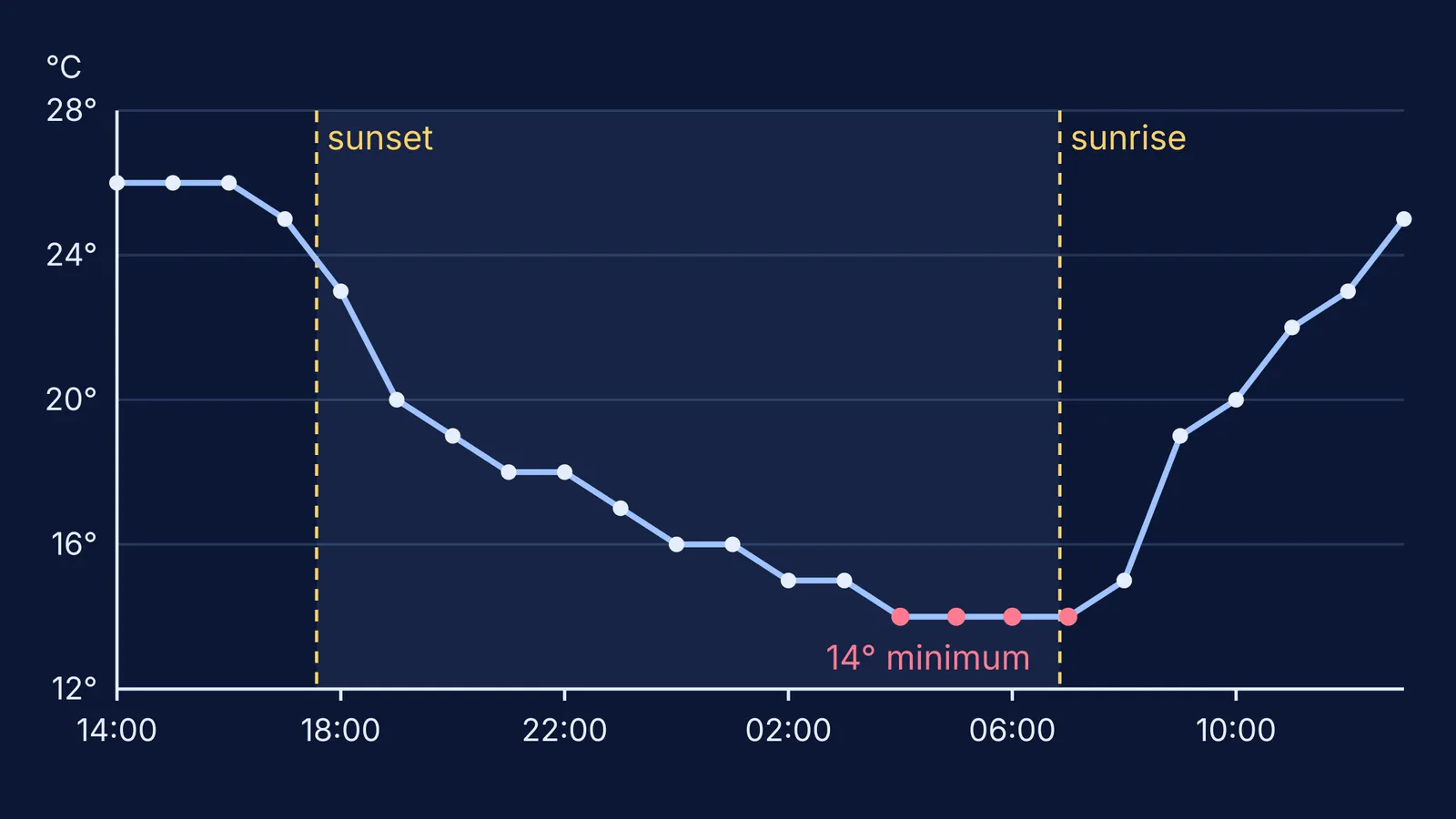
We downloaded the routine airport weather reports (METARs) for Jaipur airport (code VIJP) from the Iowa Environmental Mesonet archive, run by Iowa State University. On the night of 20–21 November 2025 the reports show no significant cloud and almost no wind from 18:30 onwards. Sunset was at 17:34 and sunrise at 06:51 IST, according to the sunrise-sunset.org calculator.
Here are the hourly temperatures:
14:00 — 26°C
17:00 — 25°C (sunset at 17:34)
19:00 — 20°C
20:00 — 19°C
22:00 — 18°C
00:00 — 16°C
02:00 — 15°C
04:00 — 14°C
06:00 — 14°C
07:00 — 14°C (sunrise at 06:51)
08:00 — 15°C
09:00 — 19°C
Now work out the rates. From 17:00 to 20:00 the air lost 6°C in 3 hours, which is 2°C an hour. From 20:00 to 04:00 it lost only 5°C in 8 hours, about 0.6°C an hour. At midnight it was 16°C, still 2°C above the night's low. The minimum of 14°C lasted from 04:00 until the 07:30 report, 39 minutes after sunrise. Then the temperature jumped 4°C between 08:00 and 09:00.
The reports round to whole degrees, so the exact minute of the low is hidden. The shape is still clear: fast evening cooling, slow night cooling, the low at dawn.
Why doesn't the temperature bottom out at midnight?
Midnight is a clock time, not a physical event. The sun is still gone and the ground is still radiating, so the temperature keeps going down.
The cooling slows as the night goes on because cooler ground gives off less infrared radiation than warm ground does. The coldest air also settles in a shallow layer near the ground, as Penn State's meteorology course notes describe for clear, calm nights. But slower cooling is still cooling.
Even sunrise does not end it at once. University of Washington atmospheric scientist Cliff Mass writes that when the sun just rises, "its feeble warmth is still dwarfed by the infrared cooling, so net cooling occurs", and that it takes about an hour after sunrise for the sun to balance the loss. That matches the Jaipur readings: no warming until 08:00.
Why are cloudy or foggy nights warmer?
Clouds absorb the ground's infrared radiation and send part of it back down. The Penn State notes say a clear, calm night will be colder than a cloudy or windy one. Wind helps too, because it mixes warmer air from above down to the surface.
Delhi airport (VIDP) on 20–21 December 2025 shows the opposite of Jaipur. Its reports in the same archive show fog setting in at 20:00, with visibility below 600 metres through the night. The temperature reached 12°C at 19:00 and stayed between 12°C and 13°C until 10:00 the next morning. Winds stayed light, at 3 to 6 knots. The fog stopped the night-long slide. Our explainer on why dense fog covers north India on winter mornings covers how that fog forms. For the extreme version of a clear night, see why deserts are hot by day and cold at night.
How can you test this at home?
Pick a night with a clear forecast and little wind.
Put a thermometer outside in the shade, away from walls. Our post on why weather thermometers are kept in a shaded white box explains why placement matters.
Read it at sunset, every hour until bedtime, and then every 30 minutes from an hour before sunrise to an hour after.
Plot temperature against time and mark sunset and sunrise.
Predict before you look: when will your lowest reading come? Then check.
Repeat on a cloudy night and compare. For ideas that are easier to see than to read, the Fermi Simulation Lab has interactive simulations. To revise heat transfer itself, each topic has its own lesson in the Fermi Concept Library.
Next clear morning, check the thermometer around sunrise instead of at midnight. That is usually when you will find the night's real low.