On this page
Put a thermometer on a sunny terrace in May and the number it shows is not the air temperature. It is the temperature of a glass bulb heated by sunlight, by the hot floor and by the air, all at once. Weather services want only the air, so they keep the thermometer in shade, inside a box built for the job.
Why are weather thermometers kept in a shaded box?
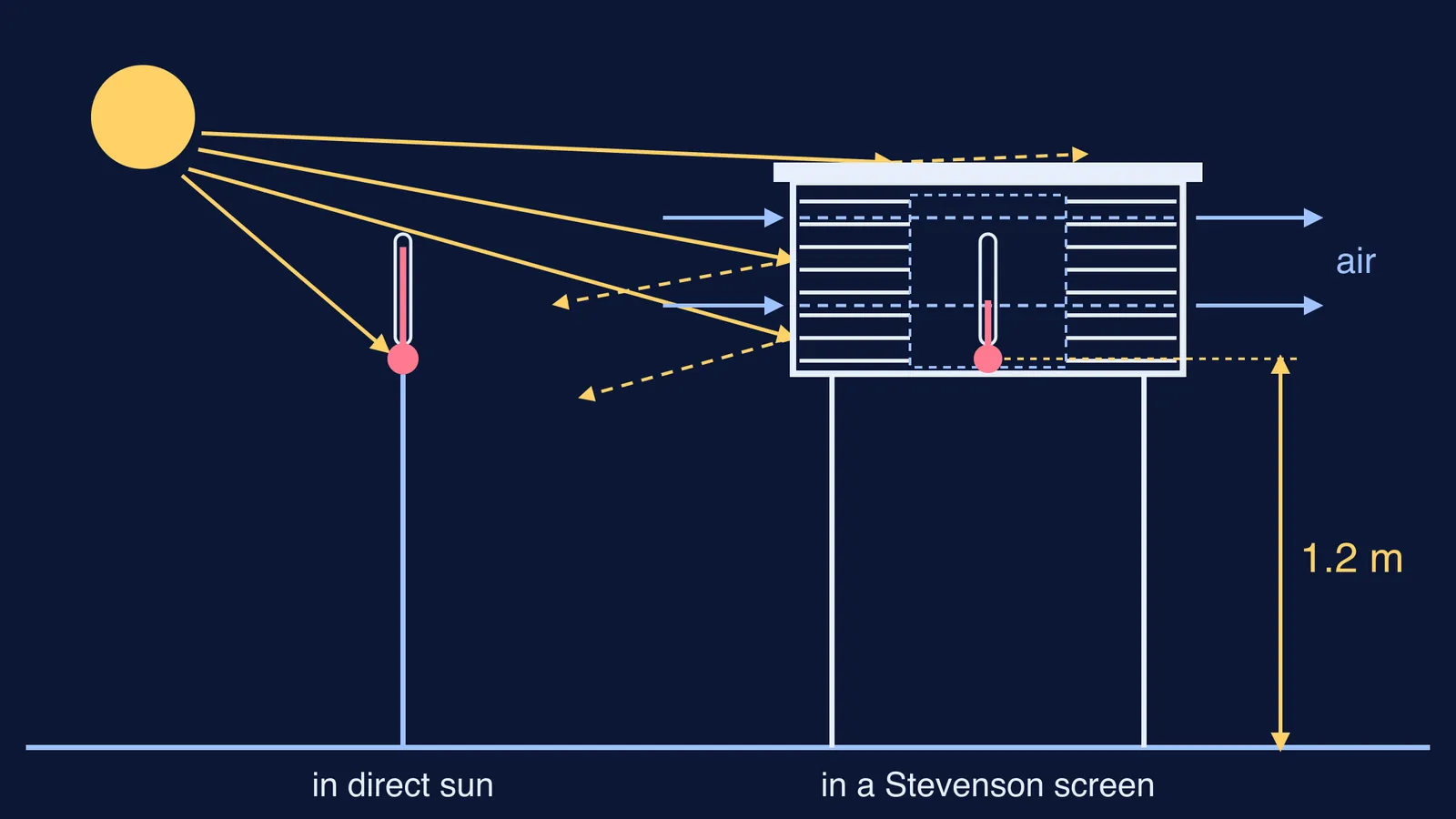
A thermometer only ever reports its own temperature. In sunlight, the bulb absorbs energy that arrives as radiation, so it settles warmer than the air around it. The Hong Kong Observatory states the rule plainly: to read true air temperature, a thermometer must be protected from solar radiation by a screen or shed that also shelters it from rain while allowing the free circulation of air around it.
Even shielded sensors can err. A 2009 study in Water Resources Research compared naturally ventilated sensors inside multiplate radiation shields with sonic anemometers, which sunlight does not affect, and found 30-minute mean differences as large as 10°C over snow (Huwald et al., 2009). The same study found that errors grew faster with sunlight reflected from the ground than with sunlight from above, which is why the surface under a weather station matters.
What does each part of a Stevenson screen do?
The Stevenson screen is a white box with louvred sides. Each feature blocks one route by which heat, other than the air's, reaches the thermometer. Australia's Bureau of Meteorology and Canada's manual of climatological observations set out the details:
White paint: the outside is painted white to minimise heat absorption (Bureau of Meteorology).
Louvres: they let air circulate around the thermometer while keeping out rain and direct sunlight (Bureau of Meteorology).
Height: the Bureau of Meteorology raises the screen so the thermometer is 1.2 m above the surface; Canada's manual places the bulbs between 1.25 m and 2 m above the ground.
Natural ground: screens stand over grass, not concrete, and well away from buildings and trees that reflect or absorb heat (Bureau of Meteorology).
Distance: at least twice the height of any nearby tree or building (Canada's manual).
Door away from the sun: in Canada the door faces north so the sun does not shine on the thermometers when it is open; in Australia it faces south.
India uses the same design. At the India Meteorological Department's Gangtok observatory, the maximum, minimum, dry bulb and wet bulb thermometers are kept inside a Stevenson screen (IMD Gangtok). A phone or car dashboard left in the sun can show a number well above the forecast because it is answering a different question.
Why does sunlight make a thermometer read high?
Think of the bulb as a small budget of energy. Sunlight pays in by radiation, which needs no air to carry it; this is the same reason, explained in our post on why sunlight bakes and shadow freezes in space, that a sunlit object can be far hotter than its surroundings. The bulb pays out by passing heat to the air that touches it. It settles where income equals spending.
In shade, the radiation income almost vanishes, so the bulb settles at the air's temperature. Moving air takes heat away faster, which is why the louvres matter as much as the shade: a sealed box in the sun would trap warm air and read high too.
If this balance of heat gained and lost is hard to picture, the Fermi Simulation Lab has interactive simulations for ideas that are easier to see than read.
How can you test this at home as a fair experiment?
This is a fair-test question: change one thing, keep everything else the same.
Take two identical thermometers. Keep them side by side indoors until they agree.
Put one in direct sun. Put the other in shade, inside a white box with slits cut in opposite sides and the opening facing away from the sun.
Keep both at the same height, over the same kind of ground, with air free to move around them.
Read both at the same moments through the afternoon, noting the sky and the wind.
Repeat on a cloudy day and on a breezy day.
The gap between the readings is the radiation error. Predict first: it should shrink when clouds cover the sun or the wind picks up. In your write-up, name the variable you changed (sunlight), the ones you controlled (height, ground, thermometer) and what you measured; our guide to writing precautions and sources of error in practicals shows how. No second thermometer? Make a bottle thermometer at home and compare two of those.
Next time your terrace feels hotter than the forecast, you will know which of the two temperatures the forecast meant.