

On this page
Ask whether space is hot or cold and the honest answer is “it depends where you are”. Space itself is close to absolute zero, yet a spacecraft's sunny side can be hotter than boiling water. The reason is that space is nearly empty, so heat has only one way to travel.
Is space hot or cold?
Start with how empty it is. Near Earth's orbit the solar wind has a density of around 6 ions per cubic centimetre, according to a NASA Goddard explainer. Air at 0 °C and standard pressure (100 kPa) holds about 2.65 × 10^25 molecules per cubic metre, or 2.65 × 10^19 per cubic centimetre (NIST's Loschmidt constant). The air around you is more than a billion billion times denser than interplanetary space.
What little temperature empty space has comes from light left over from the early universe. The cosmic microwave background has a temperature of 2.72548 ± 0.00057 K, about −270 °C, according to D. J. Fixsen's 2009 paper in The Astrophysical Journal.
But nothing you send into space drops to −270 °C straight away. Its temperature depends on how much sunlight it absorbs and how fast it radiates energy away.
Why can't space carry heat by conduction or convection?
Conduction needs particles that touch and pass on their jiggling. Convection needs a fluid, like air or water, that moves and carries warmth with it. Space has neither. NASA's guide to small-spacecraft thermal control puts it simply: “In a vacuum, heat is transferred only by radiation and conduction with no convection.” Conduction still works between parts of a spacecraft that touch, but nothing touches the outside. So heat can arrive or leave only as radiation.
That is the idea behind the vacuum flask James Dewar built to keep liquids cold. It also explains why surface finish matters so much in orbit: good absorbers of heat are also good emitters.
How hot does an object get in sunlight? A worked example
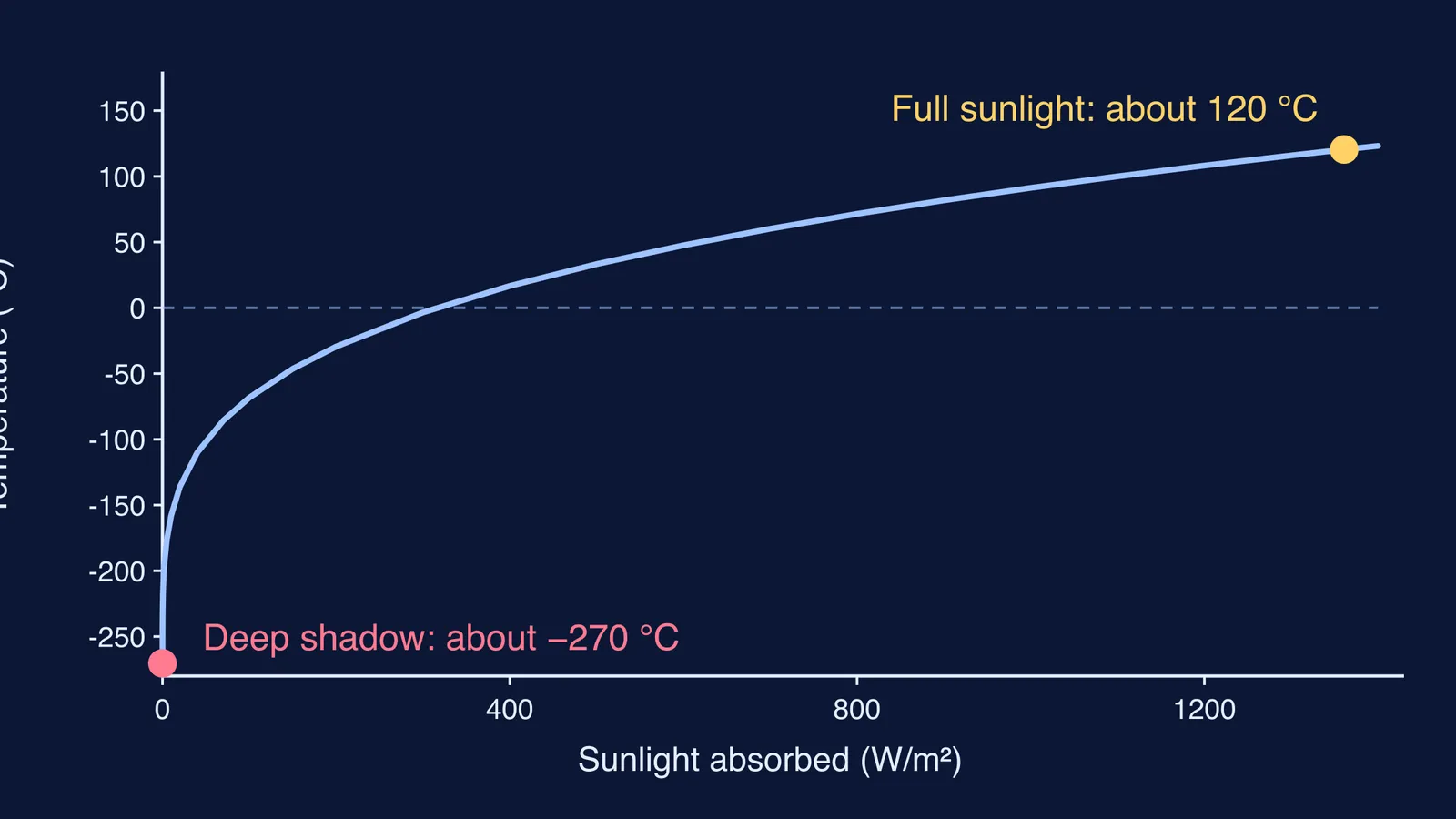
You need one law: a black surface radiates σT⁴ watts per square metre, where the Stefan–Boltzmann constant σ = 5.670374419 × 10^−8 W m^−2 K^−4 (NIST). Sunlight at Earth's distance delivers 1361 W/m², the total solar irradiance value established by NASA's SORCE mission.
Picture black ground facing the Sun. It absorbs all 1361 W/m² and, with insulating soil beneath, radiates only from its top surface.
It stops warming when energy out equals energy in: σT⁴ = 1361.
Solve: T⁴ = 1361 ÷ 5.67 × 10^−8 ≈ 2.40 × 10^10 K⁴, so T ≈ 394 K, about 120 °C.
Check against reality. NASA reports that temperatures near the Moon's equator can spike to over 121 °C in daylight, then plummet after nightfall to −133 °C. One line of physics lands close, though real lunar soil is not perfectly black.
Change the shape. A thin plate radiates from both faces, so 2σT⁴ = 1361 and T ≈ 331 K, about 58 °C. Same sunlight, different answer.
Step into shadow. Input falls to almost zero, so the object keeps radiating and cools towards the 2.7 K background. The same NASA page notes that permanently shadowed craters near the Moon's poles go below −246 °C.
How do astronauts stay at a safe temperature?
Engineers manage radiation, because it is the only route out. On NASA's Houston We Have a Podcast, host Gary Jordan said that in sunlight, structures can be exposed to temperatures as high as 500 degrees Fahrenheit, minus 150 in the shade. That is roughly 260 °C and −101 °C.
NASA's thermal-control guide lists the tools. Multi-layer insulation blankets use thin layers with low infrared emissivity to block radiation. Radiators are surfaces built to shed heat by radiating it. Electric heaters keep parts warm through cold phases. On the International Space Station, ammonia carries heat from the modules out to radiators, according to a NASA technical report. The station needs all this because it crosses from sunlight to shadow many times a day.
If the balance between absorbing and radiating still feels abstract, the Fermi Simulation Lab has interactive simulations for the ideas that are easier to see than to read.
How to answer “is space hot or cold” in an exam
Use this four-step check on any heat-in-space question:
Is there a medium? If not, cross out conduction to the outside, and convection.
What comes in? Usually sunlight, sometimes light from a nearby planet.
What goes out? σT⁴ per square metre of radiating surface, less for shiny, low-emissivity finishes.
Balance them, and keep T in kelvin until the last line.
If Stefan's law itself is the shaky part, the Fermi Concept Library gives each physics concept its own lesson, so you can go back a step before trying the worked example again.


