

On this page
Every Class 11 student meets the line "good absorbers are good emitters", usually next to a vacuum flask. It follows from a law of physics. Here is why it must be true, a worked kettle example, and the trap examiners like to set.
Why are good absorbers of heat also good emitters?
Two definitions first. Absorptivity is the fraction of incoming radiation a surface absorbs. Emissivity (e) is how much a surface radiates compared with a perfect radiator at the same temperature; e = 1 for a perfect radiator, as the NCERT Class 11 Physics chapter on thermal properties of matter puts it.
The idea that good absorbers are good emitters was known before Gustav Kirchhoff, but he stated the general law in 1860, in a paper in Annalen der Physik on the ratio of emissive power to absorptive power. In modern form, Kirchhoff's law of thermal radiation says that for a body in thermodynamic equilibrium, emissivity equals absorptivity at each wavelength.
The reasoning is short. Put any object inside a closed box whose walls are all at one temperature. It settles at that temperature, so it must give out as much radiant energy as it takes in. A surface that absorbed well but emitted poorly would warm itself above its surroundings with no help, which never happens. So a surface that absorbs strongly must emit strongly too.
What is a black body, and is anything really black?
A black body is an ideal surface that absorbs all the radiation falling on it, the limit Kirchhoff imagined, as the Wikipedia summary of his law describes. By Kirchhoff's law it is also the best possible emitter, with e = 1.
Nothing is perfectly black, but some things come close. The NCERT chapter notes that lamp black comes close to the limit, gives the emissivity of human skin as about 0.97, and that of a tungsten lamp filament as about 0.4. It writes the radiated power as H = eσAT⁴, where T is in kelvin and σ is the Stefan-Boltzmann constant, 5.670374419 × 10⁻⁸ W m⁻² K⁻⁴ according to NIST's CODATA value. Read how Josef Stefan found the fourth power radiation law, or try this blackbody radiation simulation guide.
How does Kirchhoff's law show up in a kitchen?
The NCERT chapter gives the everyday cases. The bottoms of cooking utensils are blackened so they absorb as much heat as possible from the fire. A Dewar flask has a double glass wall coated with silver and a vacuum between the walls: the vacuum cuts conduction and convection, and the silver reflects radiation back.
Polished silver has an emissivity of only 0.02 to 0.03, and aluminium foil about 0.04, according to the Engineering ToolBox emissivity table. By Kirchhoff's law those walls absorb and emit poorly, so hot tea stays hot and cold water stays cold.
How much faster does a black kettle radiate heat?
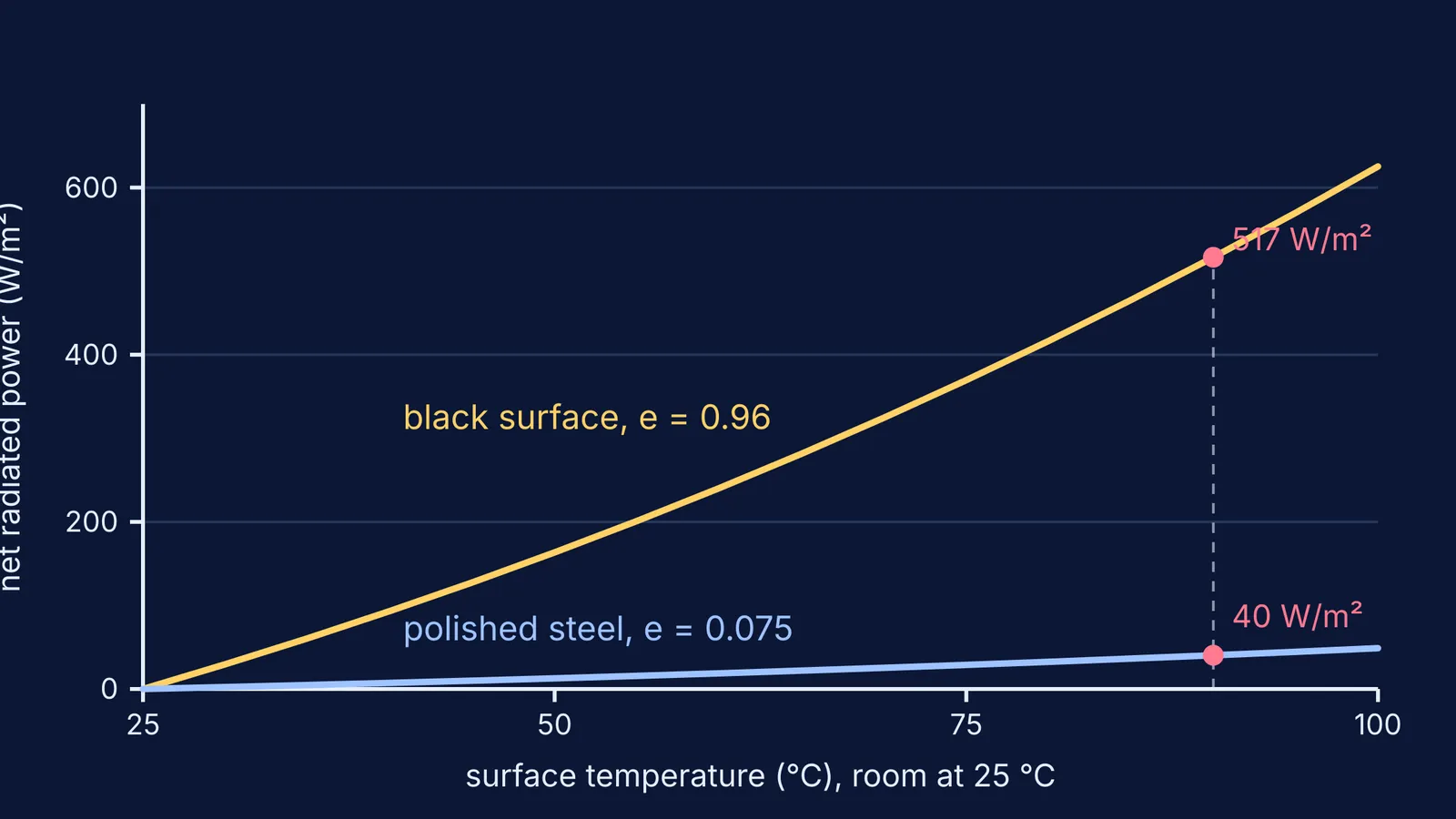
Take water at 90 °C (363.15 K) in a room at 25 °C (298.15 K). The net radiated power per square metre is eσ(T⁴ − Ts⁴), from the NCERT chapter, with emissivities from the Engineering ToolBox table.
Perfect black body: 5.67 × 10⁻⁸ × (363.15⁴ − 298.15⁴) ≈ 538 W per square metre.
Lampblack paint, e = 0.96: 0.96 × 538 ≈ 517 W per square metre.
Polished stainless steel, e = 0.075: 0.075 × 538 ≈ 40 W per square metre.
Ratio: 0.96 ÷ 0.075 ≈ 13, so the black kettle radiates about 13 times as much heat.
If convection cools both kettles about equally, radiation is the part that differs. The lesson: blacken the base that faces the flame, keep the sides shiny.
Does a white surface always emit poorly?
No, and this is the trap. Kirchhoff's law works wavelength by wavelength, and colour only describes visible light. Using Wien's constant of 2.9 × 10⁻³ m K from the NCERT chapter, a surface near 300 K radiates most strongly at about 10 micrometres, deep in the infrared.
Ice looks pale or clear, never black, yet smooth ice has an emissivity of about 0.966 according to the Engineering ToolBox table. So "black means good emitter" is shorthand for "black at the wavelengths that matter". For a hands-on version, see whether a black or white can cools faster.
How should you answer exam questions on radiation?
Run this checklist first:
Name the wavelength range: sunlight peaks in the visible, a room-temperature object radiates in the infrared.
Same surface, same wavelength: set absorptivity equal to emissivity.
Convert to kelvin before using H = eσA(T⁴ − Ts⁴).
Separate the three modes: vacuum stops conduction and convection, shiny coatings stop radiation.
Sanity check: if your answer lets an object heat itself above its surroundings, it is wrong.
If you want to practise, the Fermi Problem Library has worked problems with a step-by-step solver that explains the reasoning rather than printing an answer. If the gap is in the ideas, the Fermi Concept Library gives each physics concept its own lesson.
Next time you see a soot-black pan base, ask yourself what it absorbs and what it gives back.


