On this page
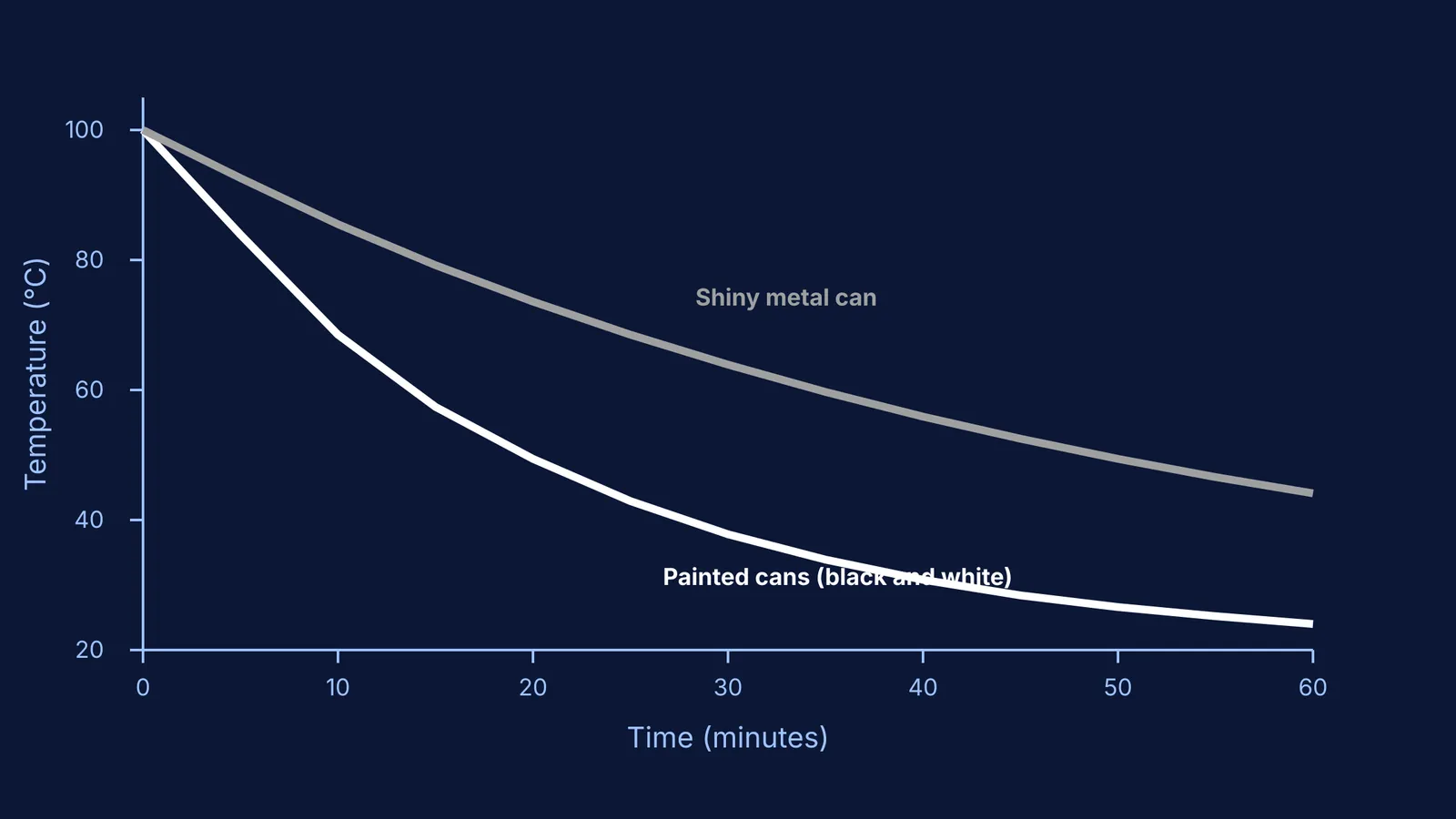
It is a classic trick question in physics classrooms: if you fill three identical cans—one matte black, one painted white, and one left as shiny, unpainted metal—with boiling water, which one cools down the fastest?
Because we know that a black shirt gets much hotter in the sun than a white shirt, our intuition tells us that black must be the best at dealing with heat. But thermal physics often defies everyday intuition when it comes to objects cooling in the dark.
Does a black or white can cool faster?
The answer is a tie. If you compare a matte black can and a white painted can, you will find they cool at almost the exact same rate. Both will lose heat much faster than the shiny, unpainted metal can.
While our eyes see a huge difference between black and white, the physics of conduction, convection and radiation depends on what is happening in the infrared spectrum. In that invisible band of light, the two painted cans behave identically.
Why does white paint behave like black paint in the dark?
Cooling by radiation is governed by a property called emissivity (ε), which measures how efficiently a surface emits thermal energy on a scale from 0 to 1. A perfect radiator is called a "black body" and has an emissivity of 1.
We are often taught Kirchhoff's Law of Thermal Radiation: a good absorber is a good emitter. This is true, but the catch is that "white" and "black" only describe how a material interacts with visible light. Hot water cooling at room temperature emits far-infrared radiation, not visible light.
In the infrared spectrum, most organic paints and coatings are virtually indistinguishable. According to standard reference data from the Engineering ToolBox, white oil paint has an infrared emissivity of 0.92 to 0.96, while black lampblack paint sits at 0.96. Because their emissivity is essentially the same, they shed heat at the same speed.
Why does a shiny can cool the slowest?
If you want your tea to stay hot, do not paint the can at all. The shiny can cools the slowest because bare, polished metal is an extremely poor emitter of infrared radiation.
Metals contain a sea of free electrons that effectively reflect electromagnetic waves. Just as polished aluminum reflects visible light to act as a mirror, it also reflects infrared heat back into the liquid rather than letting it radiate into the room. The emissivity of polished aluminum is very low, typically ranging from 0.04 to 0.06.
This is why the inner glass or steel layer of a vacuum flask is silvered. By creating a highly reflective boundary, the flask traps thermal radiation inside, drastically slowing down Newton's law of cooling.
Seeing heat with Fermi's simulations
It is difficult to unlearn the idea that white reflects heat when we apply it to everything from clothing to house roofs. The distinction between reflecting visible sunlight and emitting invisible thermal radiation is a common stumbling block.
When a student struggles to picture how heat escapes, Fermi's AI tutor notices where they are stuck and decides whether to explain the physics or show it. Rather than just printing an equation, the tutor can run the simulation in the Fermi Simulation Lab.
By adjusting an emissivity slider from 0.05 (shiny) to 0.95 (painted), students immediately see how the surface properties shift the cooling curve on a live graph, proving that visible colour does not tell the whole thermal story.