

On this page
In short
In 1879, Josef Stefan deduced that a hot object radiates energy proportional to the fourth power of its absolute temperature. By analysing experimental data from a glowing platinum wire, he found that nearly doubling the temperature increased the emitted radiation by almost 12 times.
Physics textbooks often present formulas as if they descended fully formed from the sky. But many of the fundamental laws of thermodynamics began as patterns spotted in columns of experimental data.
Before theorists could explain *why* heat behaves the way it does, careful observers had to measure *what* it was doing. Just as Dulong, Petit and the law that weighed atoms with heat found a constant in the specific heats of metals, the Austrian physicist Josef Stefan found a hidden exponent in the light of a glowing wire Wikipedia.
What is the Stefan-Boltzmann law?
The Stefan-Boltzmann law states that the total energy radiated per unit surface area of a black body per unit time is directly proportional to the fourth power of its absolute temperature Wikipedia. Because it depends on T⁴, even a tiny increase in temperature causes a massive jump in emitted energy. If you double the absolute temperature of an object, it radiates 16 times as much power (2⁴ = 16).
This fundamental rule of thermodynamics is named after Josef Stefan, who found it through experiments, and his student Ludwig Boltzmann, who later proved it using theoretical physics.
How did Josef Stefan discover the fourth power law?
In 1879, Stefan published a paper on the relationship between thermal radiation and temperature Wikipedia. He did not start with an abstract theory. Instead, he examined measurements published in 1864 by the Irish physicist John Tyndall.
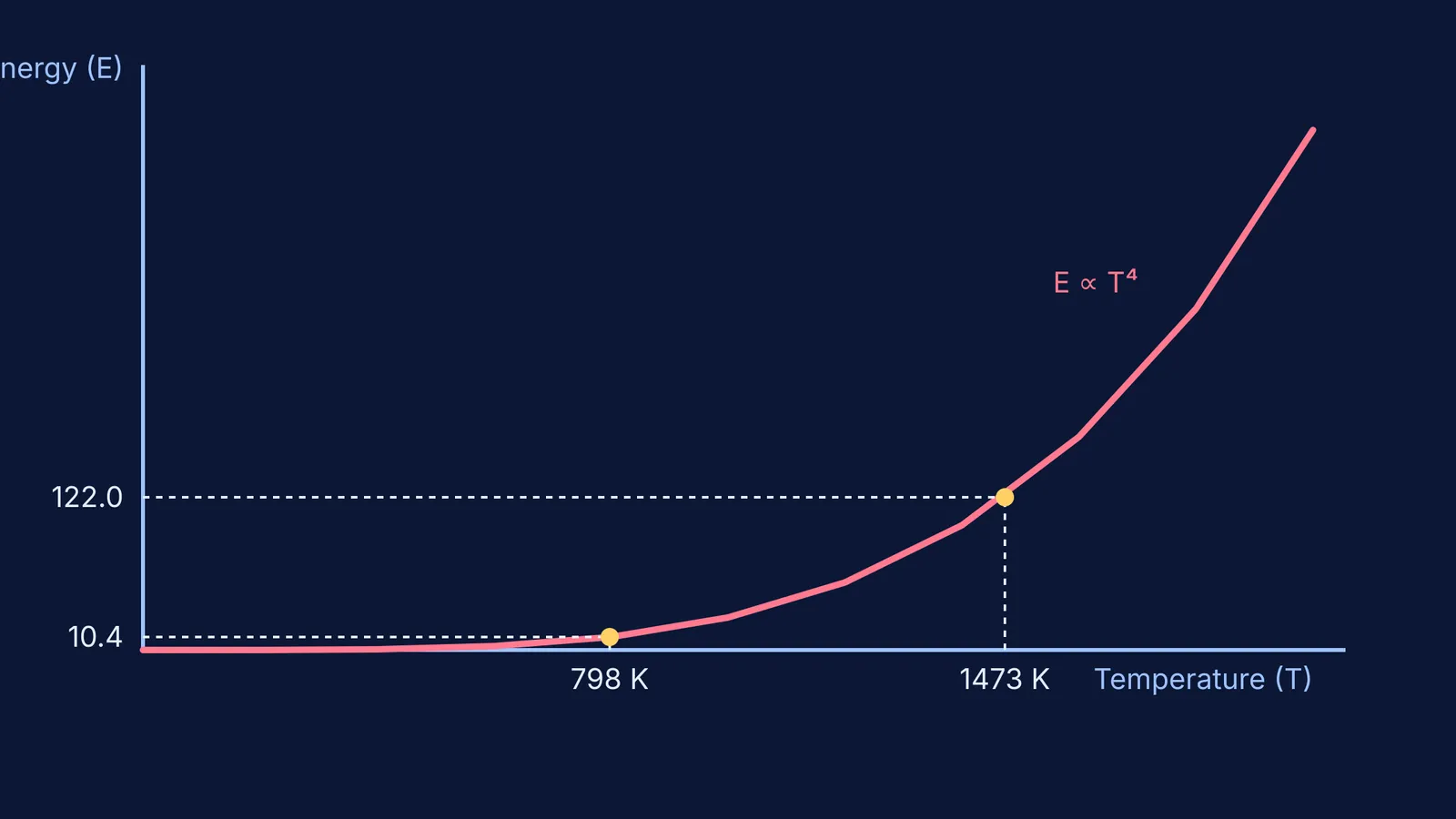
Tyndall had run an electric current through a platinum filament and recorded how much radiation it emitted as its colour changed from a weak red glow to a full white glow. In 1875, Adolph Wüllner estimated the corresponding temperatures as about 525 °C and 1200 °C, noting that the intensity of the radiation jumped from 10.4 units to 122 units.
Stefan noticed something remarkable in these numbers. To see it, we have to convert the Celsius temperatures to the absolute Kelvin scale, which begins at absolute zero (−273.15 °C).
The weak red glow of 525 °C is roughly 798 K.
The full white glow of 1200 °C is roughly 1473 K.
If we divide the higher temperature by the lower one (1473 / 798), the ratio is about 1.846. The absolute temperature had not quite doubled.
Then, Stefan looked at the radiation intensity. Dividing 122 by 10.4 gives a ratio of about 11.7.
He realised that if you take the temperature ratio and raise it to the fourth power (1.846 × 1.846 × 1.846 × 1.846), you get 11.6. This was practically identical to the 11.7-fold increase in measured radiation. From this single observation, Stefan proposed what became the Josef Stefan law: the total energy radiated by a black body is proportional to T to the fourth power (E ∝ T⁴).
When a physics problem asks you to calculate the new radiated power after a temperature change, the Fermi Problem Library breaks the calculation down step by step so you learn to set up the ratios yourself.
What is the temperature of the Sun?
Stefan immediately used his new law to solve one of the greatest scientific mysteries of his day: finding the temperature of the Sun Wikipedia.
At the time, estimates for the Sun's surface temperature ranged wildly, from as low as 1800 °C to an implausible 13,000,000 °C. Stefan turned to data gathered by Jacques-Louis Soret, who had compared the energy flux of sunlight to the radiation from a heated metal plate.
Soret estimated the metal plate was at a temperature between 1900 °C and 2000 °C, and found the Sun's energy flux reaching Earth was 29 times greater than the plate's. Stefan adjusted this ratio to 43.5 to account for the sunlight absorbed by Earth's atmosphere.
Using his fourth-power law, Stefan knew that the ratio of the absolute temperatures must be the fourth root of the radiation ratio. The fourth root of 43.5 is approximately 2.57. By taking the plate's temperature, converting it to the absolute scale, and multiplying by 2.57, Stefan arrived at a solar surface temperature of 5430 °C. This was the first sensible estimate in history, and it is remarkably close to the modern accepted value of about 5500 °C.
How did Boltzmann prove the fourth power law?
Stefan's discovery was purely empirical. He found the rule because it fit the data. Five years later, in 1884, his former student Ludwig Boltzmann proved the law theoretically Wikipedia.
Boltzmann used the laws of thermodynamics and James Clerk Maxwell's electromagnetic theory to show that a "photon gas" exerting pressure in a cavity must mathematically obey the T⁴ rule. Because of this combined effort, the relationship is now known as the Stefan-Boltzmann law. It stands as a bridge between the macroscopic world of heat engines and the quantum world of radiation, much like how Jean Perrin and the proof that atoms exist, grain by grain connected visible motion to invisible molecules.
Learning physics is much like tracing the path from Stefan's observation to Boltzmann's proof. Instead of just handing you the final formula, Fermi's AI tutor teaches you to look for the pattern in the data, asking questions to guide you toward the relationship just as Stefan deduced it.


