On this page
Astronauts aboard the International Space Station (ISS) experience 16 sunrises and 16 sunsets every 24 hours.
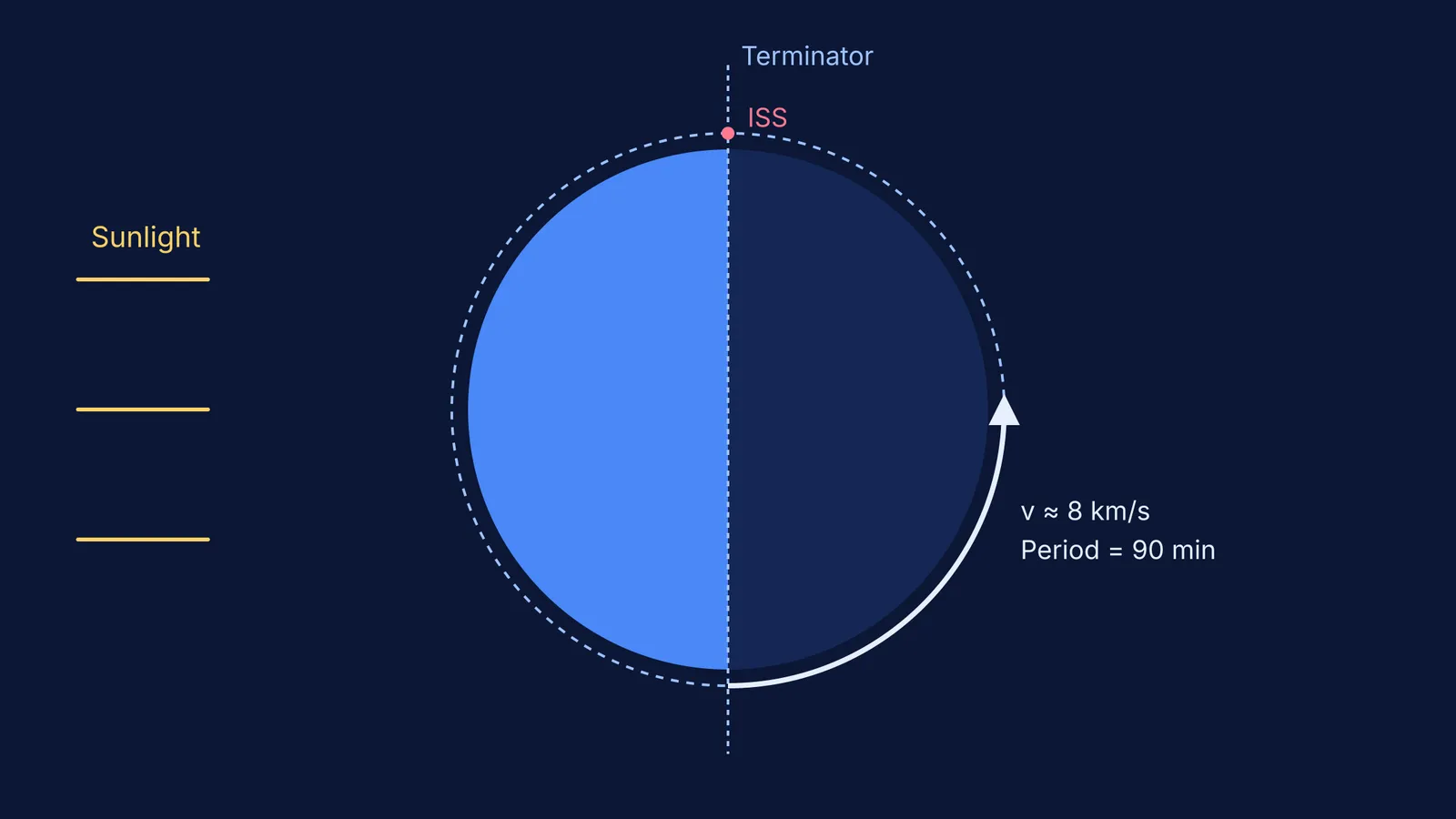
Because the station orbits the Earth at a very high speed—approximately 28,000 kilometres per hour, or 8 kilometres per second—it completes one full lap every 90 minutes. During each 90-minute orbit, the ISS moves from the Earth's shadow into sunlight and back again, creating a rapid cycle of day and night.
How many sunrises does the ISS see in a day?
If you stand on Earth, you see one sunrise every 24 hours because the planet rotates on its axis once a day. But the ISS is moving independently of Earth's rotation. At an altitude of about 400 kilometres, it travels fast enough to circle the globe 16 times in a single Earth day.
Every time the station crosses the day-night terminator line into the sunlit side of the Earth, the crew sees a sunrise. When it crosses back into the shadow, they experience a sunset.
Calculating the 90-minute orbit
How do we know the period is exactly 90 minutes? You can calculate it using simple geometry and kinematics. The Earth's radius is about 6,371 kilometres. If the ISS flies at an altitude of 400 kilometres, its total orbital radius from the centre of the Earth is 6,771 kilometres.
To find the distance of one full orbit, we calculate the circumference using the formula C = 2 × π × r. Multiplying 2 × 3.14 × 6771 gives a total travel distance of roughly 42,500 kilometres per orbit.
Since the station travels at a speed of 28,000 kilometres per hour, we divide the total distance by the speed to find the time. Dividing 42,500 by 28,000 results in approximately 1.5 hours, which equals exactly 90 minutes. In a 24-hour day, dividing 24 by 1.5 gives us 16 complete orbits, matching the 16 sunrises.
Testing the physics with active learning
In physics education, building a working model is better than just memorising a number. A landmark 2008 study by Nobel laureate Carl Wieman and Katherine Perkins on the Physics Education Technology (PhET) project found that well-designed interactive simulations are an engaging and effective tool for learning physics. When you actively participate in finding the answer, you retain the concept much longer than if you simply read a textbook.
Instead of just accepting the math above, you can prove it yourself using NASA's orbital data. If you use the Fermi Simulation Lab, you can recreate the ISS orbit and watch the sunrises happen. This is how Fermi's AI tutor teaches: it asks you to predict the outcome and run the physics, rather than just handing you the answer. For more on how to use these tools, see our guide to understanding planetary orbits with a gravity simulation.
A plan for simulating the ISS orbit
Set the constraints: Open a gravity simulation and place a satellite at an altitude of 400 kilometres above Earth.
Apply the velocity: Give the satellite a tangential velocity of 8 kilometres per second.
Run the clock: Fast-forward the simulation for 24 simulated hours.
Count the crossings: You will see the satellite cross the day-night terminator exactly 16 times.
How do astronauts sleep on the ISS?
Managing 16 sunrises a day is a serious challenge for the human body. To handle this, astronauts stick to a strict 24-hour routine. They operate on Greenwich Mean Time (GMT) to maintain a stable reference point that ignores the 90-minute orbital cycles outside their windows.
Sleeping in a microgravity environment with constant day-night shifts requires specialized equipment. Astronauts cannot simply lie down in a bed. In the absence of gravity, there is no "up" or "down," and an unrestrained sleeping person would float around the cabin, potentially bumping into sensitive instruments or other crew members. To prevent this, they sleep in personal sound-insulated compartments about the size of a telephone booth, zipping themselves into sleeping bags that are securely tethered to the wall.
Furthermore, proper ventilation is critical. Without gravity to move air naturally, the carbon dioxide that an astronaut exhales can form a bubble around their head, which could lead to oxygen deprivation. Therefore, astronauts must position their sleep stations near active air vents to ensure the carbon dioxide is continuously dispersed.
The ISS uses a Solid State Light Assembly to simulate a normal day. It produces blue-enriched light during working hours to boost alertness and shifts to warmer, blue-depleted light before bedtime to trigger natural sleep signals. Because the sun in space is intensely bright and still seeps through window shades every 45 minutes, earplugs and sleep masks are just as essential as the tethered bags. You can read more about the limits of physics simulations, and how to learn from them to see how earthly physics compares to these orbital constraints.