On this page
A bottle thermometer is a sealed bottle of coloured water with a thin straw poking out of the cap. When the water warms, it takes up more space, and the only place the extra volume can go is up the straw. It works on the same idea as a liquid-in-glass laboratory thermometer, made big enough to watch on your kitchen table.
How do you make a simple thermometer with a bottle and straw?
You need a clear 500 mL bottle, the thinnest clear straw you can find, food colouring, modelling clay, a strip of card, and two bowls of tap water, one cold and one warm. The NOVA classroom version of this build fills the jar "to the very top" with room-temperature water and seals the straw with clay (PBS NOVA, Building a bulb thermometer). The steps below follow the same idea.
Fill the bottle to the brim with water and add four to six drops of food colouring.
Make a hole in the cap just wide enough for the straw, push the straw through, and seal the gap with clay.
Screw the cap on tightly. The straw should sit well under the water but not touch the bottom, with coloured water a little way up it.
Tape the card behind the straw and mark the starting level.
Stand the bottle in the warm bowl for five to ten minutes and mark the new level. Then move it to the cold bowl and watch the column fall.
Why does the coloured water rise in the straw?
Liquids expand when they warm. At 20 °C, water's volume expansion coefficient is 2.07 × 10⁻⁴ per °C, and at 30 °C it is 3.03 × 10⁻⁴ per °C (Engineering ToolBox, water density and expansion table). The straw turns that small change in a big volume into a long rise in a narrow tube.
Predict your result before you test it:
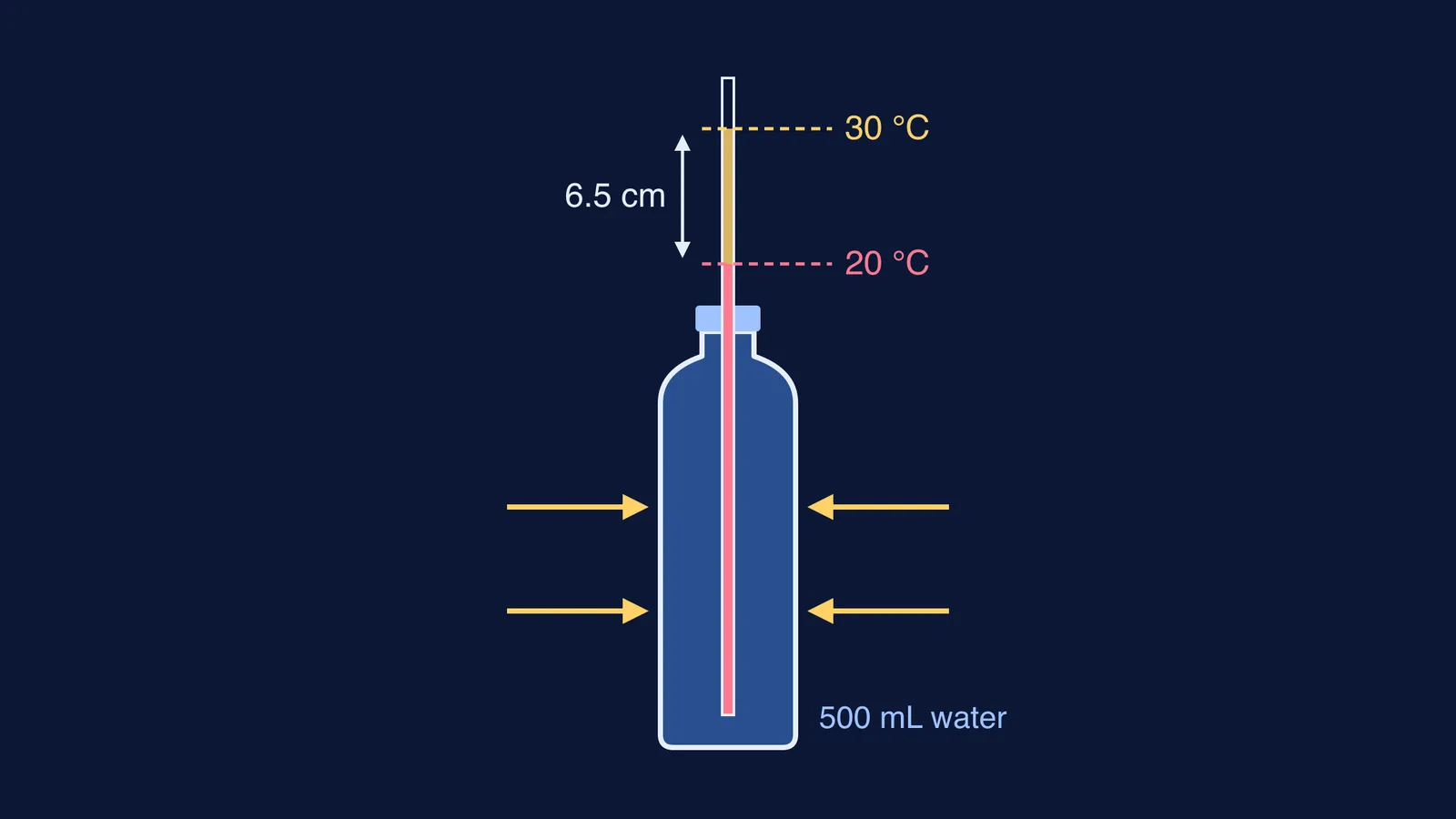
Bottle: 500 mL, full, warmed from 20 °C to 30 °C
Average coefficient over that range: (2.07 + 3.03) ÷ 2 ≈ 2.55 × 10⁻⁴ per °C
Extra volume: 500 × 2.55 × 10⁻⁴ × 10 ≈ 1.3 mL
Straw with a 5 mm inside diameter: cross-section = π × (0.25 cm)² ≈ 0.196 cm²
Rise in the straw, if the bottle did not expand: 1.3 ÷ 0.196 ≈ 6.5 cm
Measure your own straw and redo the last two lines. A thinner straw gives a taller rise, which is why real thermometers use a hair-thin bore. The bottle also expands as it warms, so the rise you see is less than the water's true expansion. A glass bottle expands far less than plastic; our post on real and apparent expansion of liquids works through that correction.
Why must the bottle be filled to the brim?
Suppose you leave 200 mL of air under the cap. By Charles's law, a gas at steady pressure has a volume proportional to its absolute temperature (NASA Glenn Research Center, Charles and Gay-Lussac's law). Warming 200 mL of air from 293 K to 303 K makes it try to grow by about 200 × 10 ÷ 293 ≈ 6.8 mL, more than five times the water's 1.3 mL. That trapped air shoves the water up the straw, so a bottle with an air gap mostly measures the air.
Why does it barely move in ice water?
Add ice to the cold bowl and the column falls more and more slowly as the water inside cools towards 4 °C. The same table puts water's expansion coefficient at 4 °C at only 0.003 × 10⁻⁴ per °C, close to zero, and below zero at 1 °C (Engineering ToolBox), so a water thermometer is almost blind there and can even creep back up just above freezing. Our explainer on why water is densest at 4 °C explains why.
How can you turn it into a real experiment?
Calibrate it: put a kitchen thermometer in each bowl, let the bottle settle, and write each bowl's temperature beside its straw mark. Check your scale in a third bowl. Questions for a school project:
Is the rise per degree the same from 20 °C to 30 °C as from 30 °C to 40 °C? The Engineering ToolBox table says the coefficient grows, so it should not be.
Does a bottle with an air gap rise more than a full one for the same warming?
To compare your build with the real thing, read our piece on clinical and laboratory thermometers.
To see expansion before you build it, the Fermi Simulation Lab has interactive simulations for ideas that are easier to see than to read. If the cross-section step still feels shaky, the Fermi Concept Library gives each physics concept its own lesson.