

On this page
Both look like thin glass tubes with a bulb at one end, and both work because mercury expands when it warms. But they are built for different jobs, and the Class 7 exam question "why can't you use a clinical thermometer to measure the temperature of boiling water?" comes down to two design choices: the range and the kink.
What is the difference between a clinical and a laboratory thermometer?
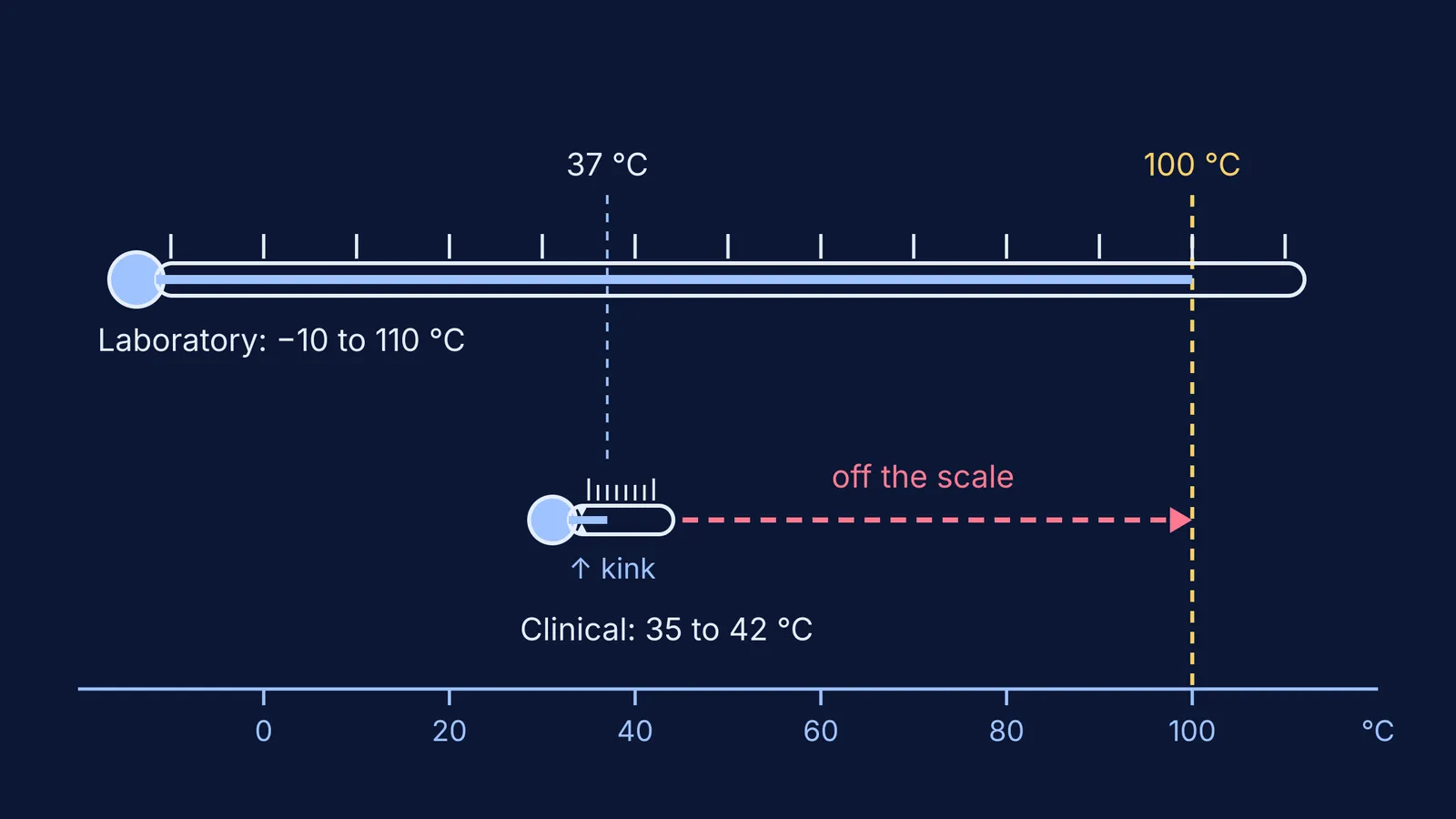
A clinical thermometer measures the temperature of the human body and reads from 35 °C to 42 °C (NCERT). The range is that narrow because body temperature normally does not go below 35 °C or above 42 °C, and the textbook gives normal body temperature as 37 °C.
A laboratory thermometer measures the temperature of other things, such as water in a beaker, and its range is generally from −10 °C to 110 °C (NCERT).
Side by side:
Range: clinical 35 °C to 42 °C; laboratory −10 °C to 110 °C.
Kink: clinical has one near the bulb; laboratory has none.
When you read it: clinical after you take it out of the mouth; laboratory while the bulb is still in the liquid, held upright.
What does the kink in a clinical thermometer do?
The kink sits in the tube near the bulb, and NCERT says its job is simple: it prevents the mercury level from falling on its own (NCERT).
That matters because you read a clinical thermometer after taking it out of your mouth, into cooler air. NCERT shows what happens without a kink using a laboratory thermometer: as soon as you take it out of hot water, the mercury level begins to fall, which is why a lab thermometer has to be read while it is still in the water.
The kink is also why you shake a clinical thermometer before using it. We explain that step in why you shake a mercury clinical thermometer.
Why can't a clinical thermometer measure boiling water?
At sea level, pure water boils at 100 °C (USGS), and the clinical scale stops at 42 °C. NCERT's caution is direct: do not use a clinical thermometer for anything other than the human body, and keep it out of the sun and away from a flame, because it may break (NCERT).
A quick calculation shows why. Mercury's volume grows by about 0.00018 of itself for every kelvin it warms (Physics LibreTexts/13:_Expansion_Compression_and_the_TdS_Equations/13.01:_Coefficient_of_Expansion)). We ignore the glass, which expands much less.
The whole clinical scale covers 42 − 35 = 7 °C. Across it, the mercury grows by 0.00018 × 7 ≈ 0.0013, about 0.13% of the bulb's volume. That small extra volume is what fills the tube from the 35 mark to the 42 mark.
Dip the thermometer from 37 °C into boiling water at 100 °C and the mercury tries to grow by 0.00018 × 63 ≈ 0.011, about 1.1% of the bulb's volume.
That is about 9 times what the whole 35 to 42 °C scale was built to hold.
Once the mercury reaches the top of the tube it has nowhere to go, which is why the thermometer could crack. A laboratory thermometer, with 120 degrees of scale, simply reads the 100 °C mark.
How do you get this question right in an exam?
Use this three-part answer for any "why not" thermometer question, built on the ranges in the NCERT chapter:
Name the range. "A clinical thermometer reads only 35 °C to 42 °C."
Compare with the target. "Boiling water is at 100 °C, far above 42 °C."
State the result. "The mercury would expand past the end of the scale, and the thermometer could break."
For the reverse question (why not use a lab thermometer for body temperature?), answer with the kink: "It has no kink, so the mercury starts to fall as soon as it leaves the mouth."
If reading the scale itself trips you up, our guide on how to read a measuring cylinder and thermometer correctly covers small divisions and line of sight.
If thermal expansion still feels shaky, the Fermi Concept Library has a lesson for each concept in physics, chemistry, biology, mathematics and computing, so you can revisit why liquids expand before the next test.
Do we still use mercury thermometers?
They are being phased out. NCERT notes that mercury is toxic and very difficult to dispose of if a thermometer breaks, and that digital thermometers without mercury are available. In 2013, WHO called for mercury fever thermometers to be phased out by ending their manufacture, import and export, and urged all countries to meet the main target date of 2020 set out in the Minamata Convention on Mercury (WHO).
To see how the digital kind works, read how a digital thermometer measures body temperature. For more practice on heat questions, try the Fermi Problem Library, where a step-by-step solver explains the reasoning rather than printing an answer.


