

On this page
A traditional glass clinical thermometer contains a sharp narrowing in the capillary bore just above the bulb. In physics and metrology, this feature is called the constriction or kink. It functions as an automatic peak-hold valve, preventing the mercury column from falling the moment the thermometer leaves a warm body.
Before this innovation, measuring fever was clumsy. As documented in a Clinical Infectious Diseases review on thermometry history and the story of Sir Thomas Clifford Allbutt's design of the modern clinical thermometer, 19th-century instruments were roughly 12 inches (30 cm) long and took 20 minutes to settle. Physicians had to read the scale while the device remained in the mouth; once exposed to room air, the mercury fell immediately. In 1867, Allbutt introduced a 6-inch pocket model manufactured by Harvey and Reynolds in Leeds that settled in 5 minutes, using a constriction to lock the peak reading.
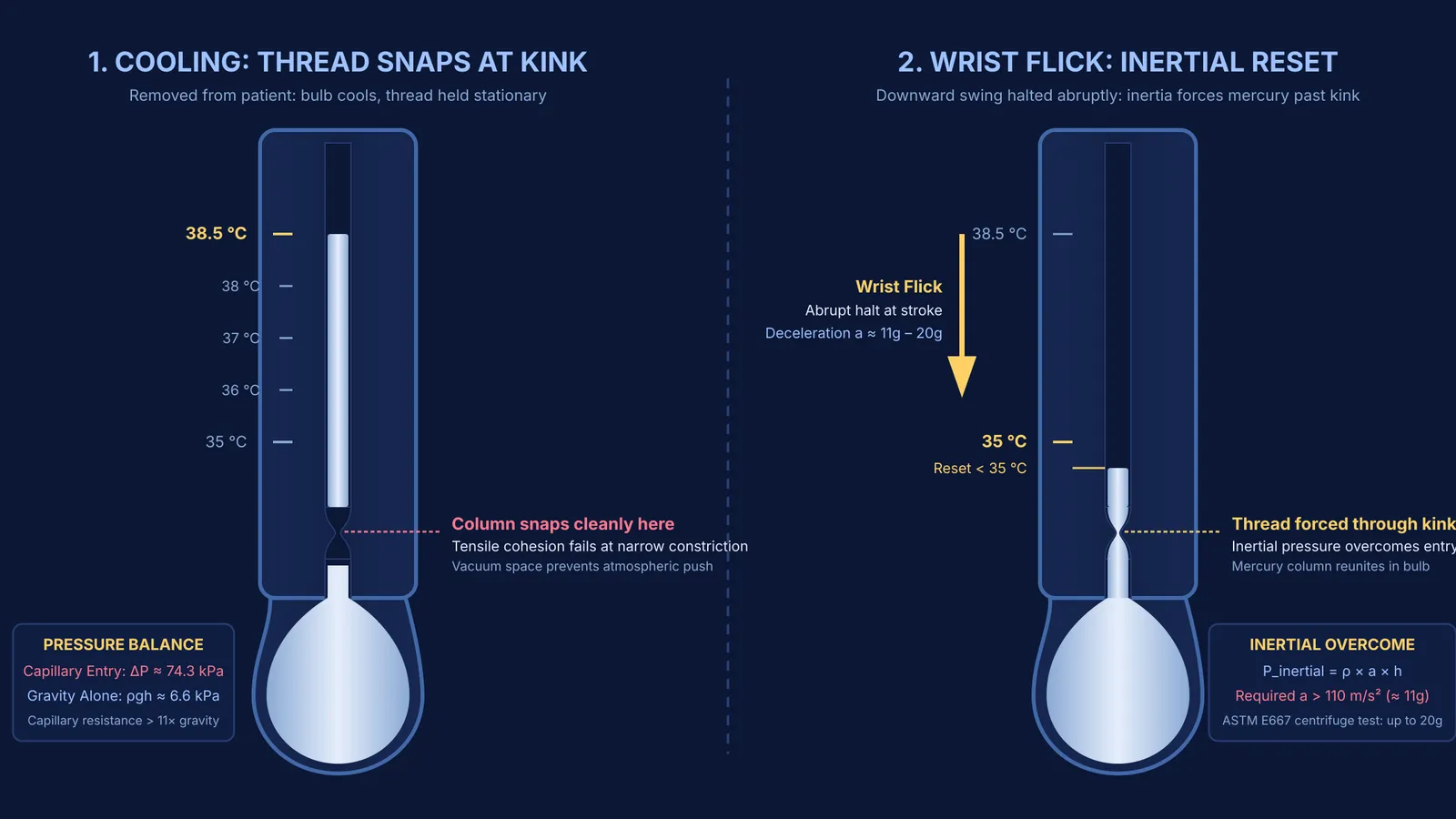
When warmed, mercury expands. Because liquids are nearly incompressible, expansion creates hydraulic pressure that drives mercury past the constriction and up the evacuated bore. When removed, the bulb cools to room temperature (around 20 °C to 25 °C) and contracts. The thread in the stem cannot follow. As tensile stress builds across the narrow kink, liquid cohesion fails and the mercury snaps in two, leaving the upper thread stationary at the peak temperature.
Why won't gravity pull the mercury back down?
Students often wonder why gravity cannot pull the mercury back into the bulb once the glass cools. Mercury is dense (13,546 kg/m³ at 20 °C according to the NIST Chemistry WebBook), and understanding how heat energy differs from temperature confirms that cooling leaves empty volume in the bulb. The answer lies in the balance between capillary resistance and hydrostatic pressure:
Capillary entry resistance: Mercury does not wet clean glass (contact angle θ ≈ 140°, cos θ ≈ −0.766) and has a high surface tension of 0.485 N/m at 20 °C, documented in the NIST Chemistry WebBook. By the Young-Laplace relation, driving non-wetting mercury through a constriction of radius r ≈ 10 μm requires an entry pressure of ΔP = (2 × γ × |cos θ|) / r = (2 × 0.485 × 0.766) / (1.0 × 10⁻⁵) ≈ 74,300 Pa (about 0.73 atm).
Hydrostatic gravity pressure: A standing column of height h = 5 cm (0.05 m) exerts a downward pressure of P = ρ × g × h = 13,546 × 9.8 × 0.05 ≈ 6,640 Pa (about 0.065 atm).
Because capillary entry resistance (74.3 kPa) is more than 11 times greater than hydrostatic pressure (6.6 kPa), and the sealed stem above is evacuated, gravity cannot move the severed thread.
How does shaking down a thermometer use inertia?
To reset the thermometer below the lowest scale marking (typically 35 °C or 95 °F), you must supply an external driving force by flicking your wrist downward.
This motion applies the inertia of motion and rest. As you swing the thermometer downward in an arc, the glass and mercury accelerate together. At the bottom of the stroke, your hand abruptly halts the glass. In this decelerating frame, the mercury's inertia carries it forward toward the bulb.
Deceleration a produces an inertial pressure P = ρ × a × h. Overcoming the 74,300 Pa capillary barrier across a 5 cm column requires:
a = ΔP / (ρ × h) = 74,300 / (13,546 × 0.05) ≈ 110 m/s²
This corresponds to roughly 11g. A brisk wrist flick generates peak decelerations between 10g and 20g, forcing the mercury past the constriction. Under the ASTM E667 standard for maximum self-registering clinical thermometers, instruments must pass an ease-of-resetting test in a centrifuge operating up to 20g. The Bureau of Indian Standards specifies matching retention and resetting criteria in IS 3055.
For students exploring fluid mechanics, microscopic capillary forces and macroscopic motion are easier to grasp interactively. In the Fermi Simulation Lab, you can interact with simulations for ideas that are easier to see than to read, testing how bore radius and acceleration change fluid flow. When working through non-inertial frames and pseudo-forces, the Fermi Problem Library provides worked problems with a step-by-step solver that explains the reasoning rather than printing an answer.
How do clinical and laboratory thermometers differ in exams?
Thermometer comparisons are common in school physics exams. Under standard specifications like IS 3055, the key differences include:
Constriction: Clinical thermometers have a kink above the bulb to hold the maximum reading; laboratory thermometers have a straight bore without a kink.
Reading timing: Clinical thermometers are read after removal from the patient; laboratory thermometers must be read while immersed.
Temperature range: Clinical models cover 35 °C to 42 °C (95 °F to 108 °F); laboratory models typically measure −10 °C to 110 °C.
Resetting procedure: Clinical thermometers require a wrist flick to reset; laboratory thermometers fall automatically as temperature drops.
Mercury clinical thermometers have largely been replaced in clinics. Because of mercury toxicity, the World Health Organization and the Minamata Convention on Mercury guided global transitions to digital thermistors and infrared sensors. Nevertheless, the classic kink remains an elegant demonstration of thermal expansion, surface tension, and inertia working together.


