

On this page
It is one of the most common traps in early physics: assuming that something with a high temperature must hold a lot of heat. If a drop of boiling oil splatters onto your arm, it stings. But if you were to step into a bathtub filled with 60 °C water, the thermal energy would be enough to cause serious harm, even though the temperature is much lower.
The difference lies in the definitions. In everyday conversation, we use "heat" and "temperature" interchangeably. In physics, they measure entirely different properties of a system.
What is temperature?
Temperature is a measure of the average kinetic energy of the particles in a substance. It tells you how fast the molecules are jiggling, vibrating or flying around, on average.
Because temperature is an average, it does not depend on how much of the substance you have. A spoonful of boiling water and a massive vat of boiling water both have a temperature of 100 °C. The average speed of the water molecules is identical in both containers.
Temperature is what dictates the direction of heat flow: energy always moves from an object with a higher temperature to an object with a lower temperature. If you place a thermometer in a freezing room, the lowest possible limit is absolute zero. Absolute zero is exactly −273.15 °C. At this point, classical molecular motion reaches its minimum.
Is heat the same thing as temperature?
No. While temperature measures the *average* energy, heat is the *total* energy in transit. Heat is the thermal energy that flows from a hotter object to a colder one.
Because heat represents total energy, it depends heavily on mass. To find out how much heat an object can transfer, you have to multiply its mass by its specific heat capacity and by its change in temperature. The specific heat capacity of liquid water is about 4184 joules per kilogram per kelvin. This means it takes a large amount of energy to change water's temperature.
What happens when heat flows?
When a hot object and a cold object are brought into contact, energy begins to transfer between them. The fast-moving molecules in the hotter object collide with the slower-moving molecules in the colder object, passing along their kinetic energy. This transfer of energy is what physicists call heat.
This process continues until both objects reach the exact same temperature, a state known as thermal equilibrium. At thermal equilibrium, the average kinetic energy of the molecules in both objects is equal. Even though individual molecules are still colliding and trading energy, there is no longer any net flow of heat in either direction. Notice that equilibrium is reached when the *temperatures* match, not when the total thermal energies match. If you drop a small red-hot horseshoe into a large cold lake, the lake will absorb heat until both reach a lukewarm equilibrium. The lake ends up holding almost all the total energy, but their temperatures are identical.
Why does a bucket of warm water hold more heat than a boiling cup?
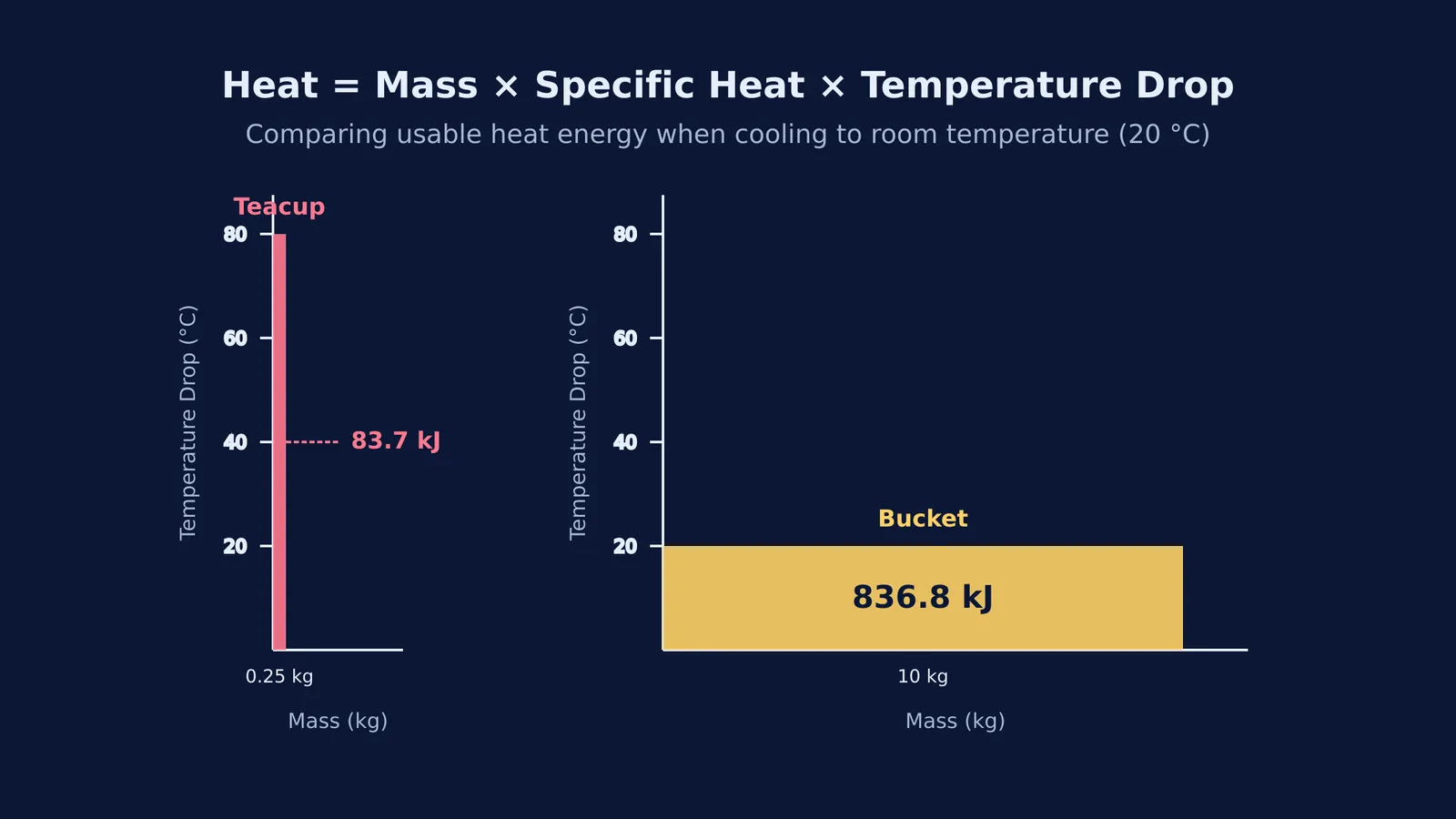
To see the difference clearly, let's run the numbers. Imagine you want to use water to warm up a cold room that sits at 20 °C. You have two options: a teacup of boiling water, or a heavy bucket of warm water. Which will release more heat energy into the room before cooling down to 20 °C?
1. The teacup of boiling water
Mass: 0.25 kg
Temperature: 100 °C
Temperature drop to room level: 80 °C
Heat released (Q = mcΔT): 0.25 × 4184 × 80 = 83,680 J
2. The bucket of warm water
Mass: 10 kg
Temperature: 40 °C
Temperature drop to room level: 20 °C
Heat released (Q = mcΔT): 10 × 4184 × 20 = 836,800 J
Even though the teacup is boiling, the bucket contains 836,800 J compared to 83,680 J—a huge difference in usable heat energy. The bucket's molecules have a lower average kinetic energy (temperature), but because its mass is vastly larger (10 kg versus 0.25 kg), their combined energy is much greater.
When you study thermal physics, this distinction is everywhere. Whether you are reading about Dulong, Petit and the law that weighed atoms with heat, or calculating Heat in isobaric and isochoric processes: using nCpΔT and nCvΔT, separating temperature from energy is the very first step.
How can you master thermal physics?
Students often struggle with these invisible concepts when they simply listen to a lecture and try to memorise the formulas. Active learning—where you work through problems, test hypotheses, and confront your own misconceptions—is far more effective. A 2014 study published in the *Proceedings of the National Academy of Sciences* found that failure rates under traditional lecturing increase by 55% over the rates observed under active learning.
Instead of just reading the definitions, you have to actively solve problems and see where your intuition fails. If you find yourself stuck on the theory, the Fermi Concept Library explains every concept in physics, chemistry, biology, mathematics and computing, each with its own lesson and its place in the map.
When it is time to practice applying those concepts to numericals, the Fermi Problem Library offers worked problems with a step-by-step solver that explains the reasoning rather than printing an answer. By tackling the calculations head-on, the difference between heat and temperature will become second nature.


