

On this page
Newton's first law states that an object will keep doing exactly what it is doing unless an external force acts on it. This natural tendency to resist a change in state is called inertia. The amount of inertia an object has depends entirely on its mass: a heavy train is much harder to push or stop than a bicycle.
In Class 9 physics, questions often ask you to classify everyday events into one of three categories: inertia of rest, inertia of motion, or inertia of direction.
What is the inertia of rest?
When an object is stationary, it tends to remain stationary. Unless you apply a force directly to it, it will stay exactly where it is.
Beating a carpet: When you hit a hanging carpet with a stick, the stick forces the carpet to move backward suddenly. However, the dust particles trapped inside resist this change due to their inertia of rest. The carpet moves away, leaving the dust behind to fall to the ground.
Shaking a tree branch: If you vigorously shake a branch, the wood moves rapidly back and forth. The leaves and fruits, wanting to stay at rest, experience a sudden strain that snaps their connection to the branch, causing them to fall.
The coin and card experiment: If you place a stiff card over an empty glass and put a heavy coin on top, flicking the card horizontally will shoot the card away. The coin's inertia of rest keeps it in place, and gravity simply pulls it down into the glass.
What is the inertia of motion?
An object moving at a constant speed wants to keep moving at that exact speed.
Sudden braking in a vehicle: When a bus or car stops suddenly, the lower half of your body stops along with the seat. Your upper body, however, continues moving forward because of its inertia of motion. A 2011 IRCOBI study into passenger kinematics found that even during medium-harsh braking, an adult's head moves forward by an average of 97 mm before the seatbelt can fully restrain it.
The long jump athlete: An athlete runs a long distance before leaping. The running builds up velocity, and the athlete's inertia of motion carries them much further through the air than they could achieve from a standing jump.
Unsecured luggage: If a car carrying suitcases on its roof brakes hard, the car slows down but the luggage continues forward at the original speed. This is why luggage must always be tied securely.
What is the inertia of direction?
Even if the speed stays the same, an object will resist any attempt to change its straight-line path.
Taking a sharp turn: When a car takes a sudden left turn, you feel as though you are being thrown to the right. Your body is actually trying to continue straight ahead due to the inertia of direction, while the car turns away beneath you.
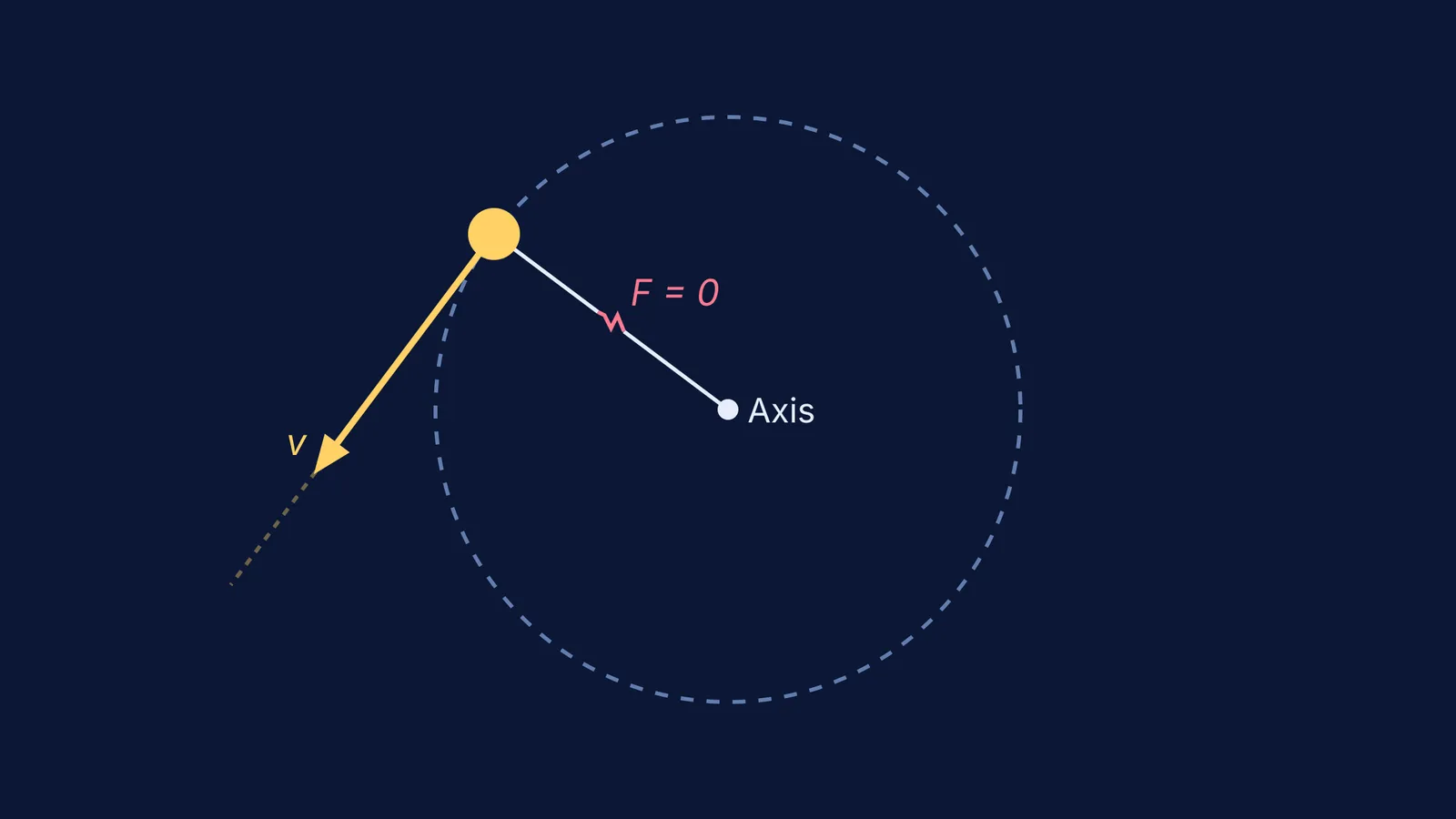
Mud on a bicycle tyre: Mud sticking to a spinning wheel will fly off along a straight, tangent line because its inertia prevents it from following the curved path once it detaches. Mudguards are placed exactly over these tangent lines to catch it.
A broken string: If you swing a stone tied to a string in a circle and the string snaps, the centripetal force vanishes. The stone immediately flies off in a straight line tangent to the circle.
How do you identify the type of inertia in an exam?
When you face a word problem asking which type of inertia is responsible for an event, use this quick three-step checklist. Look at what the object was doing *before* the change occurred:
Was it sitting still? If a stationary object is left behind when its support moves, it is the inertia of rest.
Was it moving forward? If a moving object falls forward when its vehicle stops, it is the inertia of motion.
Was it forced to turn? If an object flies outwards or to the side during a curve, it is the inertia of direction.
You can read how to calculate the effects of acceleration in our post on pseudo forces and solving problems from an accelerating frame.
To trace real physical interactions clearly, sketching a quick diagram helps. Our guide to Newton's second law with free-body diagrams: a five-step method shows you how.
Finally, if you understand the theory but struggle to set up the maths for these situations, the step-by-step solver in the Fermi Problem Library can guide you through the reasoning without just handing you the final answer.


