

On this page
In a school practical, a reading is only as good as where your eye was when you took it. Two students can look at the same measuring cylinder, write 46 mL and 48 mL, and both believe they were careful. The difference usually comes from three things: the height of the eye, which edge of the curved surface they read, and whether they knew what one small division was worth.
How do you read a measuring cylinder correctly?
Water clings to glass, so its surface curves up at the walls and dips in the middle; that curved surface is the meniscus. The US National Institute of Standards and Technology's guide to reading a meniscus (NIST GMP 3) says a concave meniscus like water's is read at its lowest point.
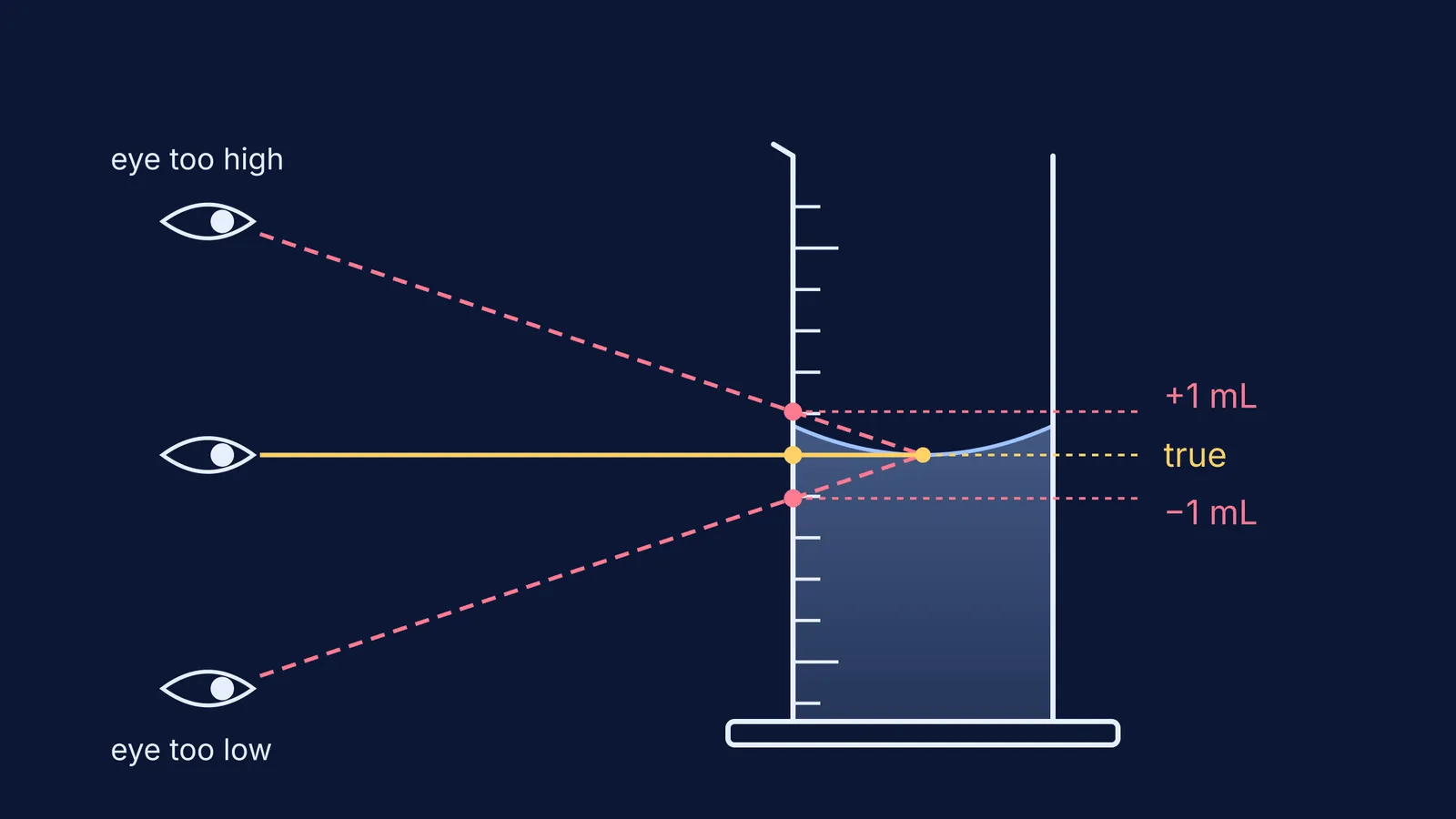
The same NIST guide says the eye should be in the same horizontal plane as the meniscus, and that reading from any other height produces parallax error.
Stand the cylinder on a flat bench.
Let the surface settle. NIST notes that if the meniscus returns to the same reading after a tap, it is stable.
Bend your knees until your eye is level with the liquid surface.
Hold a dark card just below the meniscus so its lowest edge shows up sharply, as NIST recommends.
Read the mark that lines up with the bottom of the curve.
Why is mercury read at the top of the meniscus?
Mercury does not wet glass, so its surface bulges upward. According to NIST GMP 3, a convex meniscus like mercury's is read at its highest point, and the mercury thermometer and barometer are the classic examples. Either way, read the part of the curve furthest from the walls. Our explainer on contact angle and meniscus shape shows why the curve bends one way or the other.
How do you find the least count of a thermometer or cylinder?
The least count is the value of one smallest division. NCERT's Class 7 science chapter on heat gives the method: take the difference between two numbered marks and divide by the number of small divisions between them. Its example: big marks 1 °C apart with five divisions between them make one division 1/5 = 0.2 °C.
On a cylinder numbered every 10 mL with 10 small divisions per gap, one division is 1 mL, so write 46 mL, not "about 46". Our post on reading the least count of a metre scale works through the same idea on a ruler.
How much error does parallax add?
A worked example, using straight-line geometry and ignoring the small bending of light by glass and water. The scale is on the front wall, but the lowest point of the meniscus sits on the axis, one inner radius behind it.
Inner radius of the cylinder: 1 cm.
Your eye: 30 cm away and 10 cm too high, so your line of sight drops 1 cm for every 3 cm.
Across the 1 cm from meniscus to scale, it drops 1/3 cm, meeting the scale about 3.3 mm above the true level.
NIST GMP 3 converts height error to volume with V = πr²h: π × 1² × 0.333 ≈ 1.05 cm³, about 1 mL.
So a glance from above adds a millilitre and a glance from below takes one away. On a burette, where numbers rise downward, a high eye gives a low reading instead. Our post on eye position and parallax when reading a scale has more on the geometry.
How do you read a laboratory thermometer?
NCERT's heat chapter says a laboratory thermometer generally reads from −10 °C to 110 °C, and a clinical thermometer from 35 °C to 42 °C. Its precautions for the lab thermometer:
Keep it upright, not tilted.
Surround the bulb with the liquid, clear of the bottom and sides of the beaker.
Wait until the thread stops moving.
Read it while the bulb is still in the liquid; in hot water, NCERT notes the level starts falling as soon as you lift it out.
Keep the top of the thread along your line of sight.
The thread sits inside the glass, a little behind the marks on its surface, so the same parallax applies: an eye above the thread top pushes the reading up.
A checklist before you write the number down
Least count worked out and noted at the top of your observation table.
Instrument vertical and steady.
Eye level with the surface or thread top, checked with the one-division test.
Lowest point for water, highest point for mercury.
Number written to the least count, with its unit.
If least count and error questions trip you up on paper too, the Fermi Problem Library has worked problems with a step-by-step solver that explains the reasoning rather than printing an answer. If the meniscus idea itself feels shaky, each concept in the Fermi Concept Library has its own lesson.
Try the one-division test on your next lab reading and see whether your number moves.


