

On this page
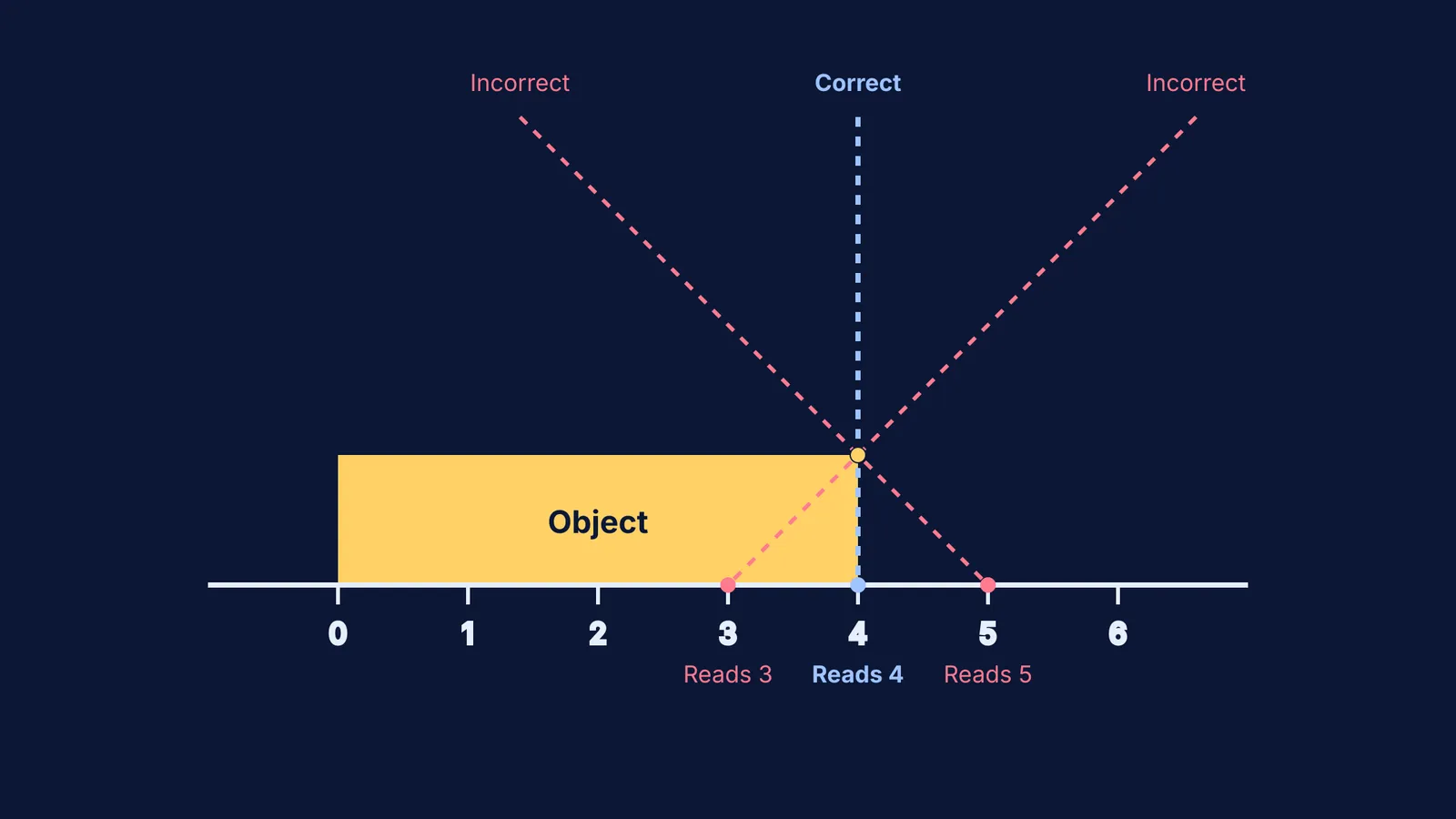
When you measure the length of a pencil or a block with a ruler, you might notice that the reading seems to change if you move your head from side to side. This apparent shift is called parallax error. It is an error that occurs when a measurement is taken from an incorrect viewing angle, as detailed in the physics of parallax.
Parallax happens because there is a physical distance—a gap—between the markings on the scale and the actual object you are measuring. If your line of sight is tilted, it cuts through the edge of the object and hits the scale at the wrong spot, causing you to read a number that is either too large or too small.
What is the correct position of eye while reading a scale class 6?
To avoid parallax error, your eye must be positioned exactly vertically above the mark you are reading on the scale.
If you look from the left side, your line of sight pushes the reading further to the right, making the object seem longer than it actually is. If you look from the right side, the reading is pushed to the left, making it seem shorter. Positioning your eye directly in front of the mark ensures that your line of sight is perpendicular—at a 90-degree angle—to the scale. This direct vertical alignment provides the true and accurate measurement.
How do you measure length if the zero mark is broken?
A common practical problem in science class is a wooden or plastic scale with worn-out edges. If the zero mark is broken or not clearly visible, you should never try to guess where the zero used to be.
Instead, place the object starting at any other full mark that is clearly visible—for example, the 1.0 cm mark. You then read the mark at the other end of the object and subtract your starting point to find the true length. If one end of the object aligns with 1.0 cm and the other end aligns with 5.4 cm, the actual length of the object is 5.4 − 1.0 = 4.4 cm.
Why is parallax error considered a systematic error?
In physics, experimental errors are generally classified as either random or systematic. Random errors fluctuate in both directions and can often be reduced by taking an average of many readings.
Parallax error, however, can be a systematic error. If a student consistently views the ruler from the left side because of how they are sitting at their lab desk, all of their measurements will be consistently larger than the true value. Averaging these incorrect readings will not fix the problem; the only solution is to change the experimental technique by viewing the scale from directly above.
How do mirror scales prevent parallax error?
In higher classes and professional laboratories, you will encounter high-precision instruments like analogue voltmeters or multimeters. These instruments often include a narrow strip of mirror placed directly behind the scale needle.
To use these instruments correctly, you must adjust your head until the physical needle perfectly hides its own reflection in the mirror, an established technique for preventing parallax. Once the reflection disappears behind the needle, it guarantees that your line of sight is exactly perpendicular to the scale, eliminating parallax error entirely.
How does parallax affect reading a liquid meniscus?
Parallax error is not limited to rulers and tape measures; it is also a major factor when measuring the volume of liquids in a chemistry lab. When you pour a liquid into a graduated cylinder, the surface often curves slightly, forming a shape known as a meniscus.
To read the volume accurately, you must bring your eye exactly level with the bottom of the meniscus. If you look down at the meniscus from above, the reading will appear too high. If you look up from below, the reading will appear too low. This is the exact same geometric principle as reading a scale, applied vertically instead of horizontally.
A practical habit for science labs
Developing strong experimental techniques early on will help you avoid frustrating systematic errors later in your studies.
Always place the scale in direct contact with the object along its entire length.
Look straight down at the starting mark to align the object precisely.
Move your head so it is directly above the ending mark before you take the final reading.
Record your units clearly, and always double-check your subtraction if you started from a non-zero mark.
If you are working through introductory physics and measurement rules, the Fermi Concept Library has a lesson for every concept in physics, chemistry and mathematics. You can also explore how accurate measurements apply to more complex scenarios, such as finding the mass of a metre scale with the principle of moments, calculating distance in the nth second of a moving object, or converting a quantity between unit systems using dimensions.


