

On this page
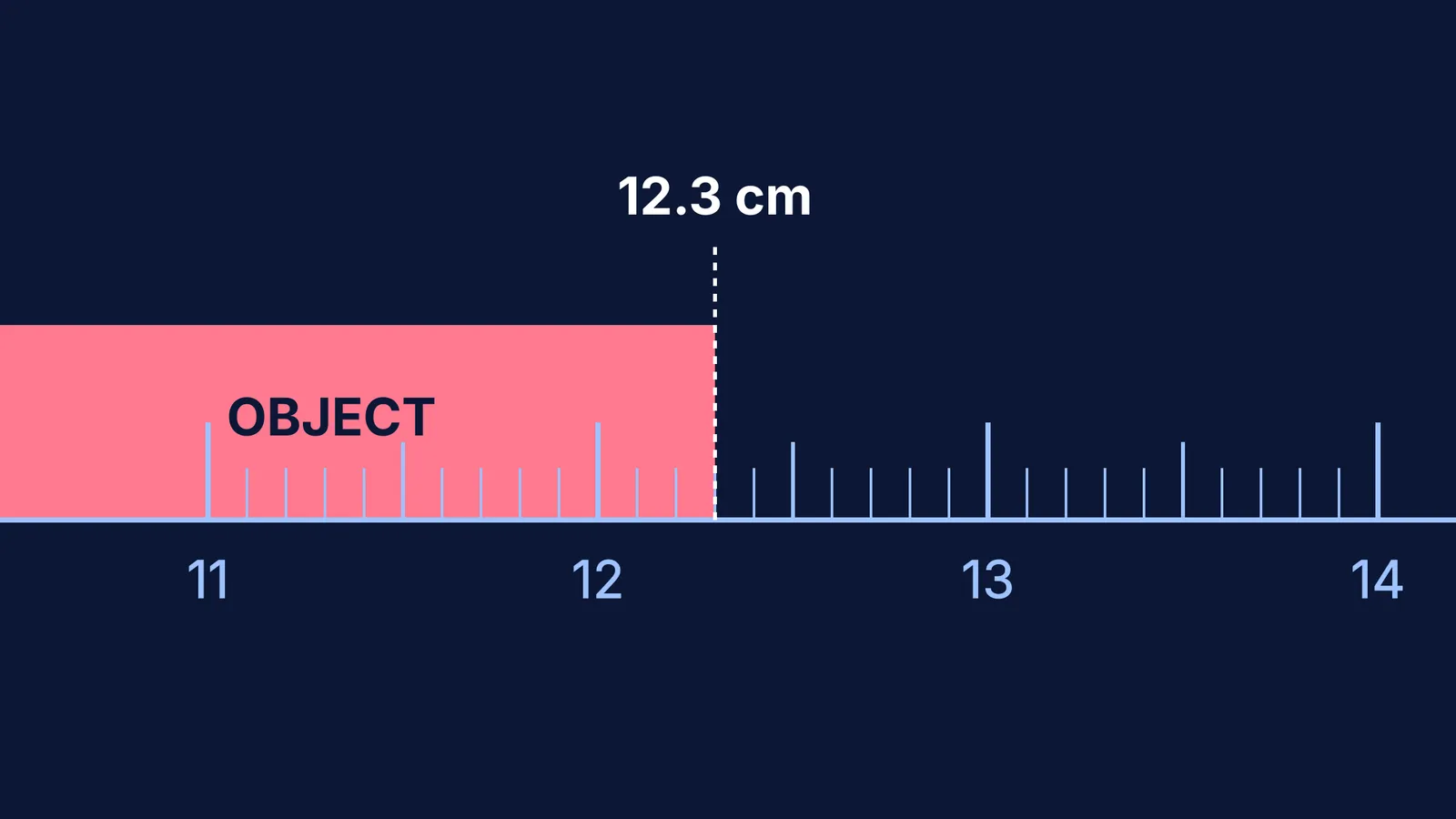
When you measure a wire in the physics lab, the number you write down is bounded by the instrument you use. If you measure a length with a standard lab ruler and record 12.3 cm, you might wonder why you cannot just write 12.30 cm to make it look more precise. In mathematics, adding a trailing zero does not change the value. In physics, however, adding that zero makes a claim about the precision of your measurement that your ruler cannot support.
The answer lies in the concept of significant figures. A metre-scale reading of 12.3 cm has exactly three significant figures, and the rules governing them stem directly from the instrument's least count. Understanding this relationship is critical for avoiding errors in lab practicals and exams.
What is the least count of a metre scale?
The least count is the smallest measurement you can make accurately with a given instrument. Every tool has a limit to its resolution, and the least count tells you exactly what that limit is. A standard laboratory metre scale has markings spaced 1 mm apart. Because 1 mm is equal to 0.1 cm, the least count of a metre scale is 0.1 cm.
This number is the physical limit of your certainty. If an object's length falls exactly on the 12 cm mark, you must record it as 12.0 cm, not 12 cm. Writing 12.0 cm tells the examiner that you used an instrument capable of measuring down to tenths of a centimetre, and the tenths place happened to be a zero. If you only write 12 cm, you imply that your instrument could only measure to the nearest whole centimetre.
How many significant figures in a metre scale reading?
According to standard conventions in physics, significant figures are defined as all the reliable digits plus the first uncertain digit. This rule ensures that anyone reading your data understands the precision of the tool you used.
If you record a reading of 12.3 cm using your metre scale:
The digits 1 and 2 are reliable. You can clearly see that the object extends past the 12 cm mark on the ruler.
The digit 3 is the first uncertain digit.
Because there are two reliable digits and one uncertain digit, the measurement 12.3 cm has three significant figures.
If you use a more precise instrument, the number of significant figures will increase. For example, a vernier caliper with a least count of 0.01 cm might give a reading of 12.34 cm, which contains four significant figures. A screw gauge might give 12.345 cm, offering five significant figures. The more precision your instrument has, the more certain digits you can report.
Why is the last digit called the uncertain digit?
Imagine the edge of your block falls exactly on the 12.3 cm mark on your ruler. Even when it looks perfectly aligned to your eye, human vision and physical alignment have limits. Because the scale does not have markings for hundredths of a centimetre, any digit beyond the tenths place is a guess.
To maintain scientific rigor, you report only the digits you are certain of, plus one digit where your uncertainty begins. For a metre scale with a least count of 0.1 cm, the tenths place is where you hit the limit of the printed markings. Therefore, the digit in the tenths place is always your first uncertain digit.
When you are studying for practicals, like tracing a ray through a glass slab: the Class 10 practical or finding the mass of a metre scale with the principle of moments, examiners look for this exact discipline in your observation tables. Recording 12.30 cm with a standard ruler will cost you marks, as it demonstrates a misunderstanding of your apparatus.
How to report measurements properly?
When taking readings in the lab, follow this sequence to ensure you never lose marks on significant figures:
Find the least count: Look at the smallest gap between marks before you measure. For a metre scale, it is 0.1 cm.
Read the certain digits: Identify the last mark the object definitively passes (e.g., 12 cm).
Read the uncertain digit: Look at the next smallest division (e.g., the 3rd millimetre mark). You estimate this digit, making it the first uncertain one.
Stop there: Write 12.3 cm. Do not add extra zeros like 12.30 cm or 12.300 cm, as those imply a more precise instrument.
Count the figures: Count all the digits you wrote down (1, 2, and 3). You have three significant figures.
If you find significant figures confusing during later calculations, the Fermi Problem Library has worked problems with a step-by-step solver that explains the reasoning rather than printing an answer. It helps you track the uncertain digit through every stage of a complex formula, ensuring you round your final result to the correct precision.


