

On this page
Water in a glass tube curves up at the edges like a bowl; mercury bulges in the middle like a dome. One quantity explains both shapes and predicts whether a liquid climbs a thin tube or sinks in it: the contact angle.
What decides the shape of a meniscus?
Cohesive forces are attractions between molecules of the same type, and adhesive forces are attractions between molecules of different types, as defined in OpenStax College Physics 2e, section 11.8.
The contact angle is the angle between the tangent to the liquid surface at the point of contact and the solid surface, measured inside the liquid (NCERT Class 11 Physics, Chapter 9).
NCERT writes the balance of surface tensions at the contact line as S_la cos θ + S_sl = S_sa, for the liquid–air, solid–liquid and solid–air interfaces. Rearranged, cos θ = (S_sa − S_sl)/S_la, so if S_sl is bigger than S_sa, cos θ turns negative and θ goes above 90°.
Why is the mercury meniscus convex and water concave?
NCERT explains that the angle is acute when liquid molecules are strongly attracted to the solid, as with water on glass, and obtuse when they are attracted strongly to each other and weakly to the solid, as with mercury. The contact-angle table in OpenStax section 11.8 gives the numbers:
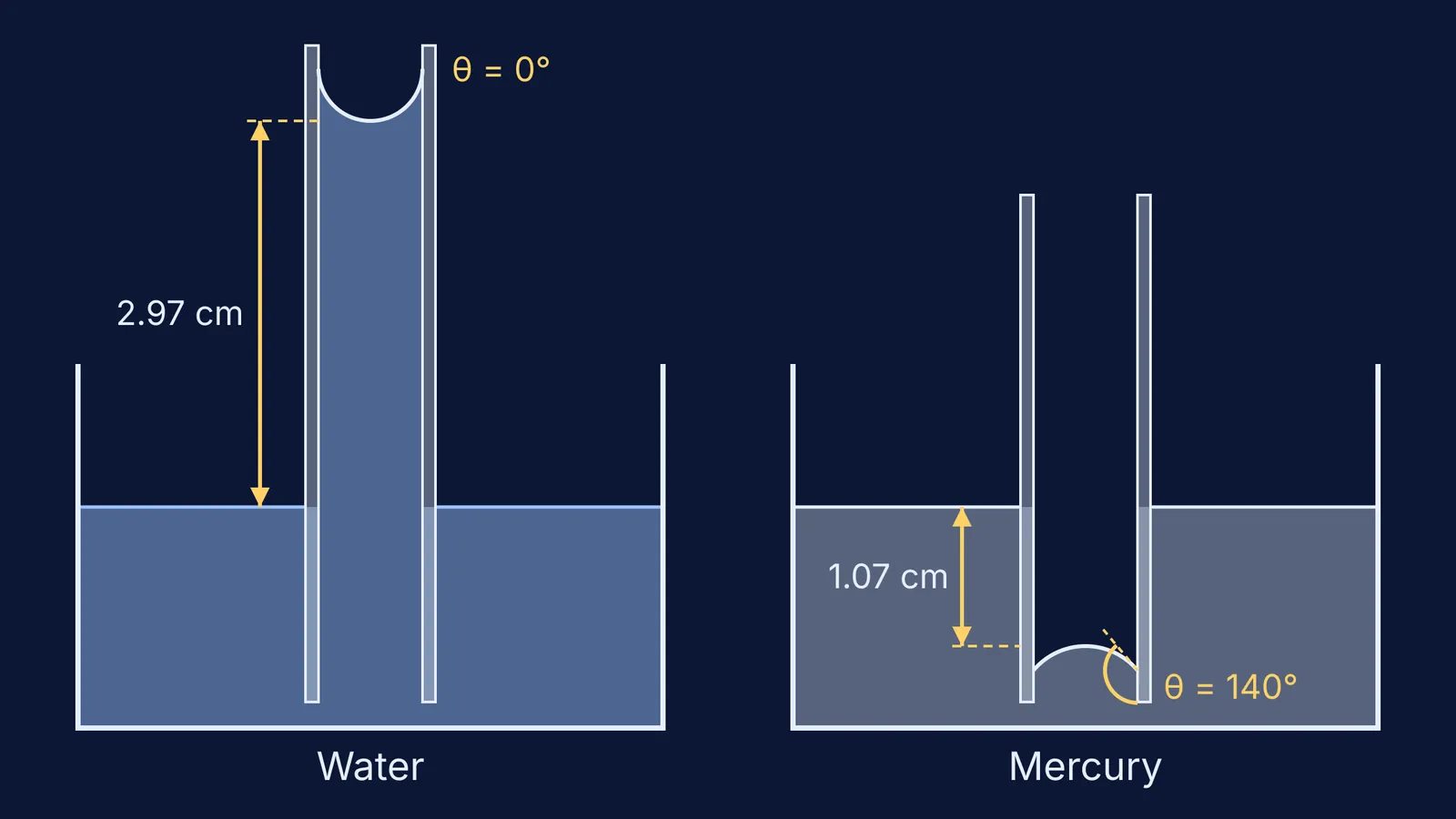
Water on clean glass: 0°. Adhesion wins; water climbs the wall, so the surface is concave.
Mercury on glass: 140°. Cohesion wins; mercury pulls back into a dome, so the surface is convex.
Water on paraffin wax: 107°. The same water now behaves like mercury on glass.
How does the contact angle decide capillary rise or fall?
NCERT shows that just under a concave water meniscus the pressure is below atmospheric, so the column is pushed up until its weight makes up the gap. That gives the capillary rise formula h = 2S cos θ/(ρga), where S is surface tension, ρ density, g gravity and a the tube's radius (NCERT Class 11 Physics, Chapter 9). The chapter adds that if cos θ is negative, as for mercury, the liquid ends up lower in the capillary.
θ below 90°: cos θ positive, meniscus concave, liquid rises.
θ equal to 90°: cos θ zero, surface flat, no rise or fall.
θ above 90°: cos θ negative, meniscus convex, liquid is pushed down.
Our guide to surface tension and viscosity covers the excess pressure across a curved surface.
Worked example: water and mercury in the same 1 mm tube
Take a clean glass tube with an inner diameter of 1.00 mm, so a = 5 × 10⁻⁴ m. Use S = 0.0728 N/m for water at 20 °C and S = 0.465 N/m for mercury from OpenStax section 11.8, densities of 1.00 × 10³ kg/m³ and 13.6 × 10³ kg/m³ from Table 9.1 of NCERT Chapter 9, and g = 9.8 m/s².
Water, θ = 0°, cos θ = 1: h = (2 × 0.0728)/(1000 × 9.8 × 0.0005) = 0.1456/4.9 ≈ 0.0297 m. The water climbs about 2.97 cm, close to the 2.98 cm NCERT works out for the same radius with S = 0.073 N/m.
Mercury, θ = 140°, cos θ ≈ −0.766: h = (2 × 0.465 × −0.766)/(13600 × 9.8 × 0.0005) = −0.712/66.64 ≈ −0.0107 m. The mercury sits about 1.07 cm below the outside level.
Water in the same tube coated with paraffin wax, θ = 107°, cos θ ≈ −0.292: h = (0.1456 × −0.292)/4.9 ≈ −0.0087 m. The water now falls by about 0.87 cm.
Mercury has more than six times water's surface tension, yet it falls: the negative cos θ flips the sign, and its density of 13.6 times water's shrinks the size.
One trap: NCERT's Table 9.3 gives mercury 0.4355 N/m, but its exercise 9.19 uses 0.465 N/m. Use the value the question gives.
How do you answer a meniscus question without losing marks?
Name the pair: which liquid, which solid.
Compare θ with 90° and write the sign of cos θ.
State the shape: concave for rise, convex for fall.
Convert diameter to radius, and millimetres to metres.
Check the size: NCERT notes that rise in fine capillaries is typically a few centimetres.
For pressure in the column, use the ρgh method from our hydrostatics problems on pressure at depth.
If you keep dropping the sign or mixing up radius and diameter, the Fermi Problem Library has worked problems with a step-by-step solver that explains the reasoning rather than printing an answer. If the link between curvature and pressure feels shaky, the Fermi Concept Library gives each concept its own lesson and its place in the map.
Next time you see a meniscus, guess the contact angle first; the shape and the direction of travel follow from it.


