

On this page
Fill a glass flask to the brim, warm it, and some liquid spills. The spill is smaller than the liquid's true growth in volume, because the flask is growing at the same time. Most exam problems on this topic come down to keeping those two expansions apart.
What is the difference between real and apparent expansion?
The expansion of a liquid measured against its container is its apparent expansion, and its actual expansion is the real (or absolute) expansion (Wikipedia, Thermal expansion). The same source states the rule you need: the real increase in volume equals the apparent increase plus the increase in volume of the vessel.
In coefficients, that is γ_real = γ_apparent + γ_vessel. For a solid vessel, γ_vessel = 3α, where α is the coefficient of linear expansion; NCERT derives this as equation 10.9 in Class 11 Physics, Chapter 10, Thermal Properties of Matter.
The numbers below come from NCERT's Table 10.2, which gives values for the range 0–100 °C:
Mercury: 18.2 × 10⁻⁵ K⁻¹
Water: 20.7 × 10⁻⁵ K⁻¹
Ordinary glass: 2.5 × 10⁻⁵ K⁻¹
Pyrex glass: 1 × 10⁻⁵ K⁻¹
Water contracts on heating between 0 °C and 4 °C, the same chapter notes, so mercury is the simpler liquid for practice.
Why does the liquid level dip first when you heat a flask?
Put a long-stemmed flask with liquid partway up the stem into a hot bath and the level first drops a little, then rises (Wikipedia, Thermal expansion). The glass touches the hot bath first, so the flask grows before heat reaches the liquid; then the liquid's larger coefficient wins.
How do you calculate overflow from a full vessel?
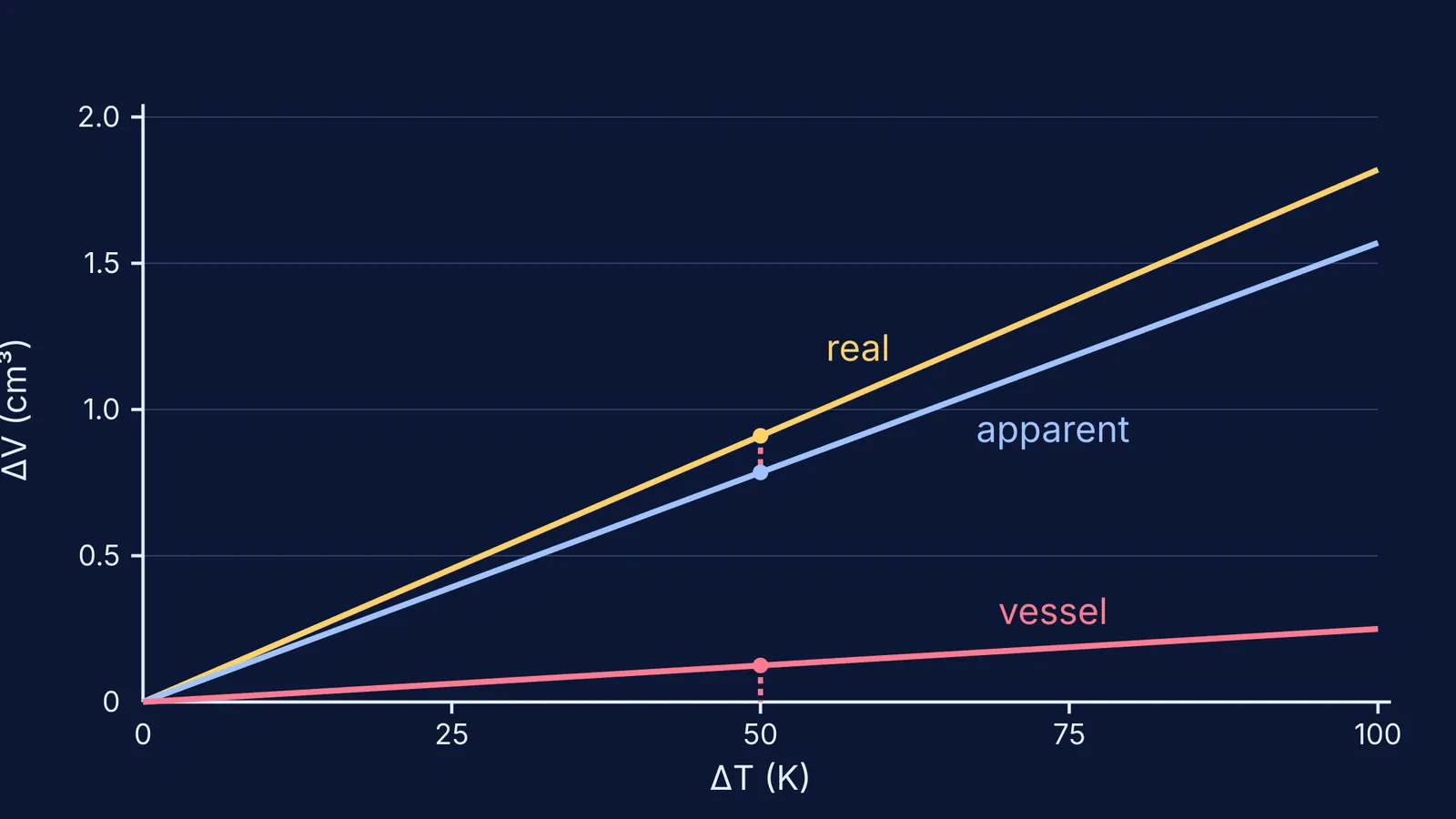
Worked example 1. A glass flask holds exactly 100 cm³ of mercury, filled to the brim at 20 °C. It is heated to 70 °C. How much spills? Use NCERT's values from the Thermal Properties of Matter chapter.
Temperature rise: ΔT = 50 K.
Real expansion of mercury: 100 × 18.2 × 10⁻⁵ × 50 = 0.91 cm³.
Expansion of the flask: 100 × 2.5 × 10⁻⁵ × 50 = 0.125 cm³.
Overflow (apparent expansion): 0.91 − 0.125 = 0.785 cm³.
So the apparent coefficient here is 15.7 × 10⁻⁵ K⁻¹, about 86% of the real value. Swap in Pyrex and the apparent coefficient rises to 17.2 × 10⁻⁵ K⁻¹, because the vessel takes a smaller share.
In OpenStax's College Physics 2e, section 13.2, the same subtraction shows a full 60.0 L steel petrol tank warmed from 15.0 °C to 35.0 °C spilling 1.10 L.
Does the level rise or fall in a heated cylinder?
In a cylinder that is not full, the liquid's height depends on the base area, which grows in two dimensions; the walls' height does not matter.
The liquid's volume becomes V(1 + γΔT) and the base area becomes A(1 + 2αΔT), so the new height is about h[1 + (γ − 2α)ΔT]. Use 2α, not 3α.
Worked example 2. Mercury stands 10 cm high in an ordinary glass cylinder and is heated by 50 K. For this glass, α = 2.5 × 10⁻⁵ ÷ 3 ≈ 0.83 × 10⁻⁵ K⁻¹ (from the NCERT values), so 2α ≈ 1.67 × 10⁻⁵ K⁻¹.
Rise in level: 10 × (18.2 − 1.67) × 10⁻⁵ × 50 ≈ 0.083 cm, a little under 1 mm.
Using 3α instead gives about 0.079 cm. Close, but in a multiple-choice question it can be the wrong option.
The level rises only if γ_liquid is greater than 2α_vessel. If they are equal, the level does not move at all.
How full must a flask be so the empty space never changes?
Worked example 3. A 1000 cm³ glass flask holds some mercury. How much mercury keeps the air space above it constant at every temperature?
The space stays constant when the liquid and the flask gain the same volume: V_mercury × γ_mercury = V_flask × γ_glass. So V_mercury = 1000 × 2.5 ÷ 18.2 ≈ 137 cm³, roughly one-seventh of the flask, using the NCERT Table 10.2 values.
A four-step checklist for any expansion problem
Ask what is measured: spill or graduated marks (apparent), true volume (real) or height (use 2α for the base).
Convert linear coefficients for the vessel: 3α for volume, 2α for area.
Write volumes before and after, then subtract. Do not jump straight to a formula.
Check the sign: does the level rise, fall or stay put, and does that match the coefficients?
If you get stuck at step 1, the gap is in the reasoning, not the arithmetic. The Fermi Problem Library has worked problems with a step-by-step solver that explains the reasoning rather than printing an answer, so you can see where the vessel's share enters. For the definitions on their own, look up thermal expansion in the Fermi Concept Library.
The same "the container moves too" idea appears in why a hole in a metal plate gets bigger when heated, correcting a metal scale's reading error at different temperatures and whether buoyant force changes when a liquid is heated.


