

On this page
If you take a metal scale calibrated in an air-conditioned laboratory and use it outdoors on a 40 °C summer day, the readings you get will be slightly wrong.
This is a classic problem in thermal physics, and one that appears often in JEE and NEET exams. The mistake students most often make is getting the sign wrong: if the scale expands, does the reading get larger or smaller?
Here is why the reading shrinks, and how to apply the linear expansion formula to find the true length.
Why does a hot scale read short?
Every measuring scale is calibrated at a specific temperature, usually 20 °C or 25 °C. At this calibration temperature (T₀), a 1 mm division on the scale is exactly 1 mm long.
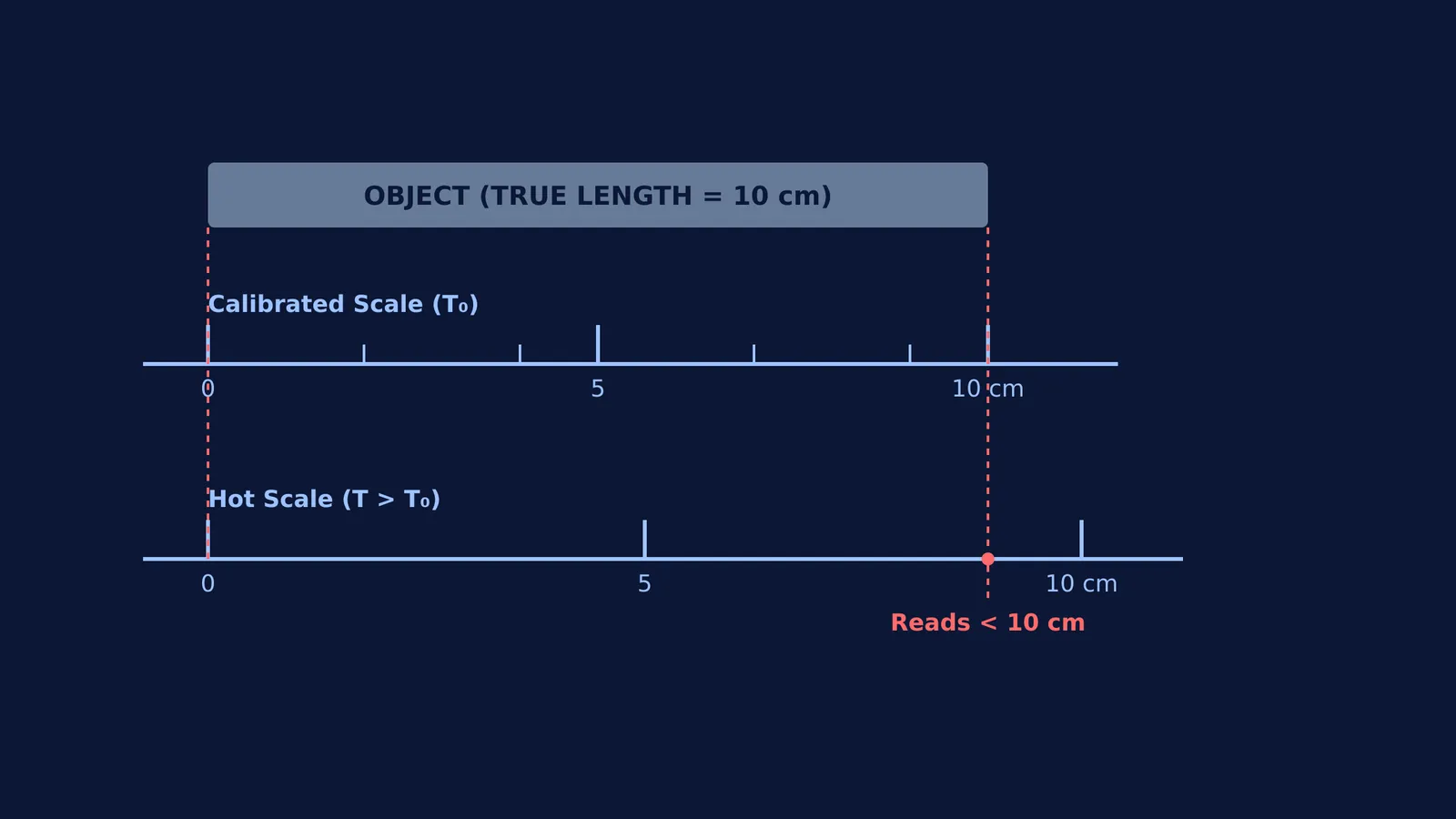
When the temperature rises to a new temperature T (where T > T₀), the metal scale expands. The distance between the zero mark and the 10 cm mark is now physically longer than 10 cm.
Because the divisions are stretched out, an object of fixed length will span fewer of these enlarged divisions. Therefore, the scale will under-read the actual length. For instance, an object that is exactly 10.0 cm long might read as 9.99 cm on the hot scale. Conversely, on a cold day (T < T₀), the scale contracts, the divisions crowd closer together, and the scale over-reads the true length.
If you find these thermal expansion rules hard to visualise, you can watch how changing the temperature alters the reading in real time in the Fermi Simulation Lab.
What is the correction formula?
The expansion of the scale follows the law of linear thermal expansion. The true length (L_true) and the measured length on the scale (L_read) are related by:
L_true = L_read × (1 + αΔT)
Where:
L_read is the length read from the scale.
α is the coefficient of linear expansion of the metal the scale is made of.
ΔT = T − T₀ is the change in temperature from the calibration temperature.
The error in the reading is the difference between the true length and the reading:
Error = L_true − L_read = L_read × αΔT
If the temperature is higher than the calibration temperature, ΔT is positive, so you must add this correction to the reading. If the temperature is lower, ΔT is negative, and you subtract it.
How do you correct a steel scale reading?
Suppose you have a steel scale calibrated at 20 °C. You use it at 40 °C to measure a block of wood, and the scale reads exactly 50.00 cm. What is the true length of the block?
According to the OpenStax *University Physics Volume 2* textbook, the coefficient of linear expansion for steel is α = 12 × 10⁻⁶ /°C.
The change in temperature ΔT is 40 °C − 20 °C = 20 °C.
The correction to apply is: Error = L_read × αΔT Error = 50.00 × (12 × 10⁻⁶) × 20 Error = 50.00 × 240 × 10⁻⁶ = 0.012 cm
Because the scale was hotter than its calibration temperature, it read short. The true length of the block is 50.00 + 0.012 = 50.012 cm.
What if the object expands too?
In exams like JEE Advanced, you are often asked to measure a metal rod using a metal scale, where both are heated. In this case, both the object and the scale expand.
If the object has a coefficient of expansion α_object and the scale has α_scale, the true length of the object at temperature T is L₀ × (1 + α_object × ΔT). The length of a single scale division is 1 + α_scale × ΔT.
The new reading is the ratio of these two: New Reading = L₀ × (1 + α_object × ΔT) / (1 + α_scale × ΔT)
If you use a binomial approximation (since αΔT is very small), this simplifies to: New Reading ≈ L₀ × [1 + (α_object − α_scale) × ΔT]
If α_object > α_scale (for example, measuring a brass rod with a steel scale, since brass expands more), the reading will increase as it gets hotter. If you have concept gaps when setting up the relative expansion equations, you can review them in the Fermi Concept Library.
For more practice on thermal effects, you can look at thermal stress in clamped rods, investigate the pendulum clock losing time in summer, or review general thermal expansion problems.


