On this page
Thermal expansion problems are mostly one formula, ΔL = αLΔT, used in clever ways. Questions ask whether a hole in a heated plate gets bigger or smaller, how much mercury spills from a flask, or how many seconds a pendulum clock loses on a hot day. This post works through each type, using coefficients from the NCERT textbook, and lists the reasoning traps.
What does the syllabus include?
The JEE (Main) 2026 syllabus lists thermal expansion in its unit on properties of solids and liquids, and the JEE (Advanced) 2026 brochure lists "thermal expansion of solids, liquids and gases". The CBSE 2026-27 curriculum adds the anomalous expansion of water, and its Class 11 activities include heating a bimetallic strip and watching a liquid's level change as its container is heated. Check the current documents for your exam.
How are linear, area and volume expansion related?
The NCERT chapter Thermal Properties of Matter defines the coefficient of linear expansion α through ΔL/L = αΔT, and the coefficient of volume expansion through ΔV/V = α_V ΔT. It shows that for a solid, α_V = 3α. The same reasoning gives 2α for area. These hold because α is tiny (around 10⁻⁵ per kelvin), so terms like α² can be dropped.
NCERT's tables give, for example:
Aluminium: α = 2.5 × 10⁻⁵ K⁻¹
Brass: α = 1.8 × 10⁻⁵ K⁻¹
Iron: α = 1.2 × 10⁻⁵ K⁻¹
Mercury: α_V = 18.2 × 10⁻⁵ K⁻¹
Ordinary glass: α_V = 2.5 × 10⁻⁵ K⁻¹
A temperature difference is the same in kelvin and degrees Celsius, so ΔT = 40 °C means ΔT = 40 K.
Worked examples
Example 1: a rail. An iron rail is 12 m long. How much longer is it after a 40 K temperature rise?
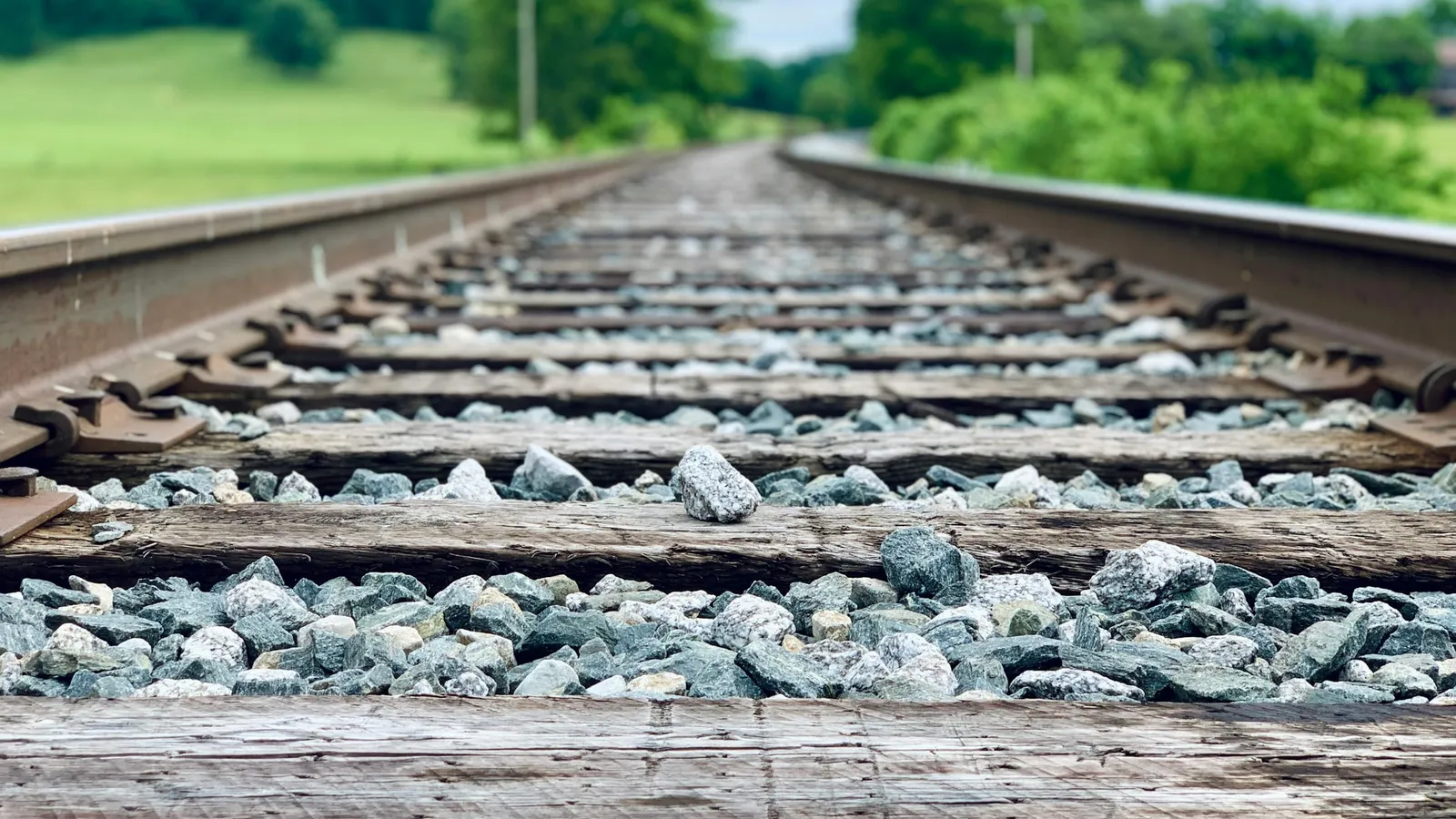
ΔL = αLΔT = 1.2 × 10⁻⁵ × 12 × 40 = 5.76 × 10⁻³ m, about 5.8 mm. That is why rails and bridges have expansion gaps.
Example 2: a hole. An aluminium plate has a hole of diameter 2.000 cm. The plate is heated by 100 K. Does the hole grow or shrink?
It grows, exactly as if it were filled with aluminium. Every length in the plate, including the hole's diameter, scales by (1 + αΔT). New diameter = 2.000 × (1 + 2.5 × 10⁻⁵ × 100) = 2.000 × 1.0025 = 2.005 cm. NCERT's example of a blacksmith heating an iron ring to fit it onto a wooden wheel uses the same idea.
Example 3: an overflowing flask. A glass flask holds exactly 500 cm³ of mercury at 20 °C. Both are heated to 70 °C. How much mercury spills?
Real expansion of mercury: 500 × 18.2 × 10⁻⁵ × 50 = 4.55 cm³.
Expansion of the flask's volume: 500 × 2.5 × 10⁻⁵ × 50 = 0.625 cm³.
Spill = 4.55 − 0.625 ≈ 3.9 cm³.
The spill measures the apparent expansion, real minus container. Forgetting that the flask expands too is the most common error here.
Example 4: thermal stress. A steel rod is clamped between two rigid walls so it cannot lengthen. Take Y = 2.0 × 10¹¹ Pa and α = 1.2 × 10⁻⁵ K⁻¹, as given in the problem. If it is heated by 30 K, the walls must push it back by the strain it would have had, αΔT. Stress = YαΔT = 2.0 × 10¹¹ × 1.2 × 10⁻⁵ × 30 = 7.2 × 10⁷ Pa. Our post on stress, strain and Young's modulus covers the elasticity half of this problem.
Example 5: a pendulum clock. A clock with a brass pendulum keeps correct time at 20 °C. How much does it lose per day at 30 °C?
The period goes as √L, so the fractional change in period is ½αΔT = 0.5 × 1.8 × 10⁻⁵ × 10 = 9 × 10⁻⁵. Over one day (86,400 s), the clock loses 9 × 10⁻⁵ × 86,400 ≈ 7.8 s. A longer pendulum swings more slowly, so the clock runs slow when it is hot.
What makes water different?
NCERT notes that water contracts on heating between 0 °C and 4 °C, so it is densest at 4 °C. That is why a lake freezes from the top down: water near 4 °C sinks, and colder water and ice float above it. Questions on this are usually qualitative, so be ready to explain it in two sentences.
Which mistakes should you avoid?
Using 3α for a liquid. Liquids have only a volume coefficient. 3α applies to isotropic solids.
Ignoring the container. For a liquid in a vessel, use real minus container expansion.
Thinking holes shrink. They expand with the material around them.
Forgetting the square root in pendulum problems. The fractional change in period is half the fractional change in length.
Converting ΔT needlessly. A difference of 10 °C is a difference of 10 K.
For the heat-flow side of this chapter, see our post on calorimetry and heat transfer. If you know the formula but keep picking the wrong one, compare your method with a full solution: the Fermi Problem Library has worked problems with a step-by-step solver that explains the reasoning rather than printing an answer.
A practice routine
Day 1: Five linear expansion problems, including two with holes or rings.
Day 2: Three liquid-in-container problems, writing real and container expansion on separate lines.
Day 3: Two thermal stress problems and two bimetallic strip questions (which metal ends up on the outside of the curve?).
Day 4: Two pendulum clock problems and a short written answer on why lakes freeze from the top.
Tonight, redo Example 5 for a clock that is 10 °C colder than its setting temperature, and decide whether it gains or loses time.