

On this page
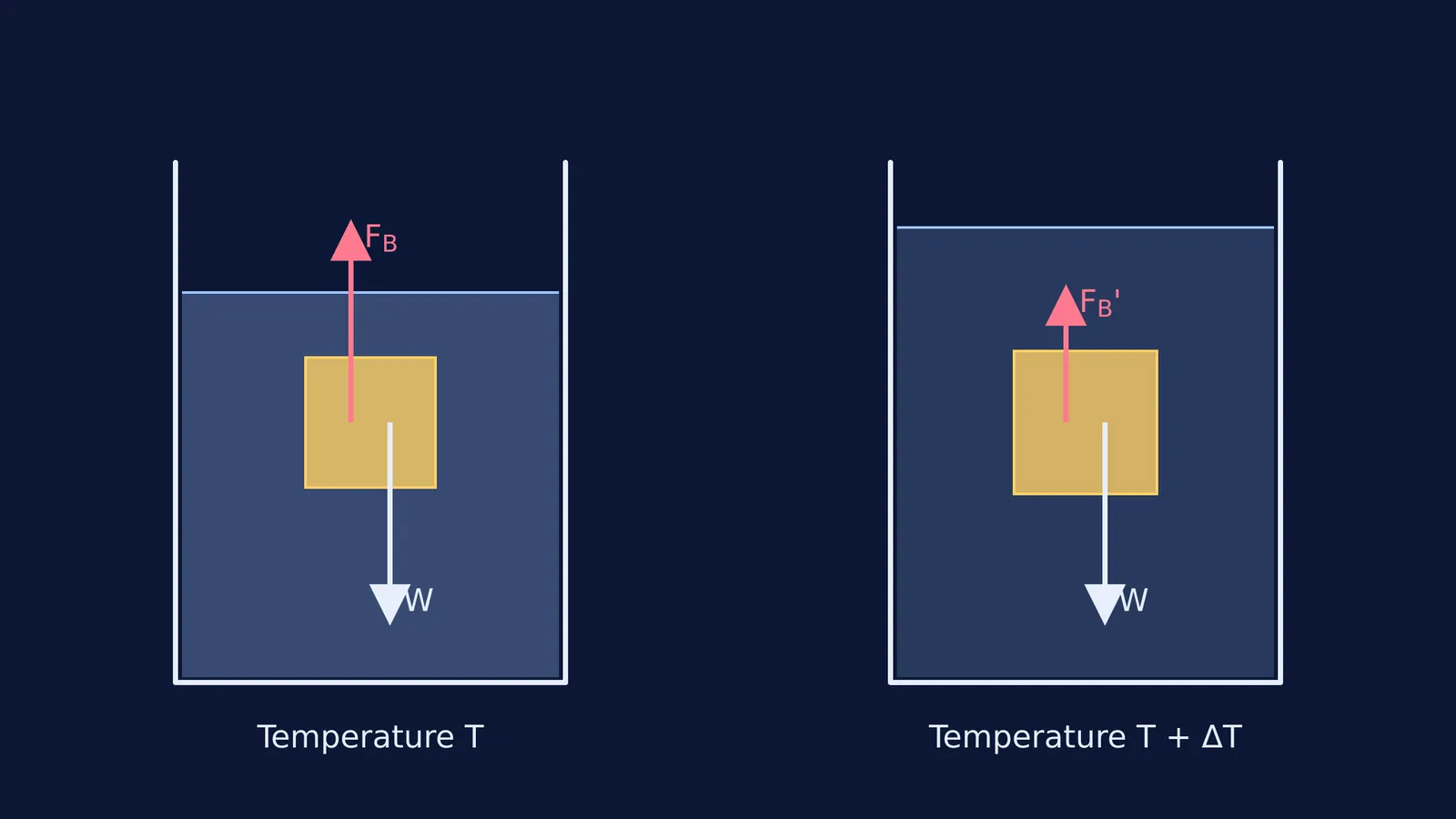
When an object is immersed in a heated bath, you might wonder if the heat changes how well it floats. Heating a system affects both the fluid and the solid submerged within it, shifting the balance of forces.
How does buoyant force change when a liquid is heated?
Archimedes' principle states that the buoyant force on an object equals the weight of the fluid it displaces/Book%3A_University_Physics_I_-_Mechanics_Sound_Oscillations_and_Waves_(OpenStax)/14%3A_Fluid_Mechanics/14.05%3A_Archimedes_Principle_and_Buoyancy). The upthrust (F_B) depends on three factors:
The volume of the submerged solid (V_s)
The density of the liquid (ρ_l)
Acceleration due to gravity (g)
This gives us the fundamental equation: F_B = V_s × ρ_l × g.
Because temperature dictates the volume and density of both the object and the fluid, a change in temperature (ΔT) will inevitably alter the buoyant force.
If these interacting concepts are hard to keep straight, you can review them from first principles in the Fermi Concept Library, which maps out every idea in physics.
What happens to upthrust during thermal expansion?
When heated, matter undergoes thermal expansion. The formula for the thermal expansion of volume is ΔV = β V ΔT/Book%3A_University_Physics_II_-_Thermodynamics_Electricity_and_Magnetism_(OpenStax)/01%3A_Temperature_and_Heat/1.04%3A_Thermal_Expansion), where β (often written as γ in exam problems) is the coefficient of volume expansion.
Let's apply this to both materials in our system:
The solid expands: Its new volume becomes V_s' = V_s(1 + γ_s ΔT). Because it is larger, it displaces more fluid, which on its own would increase the upthrust.
The liquid expands: Its mass stays constant but its volume increases by (1 + γ_l ΔT). This means its density drops to ρ_l' = ρ_l / (1 + γ_l ΔT). Less dense fluid provides less upthrust.
To find the new buoyant force (F_B'), we substitute the new volume and new density into Archimedes' equation:
F_B' = V_s' × ρ_l' × g
F_B' = [V_s(1 + γ_s ΔT)] × [ρ_l / (1 + γ_l ΔT)] × g
Rearranging this shows exactly how the force shifts. Both the solid and the liquid expand; the upthrust changes by the factor (1 + γ_s ΔT)/(1 + γ_l ΔT).
Which effect wins: does the object sink or float higher?
In almost all cases, the coefficient of volume expansion for a liquid (γ_l) is significantly larger than that of a solid (γ_s). The liquid thins out faster than the solid grows.
Because the denominator in our factor is larger than the numerator, the overall fraction is less than 1. Therefore, heating the system causes a net decrease in buoyant force. An object that is barely floating at room temperature may sink if the liquid is heated, as its apparent weight increases.
If you want to test how different materials behave in liquids of changing densities, you can set up virtual experiments in the Fermi Simulation Lab.
A practical framework for upthrust problems
When facing a problem about temperature and buoyancy—such as comparing two immiscible liquids in a manometer or finding the apparent weight of a metal block—use this checklist:
Identify the initial upthrust: Calculate F_B using the baseline temperature properties.
Compare the coefficients: Verify that γ_l > γ_s. If true, expect the final upthrust to be lower.
Apply the expansion factor: Multiply the initial force by (1 + γ_s ΔT)/(1 + γ_l ΔT).
Check for anomalies: Ensure the liquid isn't water between 0°C and 4°C/Book%3A_University_Physics_II_-_Thermodynamics_Electricity_and_Magnetism_(OpenStax)/01%3A_Temperature_and_Heat/1.04%3A_Thermal_Expansion).
If you make a mistake calculating these shifting ratios, the step-by-step solver in the Fermi Problem Library will explain the reasoning of the thermal expansion rather than just printing the final apparent weight. Mastering this interplay of expansion and density is essential for problems like the free expansion of an ideal gas and advanced fluid mechanics.


