On this page
A copied list of precautions tells an examiner very little. A line that fits your apparatus and says why it matters shows you understood the experiment.
In the CBSE physics curriculum for 2026-27, the Class XII practical is marked out of 30: two experiments carry 7 marks each, the practical record 5, one activity 3, the investigatory project 3 and the viva 5. The same document lists the simple pendulum in Class XI, and finding resistance with a metre bridge and the focal length of a convex lens from u and v in Class XII.
What is the difference between precautions and sources of error?
A precaution is something you did during the experiment to protect a reading. A source of error is a limit of the apparatus, method or your senses that can still shift your result after you were careful.
CBSE expects both. In the same curriculum document, its guidelines for visually impaired candidates say the practical file should include "aim, apparatus required, simple theory, procedure, related practical skills, precautions", and that viva questions may cover "precautions, sources of error etc."
How do you write a strong precaution?
Use a three-part line for each precaution:
Do: the exact action, naming the part of the apparatus.
Because: the assumption in the formula that the action protects.
Or else: which way the answer would go wrong.
Weak: "Readings should be taken carefully." Strong: "The swing was kept small, because T = 2π√(L/g) assumes sin θ ≈ θ; a wide swing makes T longer and g come out too small."
Three or four strong lines beat ten generic ones.
Simple pendulum: which precautions matter?
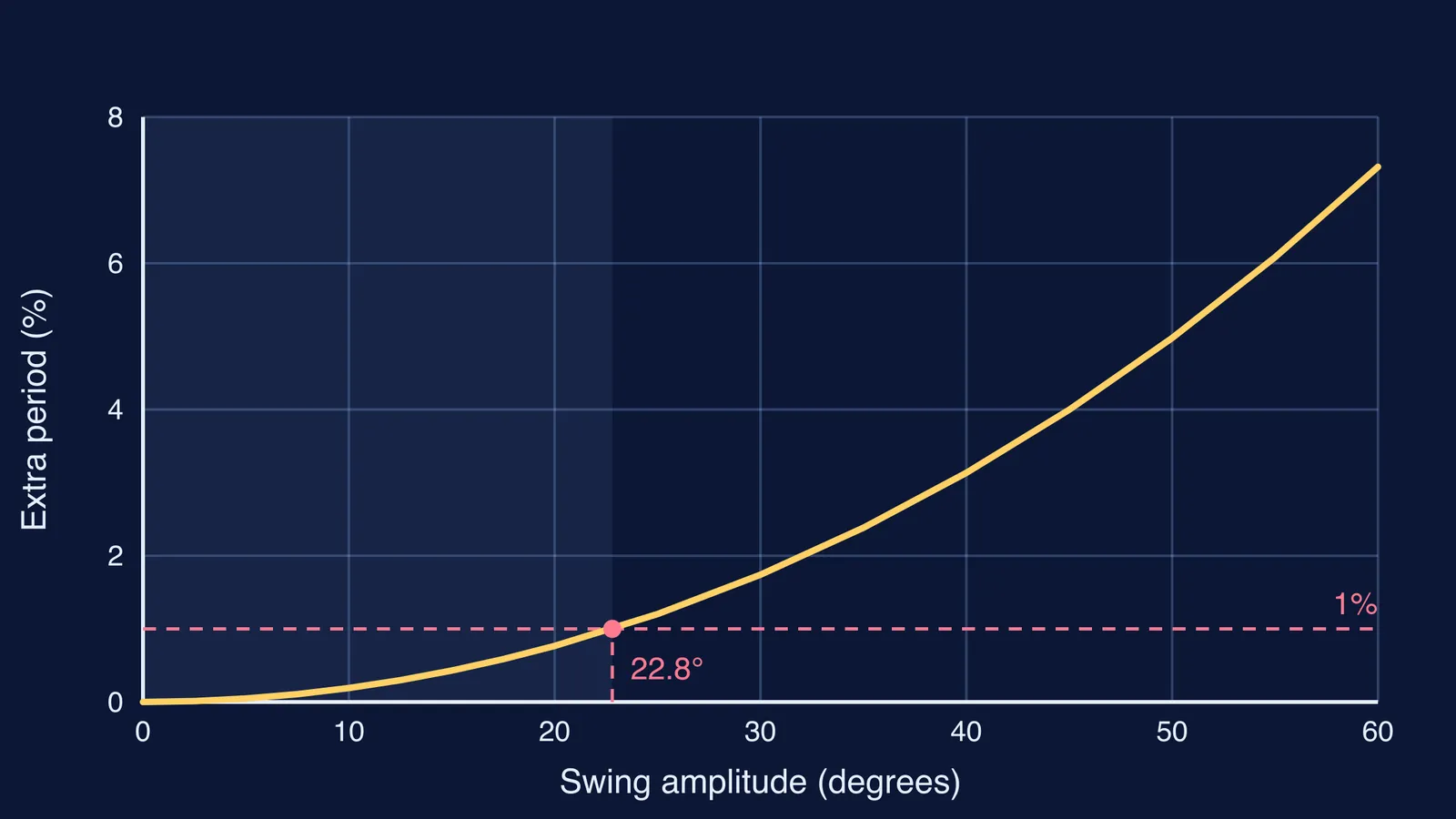
The pendulum formula depends on a small-angle approximation, and HyperPhysics notes that the error in the period is less than 1% for amplitudes below 22 degrees. Using the large-amplitude period series, we worked out that a 10 degree swing makes the period about 0.19% longer, and a 30 degree swing about 1.7% longer.
Keep the swing small and in one plane, with no spinning bob.
Measure effective length to the bob's centre: thread plus hook plus radius.
Clamp the thread firmly in the split cork.
Time 20 oscillations, repeat, and count from zero as the bob passes the mean position.
Sources of error: reaction time at the stopwatch, air resistance, and locating the bob's centre.
Why 20 oscillations? Your reaction delay is about the same for 1 swing or 20, so dividing by 20 shrinks its effect on T. Since g = 4π²L/T², an error in T counts twice; see the percentage error of a squared quantity.
Metre bridge: why keep the balance point near 50 cm?
At balance, X/R = l/(100 − l), with l in cm. If you can read l to 0.1 cm, the percentage error in X works out to 1000/[l(100 − l)] percent. Here is our worked example:
l = 50 cm: 0.4%
l = 20 cm or 80 cm: about 0.63%
l = 10 cm or 90 cm: about 1.1%
So choose R to bring the null point near the middle, and write that reason down.
Clean the wire ends and tighten every terminal and resistance-box plug.
Touch the jockey gently on the wire; never slide it, because scraping changes the wire's thickness.
Close the key only while reading. Resistance rises as wires warm; HyperPhysics gives copper's temperature coefficient as 3.9 × 10⁻³ per °C.
Interchange X and R and average the two results, to reduce the effect of end resistance at the copper strips.
Sources of error: end resistances, a wire that is not perfectly uniform, heating, and a poor jockey contact.
Convex lens by the u-v method: what should you write?
Keep the lens clean and vertical, with needle tips level with its optical centre.
Remove parallax tip to tip, moving your eye sideways until the tips move together.
Apply the index correction to bench distances.
Take object distances on both sides of 2f.
Use one sign convention throughout; in the Cartesian convention HyperPhysics describes, a real object distance is negative and a real image distance is positive.
Sources of error: parallax not fully removed, uprights not exactly vertical, and the lens's thickness, which the thin-lens formula ignores.
A five-minute checklist before you write the record
Write the formula and circle every assumption.
Write one precaution per assumption.
Name each instrument's limit as a source of error.
Say which way each error pushes the result.
Cross out anything you did not do.
For repeated readings, see how to find the mean absolute error from readings. If an assumption is unclear, the Fermi Concept Library has a lesson for every concept in physics. For error numericals, the Fermi Problem Library has worked problems with a step-by-step solver that explains the reasoning rather than printing an answer.
Parents: if practical marks keep slipping, start with our guide on what to do when your child gets low marks in practicals.