On this page
Your child's practical mark is well below their theory mark, and they are not sure why. Before booking extra lab sessions, find out where the marks went. A practical exam is several small tests stapled together, and each is fixed differently.
How are science practical marks split in Class 11 and 12?
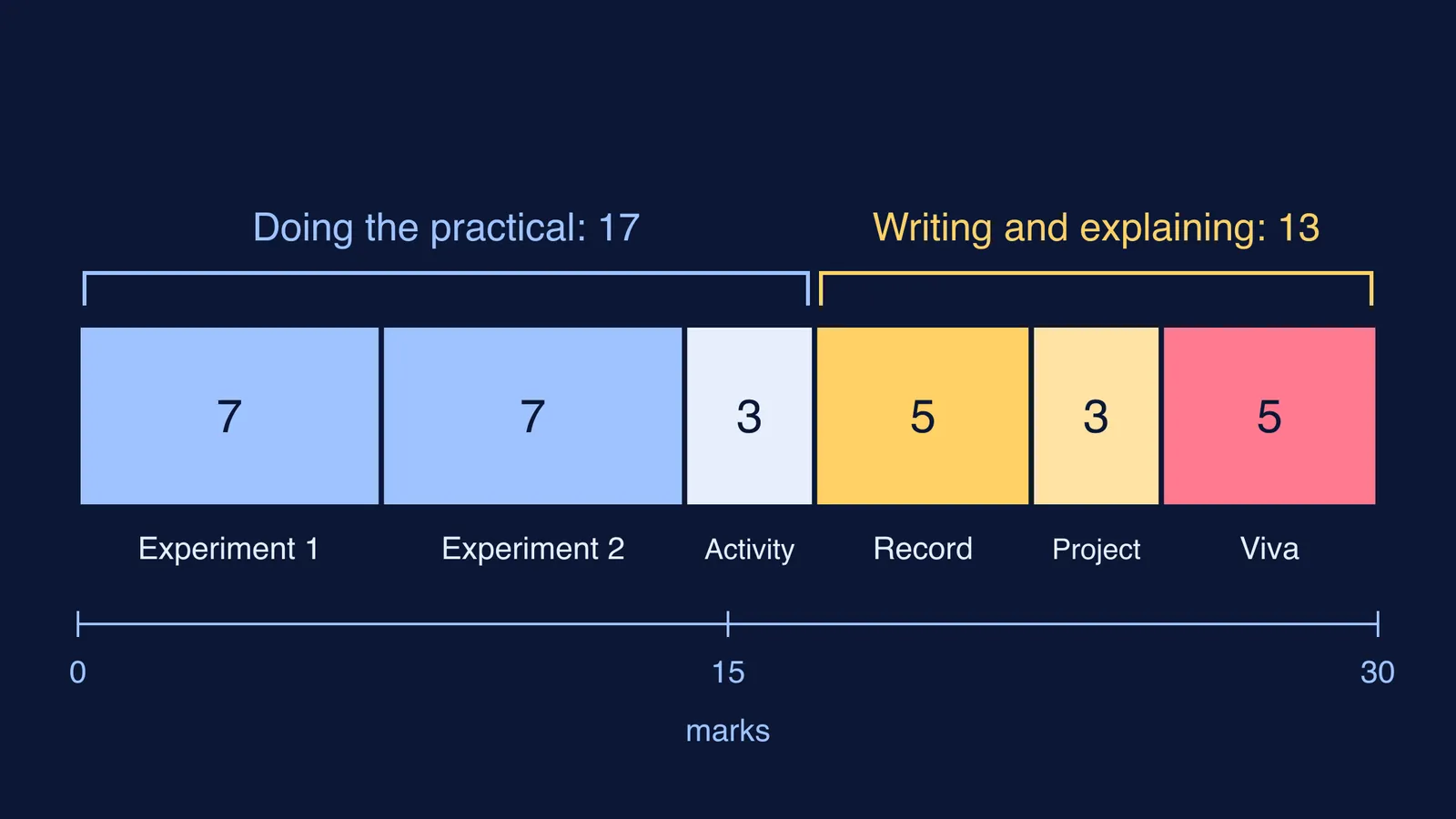
In the CBSE Physics curriculum for 2026-27, the Class 12 practical exam is worth 30 marks and lasts 3 hours. Two experiments carry 7 marks each, one activity carries 3, the practical record carries 5, the investigatory project carries 3 and the viva carries 5. Class 11 Physics uses the same split.
So 13 of the 30 Physics practical marks depend on writing and explaining, not on the readings taken on the day.
Chemistry is weighted differently. The CBSE Chemistry curriculum for 2026-27 gives Class 12 volumetric analysis 8 marks, salt analysis 8, a content-based experiment 6, project work 4, and class record and viva together 4. Other boards differ, so ask the school for yours.
What should I ask my child after low practical marks?
Ask calmly about parts, not the total:
"Which experiment did you get, and did you finish it in time?"
"Was your record complete and signed when you handed it in?"
"What did the examiner ask in the viva? Which question did you get stuck on?"
"Was anything about the apparatus confusing?"
Then sort the answers into three buckets:
Record: missing experiments, no signatures, results without units.
Viva: knew the steps but could not explain why.
Performance: could not set up the apparatus, ran out of time, or lost track of a titration or salt analysis.
If the breakdown does not match what your child remembers, ask the school about the mark politely.
How can my child write a better practical record?
The record is the easiest part to fix, because it is done at home. The CBSE Physics curriculum, in its general guidelines (printed with the practical exam for visually impaired students), says each experiment in the practical file should include the aim, apparatus required, simple theory, procedure, related practical skills and precautions, and should be checked and signed by the internal examiner. That makes a good template for any record. Use this checklist on every page:
Aim copied exactly from the syllabus wording.
A labelled diagram or circuit.
An observation table with units in the column headings.
The calculation shown line by line, ending in a result with units.
Two or three precautions and sources of error specific to that experiment.
The teacher's signature, collected the same week.
If your child drafts with AI help, use it the way we describe in checking a lab record's aim, table and result with AI, then rewrite in their own words.
How do you prepare for practical viva questions?
The same CBSE guidelines say viva questions may cover the basic theory or principle, apparatus, procedure, precautions and sources of error. So most viva questions follow a pattern you can practise. A worked example for the Class 12 metre bridge experiment:
What is the principle? A balanced Wheatstone bridge, where the ratio of resistances on one side equals the ratio on the other.
Why keep the balance point near the middle of the wire? It reduces the effect of end resistance and errors in reading the length.
Why is the wire usually made of constantan or manganin? High resistivity and resistance that changes little with temperature.
Why should you not slide the jockey along the wire? It scrapes the wire and makes its thickness uneven.
Have your child write four questions like these per experiment and answer aloud without notes. You do not need to know the physics; just ask "why?" once more. Our guide on preparing for an oral test or viva has more on the speaking part. When an answer falls apart at the theory, Fermi's Concept Library has a lesson for each concept in physics, chemistry and biology to go back to.
How can a child get more comfortable with lab work?
Some children follow the steps but freeze when something looks different. In a study of 25 typical science lessons involving practical work in English secondary schools, Ian Abrahams and Robin Millar found practical work was generally effective at getting students to do what was intended with equipment, but much less effective at getting them to use the intended ideas to guide what they did and reflect on their data (International Journal of Science Education, 2008).
So practise thinking about the lab, not only doing it:
Before each lab class, your child says what the experiment measures and what result they expect.
At home, practise reading scales on a ruler or measuring jug: the reading, the smallest division, the units.
After each lab class, they explain one reading that surprised them.
For ideas that are easier to see than to read, the Fermi Simulation Lab has interactive simulations your child can explore before facing the real apparatus.
Start tonight with one question about each part of the exam.