

On this page
You timed a pendulum five times and got five different answers. That is normal. NCERT's Class XI Laboratory Manual: Physics says it in capital letters: "THERE IS NO MEASUREMENT WITHOUT ERRORS." The same manual explains that random errors cannot be avoided, but their size can be reduced by measuring the same quantity again and again and taking the mean.
Mean absolute error turns that scatter into one number you can write next to your answer. Here is the whole method on one set of five readings.
What is mean absolute error in physics?
Five terms, each built from the one before:
Mean value: add the readings and divide by how many there are. The international guide on measurement uncertainty, JCGM 100:2008, the GUM, says that for repeated observations made under the same conditions, the arithmetic mean is, in most cases, the best available estimate of the quantity's expected value.
Absolute error of a reading: how far that reading is from the mean, with the sign dropped.
Mean absolute error: the average of those absolute errors.
Relative error: mean absolute error divided by the mean value. It has no unit.
Percentage error: relative error multiplied by 100.
NCERT's current Class 11 chapter, Units and Measurement, uses the same ratio: a mass of 1.02 g known to ±0.01 g has a relative error of (0.01/1.02) × 100% ≈ 1%.
How do you calculate mean absolute error from five readings?
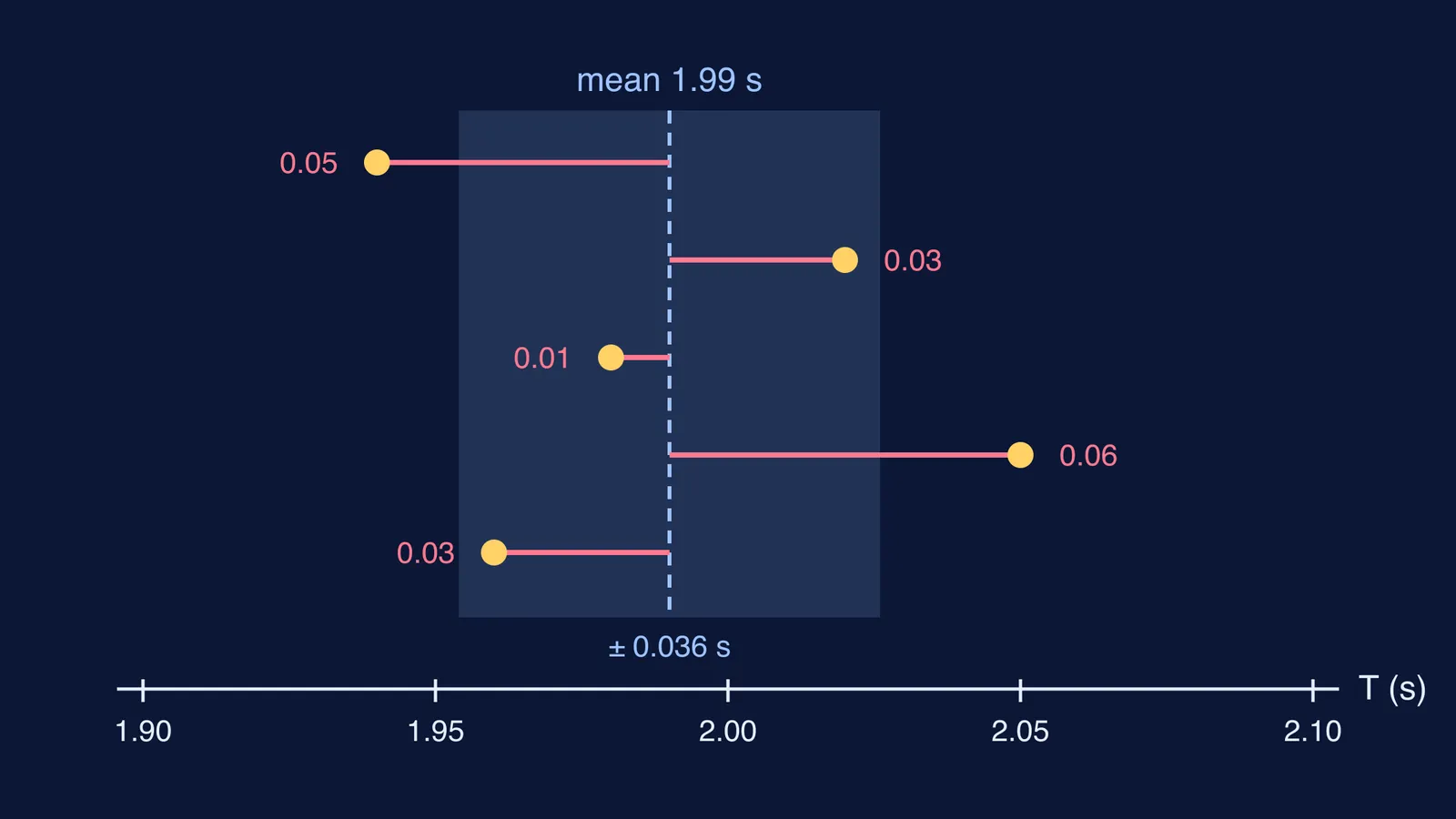
Say you time one oscillation with a stopwatch that reads to 0.01 s and get 1.94 s, 2.02 s, 1.98 s, 2.05 s and 1.96 s.
Step 1, the mean. 1.94 + 2.02 + 1.98 + 2.05 + 1.96 = 9.95 s, and 9.95 ÷ 5 = 1.99 s.
Step 2, the absolute errors, reading by reading:
Reading 1, 1.94 s: |1.94 − 1.99| = 0.05 s
Reading 2, 2.02 s: |2.02 − 1.99| = 0.03 s
Reading 3, 1.98 s: |1.98 − 1.99| = 0.01 s
Reading 4, 2.05 s: |2.05 − 1.99| = 0.06 s
Reading 5, 1.96 s: |1.96 − 1.99| = 0.03 s
Step 3, the errors.
Sum of absolute errors: 0.05 + 0.03 + 0.01 + 0.06 + 0.03 = 0.18 s.
Mean absolute error: 0.18 ÷ 5 = 0.036 s.
Relative error: 0.036 ÷ 1.99 ≈ 0.018.
Percentage error: 0.018 × 100 ≈ 1.8%.
We kept 0.036 s, not 0.04 s, until the end. The NCERT Units and Measurement chapter advises carrying intermediate results to one more significant figure than the least precise measurement, otherwise rounding errors can build up.
How do you write the final answer?
NCERT's lab manual says a reported result needs three things: the measured value, the expected uncertainty and the unit, written as value ± error (units). So:
T = (1.99 ± 0.04) s, or
T = 1.99 s ± 1.8%
Round the error first, then give the value to the same decimal place. Two more checks:
Compare with the least count. The manual treats an instrument's least count as the maximum error in a single direct reading. Our stopwatch reads to 0.01 s but the scatter is 0.036 s, so the limit here is most likely your reaction time, not the stopwatch.
Shrink the error you can control. Time 20 oscillations and divide by 20. The same reaction-time error is spread over 20 swings, so the error in one period becomes 20 times smaller.
Not sure whether your scatter is random or a steady offset such as a zero error? Read our guide to accuracy, precision, random and systematic errors. When you calculate g from T and the length, percentage errors combine, as we explain in error propagation in measurement; the full practical is in the simple pendulum experiment to find g.
Is mean absolute error the same as standard deviation?
No. The GUM uses the experimental standard deviation, and the standard deviation of the mean (standard deviation divided by √n), to show how well the mean estimates the quantity. For our five readings the standard deviation is about 0.045 s and the standard deviation of the mean about 0.020 s.
Both describe spread, but they answer slightly different questions. Use the method your teacher or exam asks for, and say which one you used.
If your answer differs from the book and you cannot see why, the Fermi Problem Library has worked problems with a step-by-step solver that explains the reasoning rather than printing an answer, so you can find the step where yours went off. For the ideas underneath, such as least count and significant figures, the Fermi Concept Library gives every physics concept its own lesson.
Take your next five readings, run them through the three steps above, and write the answer with its ± before you close the file.


