

On this page
You measure a wire's diameter several times with a screw gauge, and the readings agree almost perfectly. Then your teacher points out that the gauge does not read zero with its jaws shut. Your readings were precise but not accurate. Here is the difference, and the answer to the viva question that follows: will more readings fix it?
What is the difference between accuracy and precision?
Accuracy is the closeness of agreement between a measured value and the true value of the quantity, as defined in the International Vocabulary of Metrology (VIM), entry 2.13.
Precision is the closeness of agreement between values obtained by repeated measurements of the same thing under specified conditions, according to VIM entry 2.15. The same entry notes that precision is sometimes incorrectly used as a synonym for accuracy.
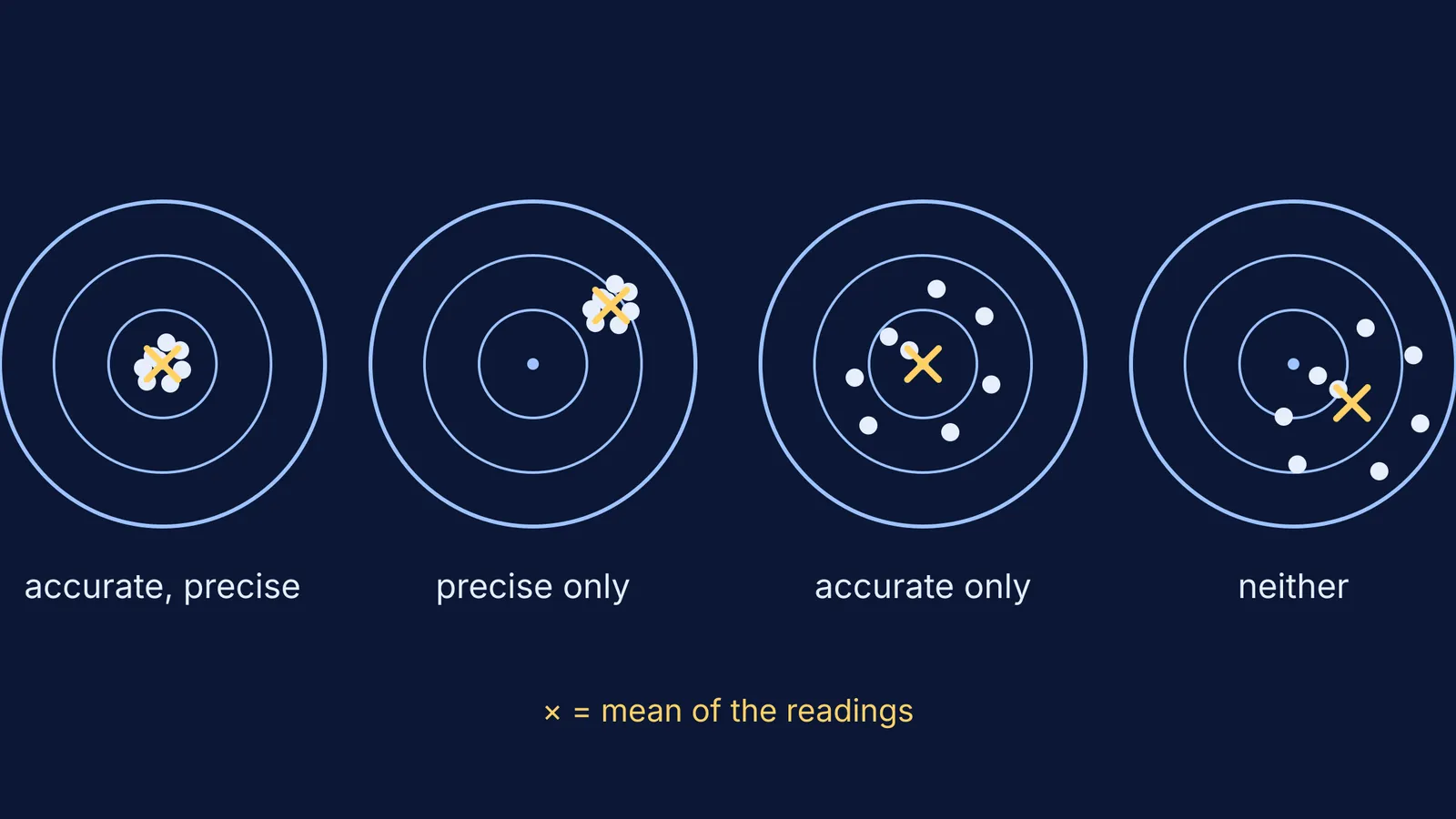
On a target, a tight cluster off to one side is precise but not accurate; a wide scatter centred on the bullseye is accurate but not precise.
What are systematic and random errors?
A systematic error is the part of a measurement error that stays constant, or changes predictably, when you repeat the measurement (VIM 2.17). A random error is the part that varies unpredictably from one repeat to the next (VIM 2.19).
Examples from Class 11 and 12 practicals:
Systematic: zero error in a vernier calliper or screw gauge, a metre scale with a worn end, always reading a scale from above instead of at eye level.
Random: your reaction time on a stopwatch, small wobbles in a pendulum's swing, judging where a pointer sits between two divisions.
Systematic error spoils accuracy; random error spoils precision. The vocabulary says it directly: trueness, how close the long-run average gets to the reference value, "is inversely related to systematic measurement error, but is not related to random measurement error" (VIM 2.14).
Why do repeat readings reduce only random error?
Random errors push some readings up and some down, so they tend to cancel when you average. The international Guide to the Expression of Uncertainty in Measurement says it is not possible to compensate for random error, but "it can usually be reduced by increasing the number of observations" (JCGM 100:2008, section 3.2.2).
A systematic error pushes every reading the same way, so the average keeps it. The same guide says that once a systematic effect is recognised, a correction can be applied to compensate for it (section 3.2.3). You fix it by finding it, not by repeating.
Worked examples: do more readings make a result more accurate?
Timing a pendulum. The same guide gives the variance of a mean of n readings as the single-reading variance divided by n (section 4.2.3, equation 5), so the spread of the mean shrinks as 1/√n. Suppose your stopwatch times for 20 oscillations scatter by about 0.2 s.
Mean of 4 readings: spread about 0.2/√4 = 0.1 s.
Mean of 16 readings: about 0.2/√16 = 0.05 s.
Halving it again needs 64 readings, so returns shrink fast.
If the stopwatch itself runs 1% fast, all 64 readings are 1% too long, and so is their mean.
The screw gauge. Say the five readings are 0.52, 0.54, 0.53, 0.55 and 0.51 mm, and the gauge shows +0.03 mm with its jaws closed. The mean is 2.65 ÷ 5 = 0.53 mm. Fifty more readings would still average about 0.53 mm, because the zero error sits inside every one. The fix is the correction: 0.53 − 0.03 = 0.50 mm. If zero error signs trip you up, see our guide to reading a vernier calliper and screw gauge with zero error.
How do you explain accuracy and precision in a lab viva?
Examiners want a definition, an example from your own experiment, and the fix. A script you can adapt:
"Accuracy or precision, what's the difference?" "Accuracy is how close my result is to the true value. Precision is how close my repeated readings are to each other. Readings can agree well and still all be wrong."
"Why did you take several readings?" "To reduce random error, like my reaction time on the stopwatch. Averaging cancels errors that go both ways."
"So is your answer accurate?" "Not from averaging alone. Averaging does not remove systematic error, so I checked the zero error first and corrected for it."
"Name a systematic error here." Pick one you actually checked, such as zero error, parallax or end correction.
For the rest of the practical, read how to prepare for CBSE Class 12 physics practicals and viva, and for the step after this one, how to combine absolute and percentage errors.
Before recording readings: bring the instrument to zero and note any zero error with its sign, read every scale at eye level, take several repeats and note their spread, and correct the mean for known systematic errors before calculating anything else.
If the definitions blur under exam pressure, the Fermi Concept Library gives every physics concept its own lesson, and the Fermi Problem Library has worked problems with a step-by-step solver that explains the reasoning, so you can practise error questions.


