

On this page
When you measure a quantity in physics, your measurement is never exact. There is always a tiny margin of uncertainty, known as the absolute error. But what happens to that error when you plug your measurement into a formula and square it?
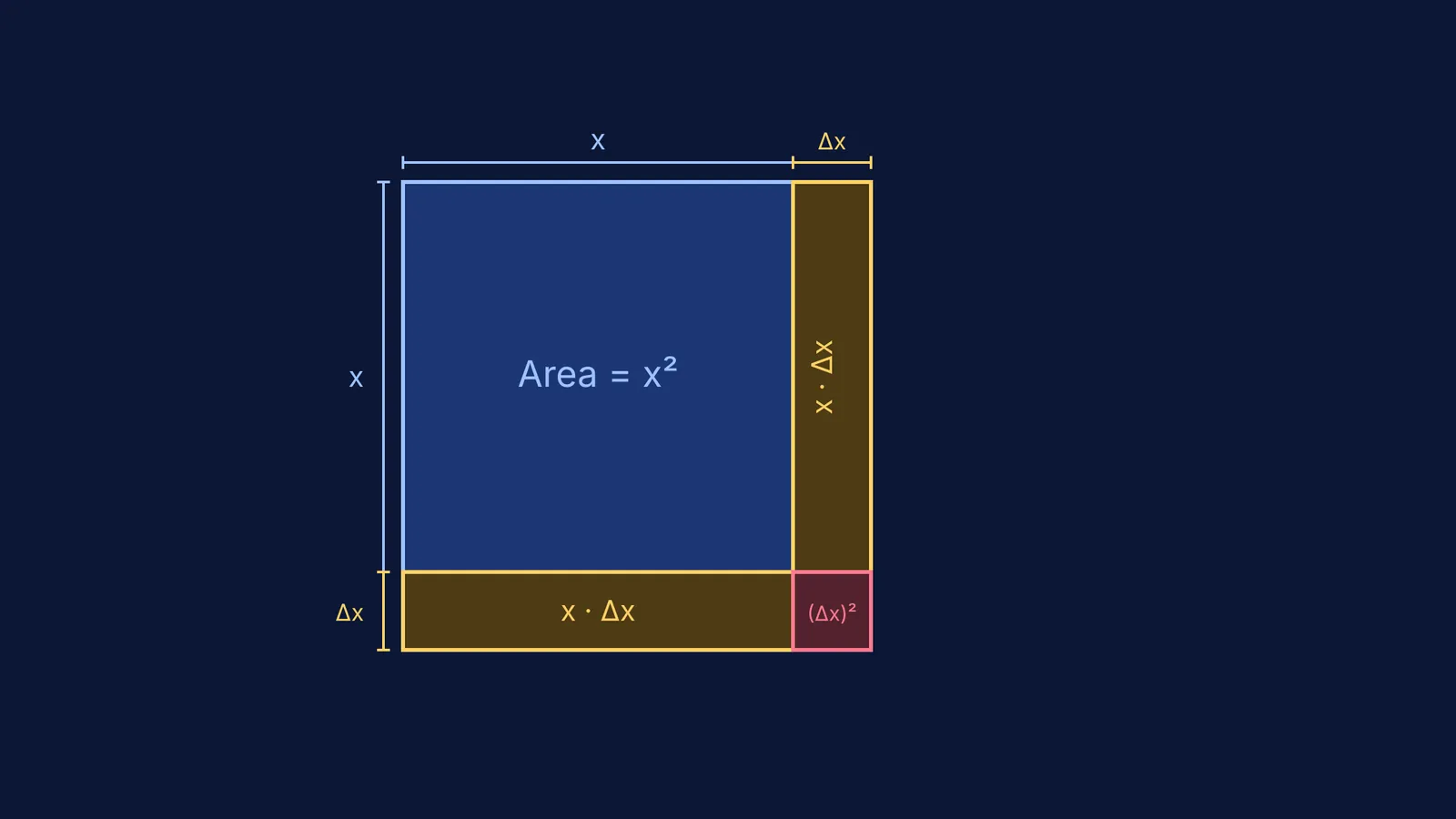
Think about calculating the area of a square with a side length x. The true area is x². If your ruler slips and you make a small error Δx in measuring the side, the area you calculate becomes (x + Δx)². When you expand this bracket using basic algebra, you get x² + 2xΔx + (Δx)².
The original area was x². The extra bit—the absolute error in your area—is mostly the 2xΔx term, because the tiny corner square (Δx)² is so small it can safely be ignored. As the diagram at the top of this page shows, this error forms two rectangular strips along the edges of your square. Because there are exactly two strips of area x·Δx, the relative error is doubled.
Why does percentage error double when a quantity is squared?
The mathematical proof for this doubling rule comes directly from calculus. According to OpenStax Calculus Volume 1, if you have a quantity y = x², taking the differential to find the small change gives dy = 2x dx.
To find the relative error, you divide the absolute error (dy) by the original value (y). So, the ratio dy/y becomes (2x dx) / x². When you cancel out one x from the top and bottom, this simplifies perfectly to 2(dx/x).
This calculus step proves that the relative error in a squared quantity is precisely 2 times the relative error of the base measurement. When you convert this to percentages by multiplying by 100, a 1% error in measuring a side length automatically becomes a 2% error when you square it to find an area.
If you are stuck on similar derivations or want to see how these math rules apply across science, the Fermi Concept Library maps every concept in physics and mathematics so you can trace the logic step by step.
What is the formula for percentage error in powers?
This calculus rule gives us a general formula for any measured quantity raised to a power. If a physical result Z is defined as Z = Aⁿ, the rule states:
Relative error in Z = n × (Relative error in A)
You simply multiply the percentage error of the measurement by the power it is raised to. This works for cubes, square roots (where the power is 1/2), and negative powers.
If a formula has several terms, such as Z = A² / B, you add the percentage errors together. Errors always add up, even when you divide quantities, because physicists always calculate the maximum possible error. A common mistake students make is subtracting the error of B because it is in the denominator. You must never subtract errors; a mistake in B makes your final answer worse, not better.
This is a common place to lose marks in numerical problems, so it helps to use dimensions to check your physics answers before you submit them.
How do you calculate percentage error in a pendulum experiment?
A classic experiment in high school physics is using a simple pendulum to find g, the acceleration due to gravity. According to OpenStax University Physics, the time period T of a simple pendulum is:
T = 2π √(L/g)
To find g, you square both sides to remove the square root and rearrange the formula:
g = (4π² L) / T²
Notice that the string length L has a power of 1, but the time period T has a power of 2 because it is squared in the denominator. Since 4π² is a constant mathematical number, it has no measurement error. Using our power rule, the percentage error in g is the percentage error in L plus twice the percentage error in T.
Let's work through an exam-style example:
You measure the length L of the pendulum with a percentage error of 1%.
You use a stopwatch to measure the time period T with a percentage error of 2%.
Percentage error in g = (Percentage error in L) + 2 × (Percentage error in T)
Percentage error in g = 1% + 2(2%) = 5%
Because the time period T is squared in the gravity formula, its small 2% measurement error contributes a significant 4% to the final answer. This proves why timing the pendulum accurately is far more critical than measuring its length in the lab. Usually, students measure the time for 20 oscillations instead of just one to reduce this crucial time error.
If you are practising these calculations at home, it pays to solve physics problems step by step so you do not miss the power multiplier. Checking symbols and powers is crucial in exams. If you forget whether a term in an equation is squared or cubed, you can ask an AI what each symbol means to remind yourself of the formula's exact structure before you start combining errors.


