

On this page
When you first encounter a new physics or mathematics equation, it can look like an impenetrable string of letters. Before you can use a formula to solve a problem, you have to know exactly what every part of it stands for.
Asking a conversational AI to break down a formula is one of the most efficient ways to start. But simply reading a list of definitions will not make the knowledge stick. To truly understand the mathematics, you need to engage in a process cognitive scientists call self-explanation.
Why does a formula look like alphabet soup?
A formula is a highly compressed physical model. When you look at the equation of trajectory of a projectile, the letters hide layers of physical reality. A single variable might represent a vector with a specific direction, a fundamental constant of the universe, or a quantity that changes over time as an object moves.
If you try to memorise the string of letters without unpacking what they represent, you will quickly hit a wall when an exam question changes the scenario slightly. You have to translate the mathematical shorthand back into physical ideas. Understanding what each symbol means is what prevents you from plugging the wrong numbers into the right equation.
What does each symbol mean in a formula?
When you are stuck on an equation, you can use an AI to unpack it. To get a useful breakdown, you need to ask for three specific things for every symbol: its formal name, its standard scientific unit, and its physical meaning in plain language.
Try pasting this exact prompt into your AI tool alongside your formula:
"What does each symbol mean in this formula? For every symbol, give me a bullet point with its name, its SI unit, and a one-sentence explanation of what it represents in the physical world."
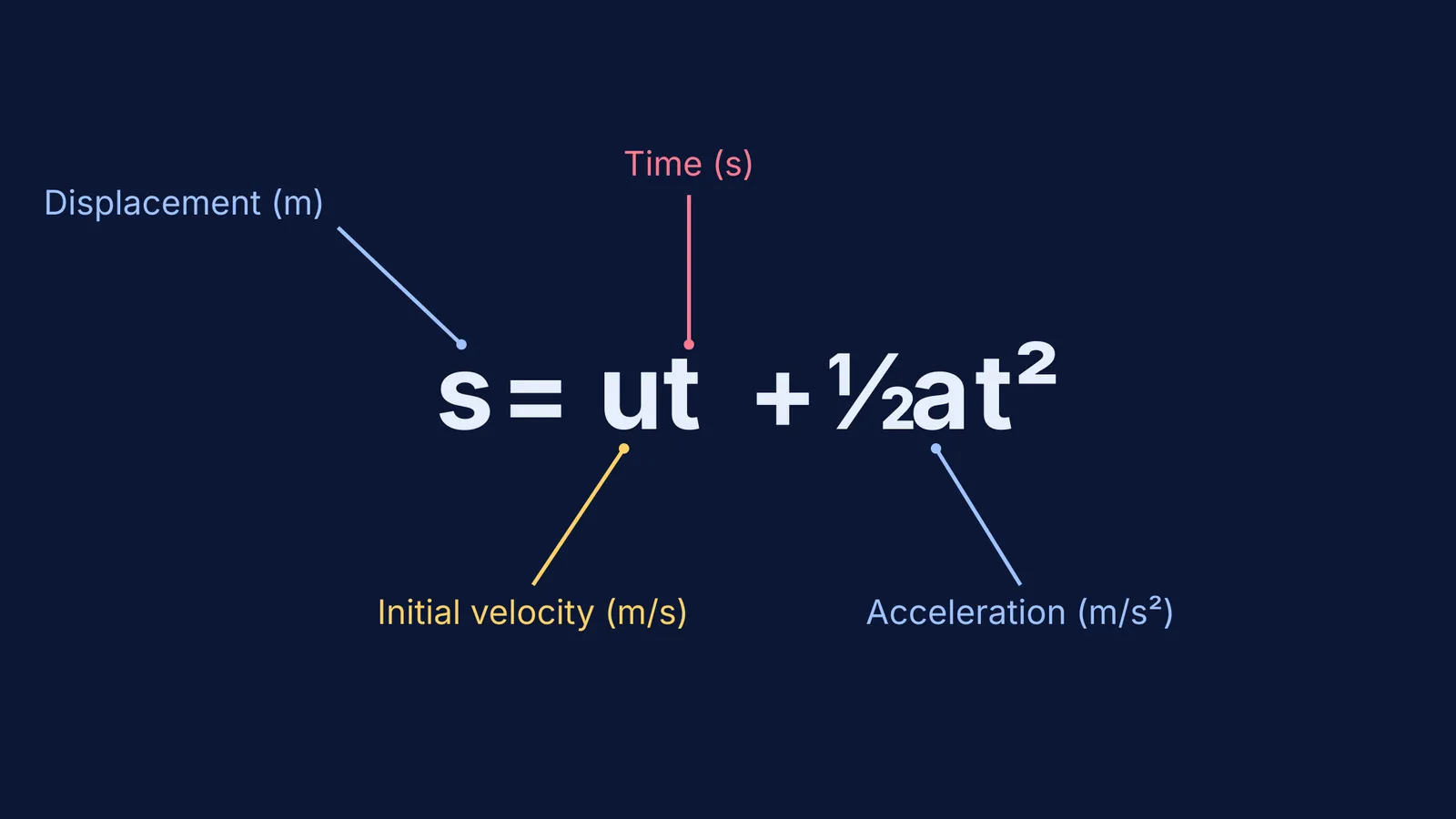
For example, if you ask about the formula for distance in the nth second, the AI will tell you that u is not just a letter, but the initial velocity in metres per second, representing how fast the object was moving when the clock started. If you ask about the E = 1240/λ shortcut, the AI will clarify that λ must be in nanometres for the constant to work, saving you from a common unit-conversion mistake.
Why must you explain it back in your own words?
Getting the definitions is only the first step. The critical part of learning happens when you put the AI's explanation away and try to reconstruct the logic yourself. Cognitive scientists call this active generation of meaning the "self-explanation effect".
In a landmark 1989 study on how students learn from worked examples in physics, researcher Michelene Chi and her colleagues at the University of Pittsburgh measured exactly how much this matters. The study found that successful students generated 15.3 self-explanations per worked example, whereas poor solvers generated only 2.8.
The successful students did not just read the text and nod along; they constantly asked themselves why a mathematical step was taken and what the physical conditions were for applying a particular formula. By explicitly explaining the reasoning to themselves, they built robust mental models that allowed them to tackle completely new problems successfully.
The self-explanation checklist
To apply this research to your own study habits, use this framework every time you learn a new formula. After the AI gives you the definitions, hide the screen and ask yourself these three questions:
What is the underlying principle? Name the physical law the formula represents (for example, conservation of energy or Newton's second law).
What are the boundary conditions? When are you allowed to use this formula, and when will it give you the wrong answer? (For example, kinematic equations only work when acceleration is constant).
What is the physical map? Point to a diagram of the problem and map each mathematical symbol to a physical part of the drawing.
How does an AI tutor build on this strategy?
Most chatbots simply answer questions by printing a list of definitions, leaving it up to you to force yourself to study actively. Fermi's AI tutor takes a different approach because it teaches rather than answers.
Fermi holds a line of reasoning across a whole session, notices where a student is stuck, and decides whether to explain, ask, or show. If you bring a confusing formula or problem set to the platform, Fermi works out what you already know, builds a plan for the session, and teaches through it — writing on a board, drawing the figure, and checking your understanding as it goes.
Instead of just handing you the final equation, it will ask you to identify the physical principles at play and the units involved, ensuring you generate the self-explanations that lead to real mastery.


