On this page
Run a ceiling fan on speed 1 with an old box-type regulator, then touch the regulator plate. It is warm. That warmth is electricity you paid for that never reached the fan.
Why does a fan regulator get hot?
An old resistor-type regulator puts a coil of resistance wire in series with the fan. The resistor takes a share of the supply voltage, so the fan slows, but the same current flows through it.
The NCERT Class 10 science textbook gives electric power as P = VI = I²R = V²/R (NCERT Class 10 Science, Chapter 11: Electricity). The same chapter states Joule's law of heating, H = I²Rt, and notes that unwanted heating converts useful electrical energy into heat. In the regulator, every joule of I²R heat is a loss. For more on the law, see our explainer on the heating effect of current, power and fuses.
An electronic regulator works on the same idea as an electronic light dimmer: a semiconductor switch (a TRIAC) turns the supply on at an adjustable moment in each AC half-cycle, and because it switches instead of absorbing part of the voltage, very little power is wasted (Wikipedia: Dimmer).
How much electricity does an old fan regulator waste?
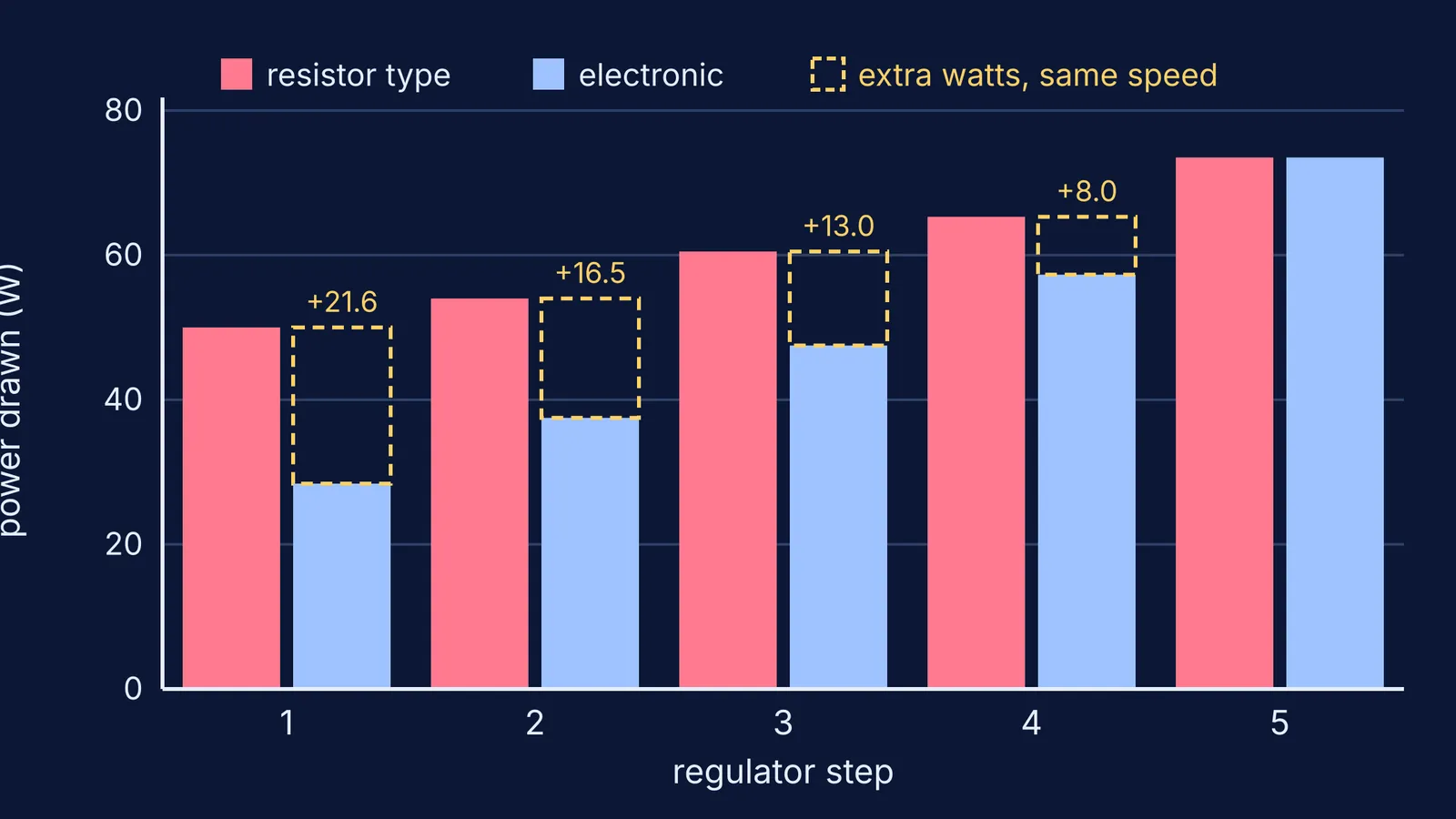
The Energy Management Centre, Kerala, under the state's Department of Power, ran a 1400 mm ceiling fan through a 5-step resistive regulator and then a 5-step electronic one, matched the fan's voltage and speed at each step, and measured the power drawn (EMC Kerala technical fact sheet on ceiling fan speed control). Same fan, same speed:
Step 1 (140 V, 176 rpm): 50 W with the resistor type, 28.4 W with the electronic one
Step 2 (160 V, 206 rpm): 54 W vs 37.5 W
Step 3 (180 V, 233 rpm): 60.5 W vs 47.5 W
Step 4 (200 V, 258 rpm): 65.3 W vs 57.3 W
Step 5 (230 V, 283 rpm): 73.5 W for both
At full speed there is no difference, because the fan gets the full supply voltage. The waste is largest at the lowest speed: 21.6 W extra at step 1. EMC Kerala put the average saving from an electronic regulator at 27% across the reduced speeds.
Worked example: check the waste with P = I²R
Model step 1 with Class 10 tools. Treat the fan as a simple resistor taking 28.4 W at 140 V, the electronic-regulator reading from the EMC Kerala table.
Current through the fan: I = P / V = 28.4 / 140 ≈ 0.203 A.
Voltage left for the regulator's resistor: 230 − 140 = 90 V.
Resistance of that step: R = V / I = 90 / 0.203 ≈ 444 Ω.
Heat in the resistor: P = I²R = (0.203)² × 444 ≈ 18.3 W.
The model predicts about 18 W against a measured 21.6 W. It is not exact because a fan is an AC motor, not a plain resistor, so the two voltages do not simply add. The lesson holds: on the lowest step, a resistor regulator turns more than a third of what you pay for into heat.
For more series-circuit power numericals, the Fermi Problem Library has worked problems with a step-by-step solver that explains the reasoning rather than printing an answer.
How many units does it waste in a month?
Energy is power × time, and one unit on your bill is 1 kWh = 3.6 × 10⁶ J (NCERT Class 10 Science, Chapter 11). Using the step 1 readings from EMC Kerala, say the fan runs on step 1 for 8 hours a night for 30 days (240 hours):
Resistor type: 50 W × 240 h = 12,000 Wh = 12.0 kWh
Electronic: 28.4 W × 240 h = 6,816 Wh ≈ 6.8 kWh
Lost to the resistor: 21.6 W × 240 h = 5,184 Wh ≈ 5.2 kWh
That is about 5.2 units a month per fan. At the ₹3.00 per kWh used in an NCERT textbook example, it is about ₹15.55 a month. Our guide to calculating an electricity bill in kWh shows how to read your real rate.
Should you replace a resistor-type fan regulator?
Note how many hours each fan runs below full speed. At top speed, a new regulator saves almost nothing (step 5).
If it runs slow for long hours, a swap pays. EMC Kerala estimated payback in under 10 months, assuming 12 hours a day, a ₹200 regulator and ₹3 per unit, so redo the sum with your own figures.
Have a licensed electrician fit a good-quality step-type electronic regulator. Do not open a switchboard yourself.
Your fan's capacitor does a different job: see why ceiling fans need a capacitor to start spinning. If series circuits and Joule heating still feel shaky, the Fermi Concept Library gives each concept in physics its own lesson and its place in the map.