On this page
A creaking door is physics you can hear: two metal surfaces inside the hinge take turns gripping and letting go.
Why do door hinges creak?
A hinge is a metal pin turning inside curled metal knuckles. The NCERT Class 8 Friction chapter says even surfaces that look very smooth have a large number of minute irregularities that lock into one another. It treats the force to start an object moving from rest as a measure of static friction, and the force to keep it moving as a measure of sliding friction. Sliding friction is slightly smaller than static friction (NCERT Class 8 Science, Chapter 9).
That small gap causes the creak. In a 1997 paper, Nonlinear dynamics of dry friction, Franz-Josef Elmer of the University of Basel explains that when kinetic friction is less than static friction, the surfaces alternately stick and slip: "This jerky motion leads to the everyday experience of squeaking doors and singing violins."
What is stick-slip friction, step by step?
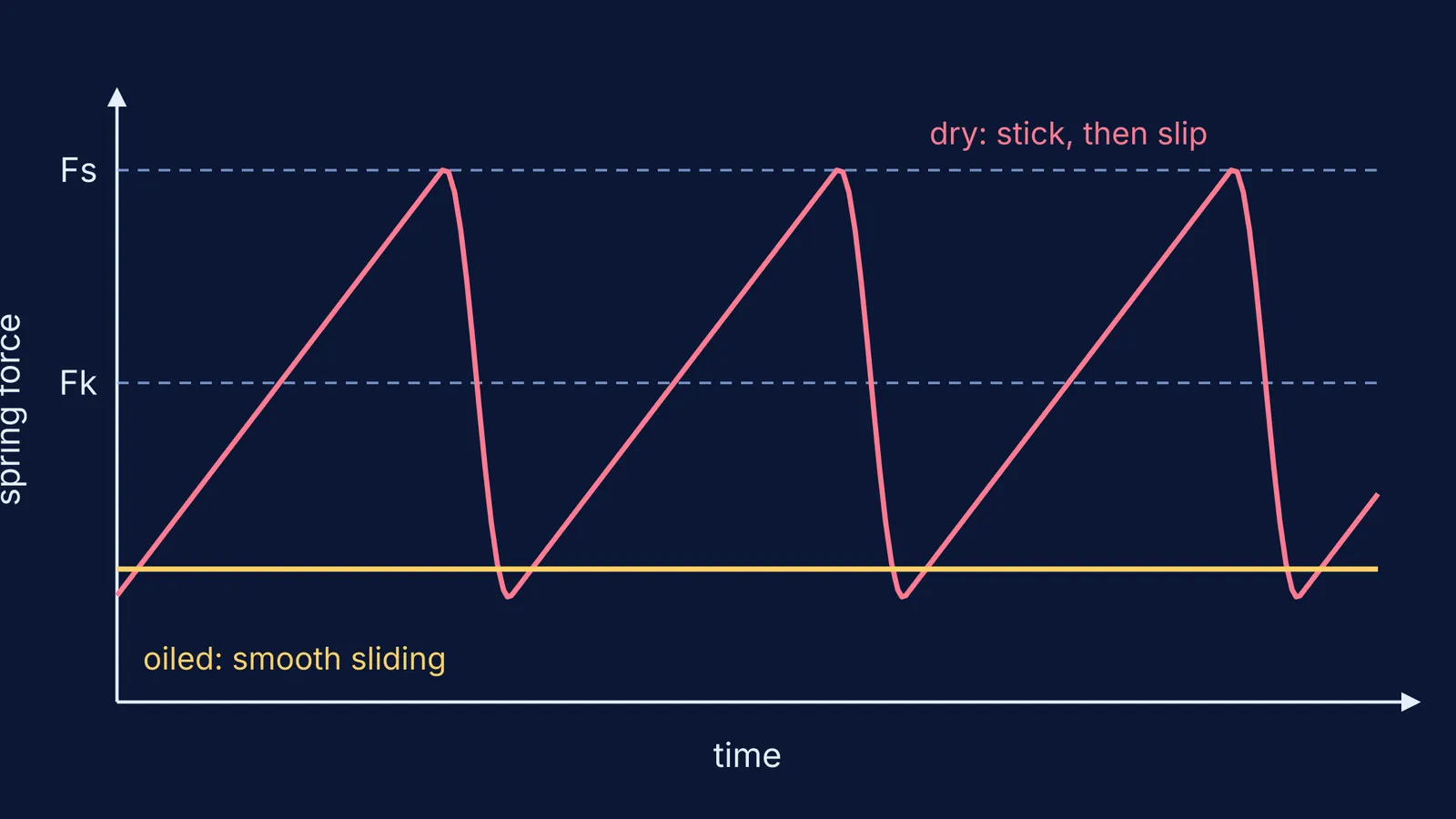
Stick-slip friction is a repeating cycle: two surfaces grip under static friction, force builds up, they jerk forward under the weaker sliding friction, then grip again (Elmer, 1997). In a door:
Stick: you push, the pin does not turn yet, and the door and hinge flex slightly, storing the push like a spring.
Slip: the stored force passes the static limit, the pin breaks free, and because sliding friction is weaker it jumps forward.
Stick again: the pin slows and locks. A run of these jolts shakes the door, and you hear a creak.
Elmer's spring-and-block model makes this precise. Each sticking phase usually lasts 2(Fs − Fk)/(κv), where Fs and Fk are the static and kinetic friction forces, κ is the spring's stiffness and v is the sliding speed (Elmer, 1997). The bigger the gap between static and sliding friction, the longer each stick and the bigger each jump; stick-slip needs Fk to be strictly less than Fs. Elmer also notes that above a critical speed stick-slip disappears: "squeaking of doors can be avoided by moving them faster."
To watch an idea move rather than read about it, the Fermi Simulation Lab has interactive simulations for ideas that are easier to see than to read.
How does oil stop a hinge from creaking?
NCERT uses this exact example: when a few drops of oil are poured on the hinges of a door, the door moves smoothly (NCERT Class 8 Science, Chapter 9). Oil, grease or graphite forms a thin layer, so the moving surfaces do not rub directly and interlocking is avoided to a great extent. Substances that reduce friction are called lubricants.
An NPTEL tribology course FAQ adds the stick-slip part: stick-slip comes from a large difference between static and kinetic friction, and the best way to reduce it is a lubrication mechanism that keeps that difference negligible. So a suitable lubricant does two jobs: it lowers friction and it shrinks the gap that drives the jerks. You can see that gap as the drop on a graph of friction against applied force, and the same physics explains why chalk squeaks on a blackboard.
Which lubricant should you use on a door hinge?
A Bob Vila guide to fixing a squeaky door calls multipurpose oil and silicone spray the best options. Its guide to lubricants for door hinges compares the rest:
Silicone spray: light and easy to apply, but collects dust and dirt and wears off sooner.
White lithium grease: lasts longer than silicone and resists dust, but cold can make it solidify.
Graphite powder: very effective, but messy, and can stain carpets and woodwork.
Nothing else at home: petroleum jelly, bar soap or cooking oil will do for now, but the guide says these are not permanent fixes.
Whatever you choose, use a little: big globs of oil and grease collect dirt, dust and lint (Bob Vila). For more, see ways to increase and decrease friction, with real numbers.
How do you oil a squeaky hinge properly?
These steps follow the Bob Vila repair guide:
Spray lubricant at the seams between the hinge knuckles, then open and close the door a few times to work it in.
If it still creaks, tap the pin out with a nail and hammer.
Clean the pin with a grease-cutting cleaner or steel wool, and the knuckles with a cotton swab.
Put a few drops of multipurpose oil into the hinge holes, holding a rag underneath.
Tap the pin back in and open and close the door a few times to spread the oil.
If the creak survives all this, the hinge may be bent; the guide suggests tapping the bent knuckle back into shape or replacing the hinge. Ask an adult before using a hammer on a door.
If static and sliding friction still feel fuzzy before a test, the Fermi Concept Library gives every physics concept its own lesson and shows its place in the map.