On this page
Friction is the force that resists one surface sliding over another. Whether you want more of it or less depends on the job. A bus braking on a wet road in Mumbai needs all the grip it can get, while the fan above your desk runs best with as little friction as possible. Every method on the textbook list does one of three things: it changes the materials in contact, changes what sits between them, or swaps sliding for rolling.
What decides how much friction there is?
For two dry surfaces, the friction force is roughly μN, where N is the normal force pressing them together and μ, the coefficient of friction, depends on the pair of materials. OpenStax University Physics explains that the real contact area is a tiny fraction of the total "because only high spots touch", and that friction depends on the normal force and the materials, not on the area in contact. We go through that last point in why friction does not depend on area of contact.
So you have three levers: μ (the materials and their surfaces), N (how hard they press together), and the type of motion (sliding or rolling).
How can you increase friction?
Treads and grooves. Grooves on tyres and shoe soles give water somewhere to go, so rubber stays on the road. TyreSafe, a UK tyre safety charity, says the grooves "channel water away to reduce the risk of aquaplaning".
Sand and grit. Locomotives carry sandboxes that drop sand on the rail in front of the driving wheels "in wet and slippery conditions and on steep grades to improve traction" (Wikipedia: Sandbox (locomotive))). Sand on a slippery path works the same way.
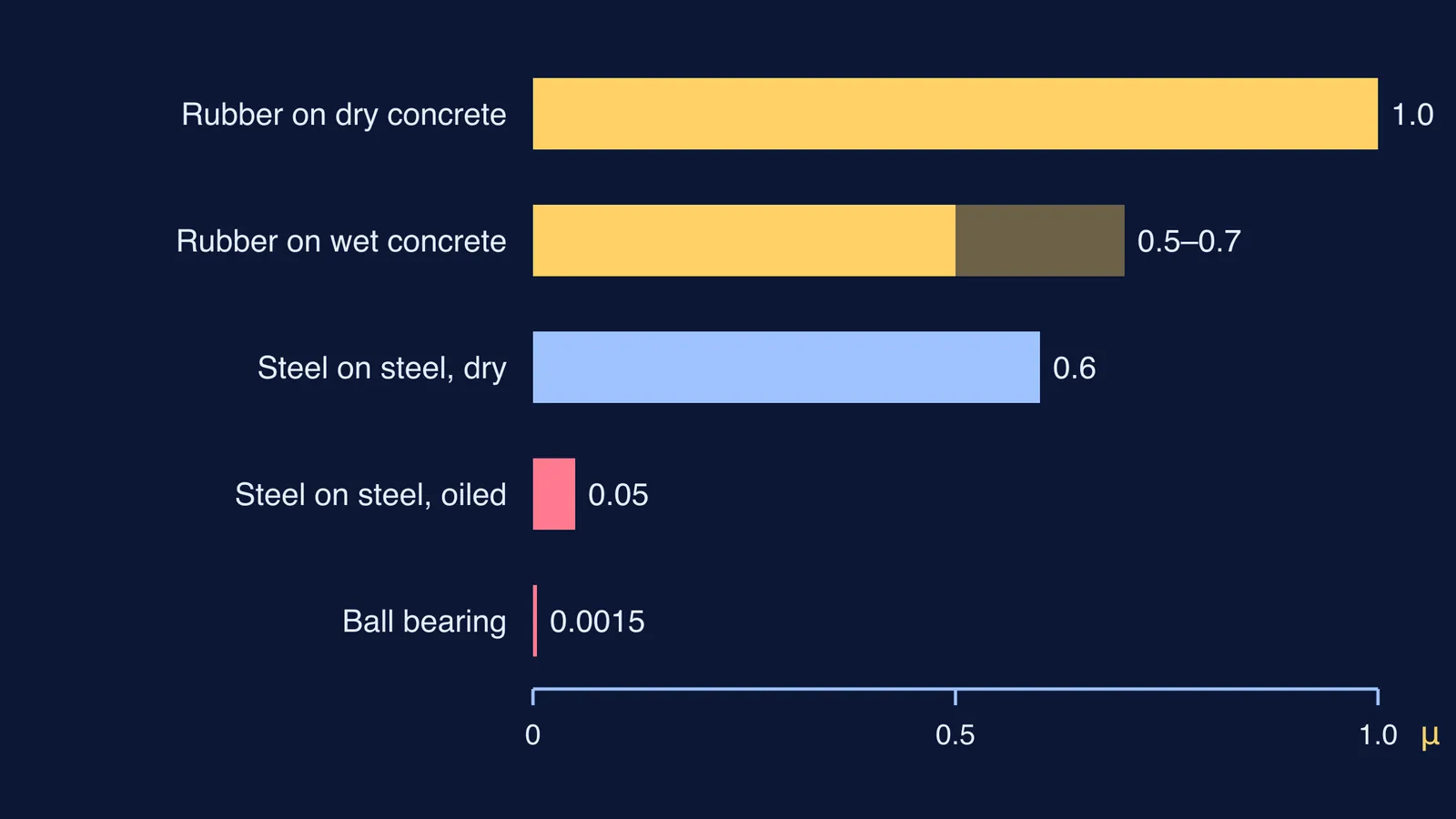
Grippier materials. In the OpenStax friction table, shoes on wood have a static coefficient of 0.9, while shoes on ice have 0.1. Rubber grips on a cricket bat handle and chalk on a gymnast's hands use the same lever.
Pressing harder. Friction grows with N, which is how brake pads work: they clamp hard onto the spinning disc.
Tread depth also matters. TyreSafe reports tests by MIRA, a UK technical organisation, in which cars with 1.6 mm of tread had up to 44% longer braking distances in the wet than cars with 3 mm (TyreSafe tread depth guide).
How can you reduce friction?
Oil and grease. In the OpenStax table, dry steel on steel has a static coefficient of 0.6, and oiled steel on steel has 0.05, about one-twelfth. The lubricant keeps the high spots apart. For the history, read how Elijah McCoy's automatic lubricator kept engines oiled while they ran.
Ball bearings and wheels. Rolling replaces rubbing. A bearing maker, American Roller Bearing, lists a friction coefficient of 0.0015 for a lubricated deep groove ball bearing. That is why ceiling fans, cycle hubs and skateboard wheels run on bearings.
Smooth or slippery surfaces. Teflon on steel has a coefficient of 0.04, and waxed wood on wet snow 0.14 (OpenStax). Think non-stick pans and waxed skis.
Streamlining. Shapes that let air or water flow past smoothly cut fluid drag, the friction of moving through a fluid.
How much does a wet road change braking? A worked example
Take a car at 50 km/h, which is 13.9 m/s, braking hard enough to skid. With a skid, the stopping distance is d = v² / (2μg), using the kinetic coefficients for rubber on concrete from the OpenStax table and g = 9.8 m/s².
Dry concrete, μ = 0.7: d = 193 / (2 × 0.7 × 9.8) ≈ 14 m.
Wet concrete, μ = 0.5: d = 193 / 9.8 ≈ 20 m.
Wet concrete, μ = 0.3: d = 193 / 5.88 ≈ 33 m.
Same car, same speed, and the stopping distance can more than double. This is a simple model (cars with ABS brake just short of skidding), but it shows why grip matters. For more numericals like this, the Fermi Problem Library has worked problems with a step-by-step solver that explains the reasoning rather than printing an answer.
Should you increase or reduce friction? A quick decision list
Is slipping the danger (feet, tyres, rails, ropes, brakes)? Increase friction with treads, sand, rubber or dry surfaces.
Is wasted energy, heat or wear the problem (engines, fans, hinges, axles)? Reduce it with oil, grease, bearings or smoother surfaces.
Is it both? A bicycle needs grip at the tyre and low friction at the hub. Racing cycles go further, as we explain in why racing bicycles have thin hard tyres.
Name the lever: μ, N, or rolling instead of sliding.
If the μN idea still feels shaky, the Fermi Concept Library covers every concept in physics, each with its own lesson and its place in the map, so you can see where friction connects to forces and energy.