On this page
Elijah McCoy's 1872 lubricator solved a dull but costly problem. A steam engine needs oil on its moving parts, and before devices like his, people did that oiling by hand. His cup fed oil while the engine ran, using the engine's own steam to do the work.
Who was Elijah McCoy?
Elijah McCoy was born on 2 May 1844 in Colchester, Ontario, and died on 10 October 1929, according to the National Inventors Hall of Fame. His parents had escaped slavery in Kentucky and reached Ontario with help from the Underground Railroad, as his Wikipedia biography records. At 15 he was sent to Edinburgh, Scotland, to study mechanical engineering.
Back in Michigan, discrimination kept him out of engineering jobs, so he went to work for the Michigan Central Railroad as a fireman, shovelling coal and lubricating the engine's moving parts (National Inventors Hall of Fame). The Lemelson-MIT programme describes the routine: walking the length of the train and oiling its axles, bearings and other moving parts. McCoy went on to hold more than 50 US patents, mostly related to the railway industry, and was inducted into the National Inventors Hall of Fame in 2001.
How did McCoy's automatic lubricator work?
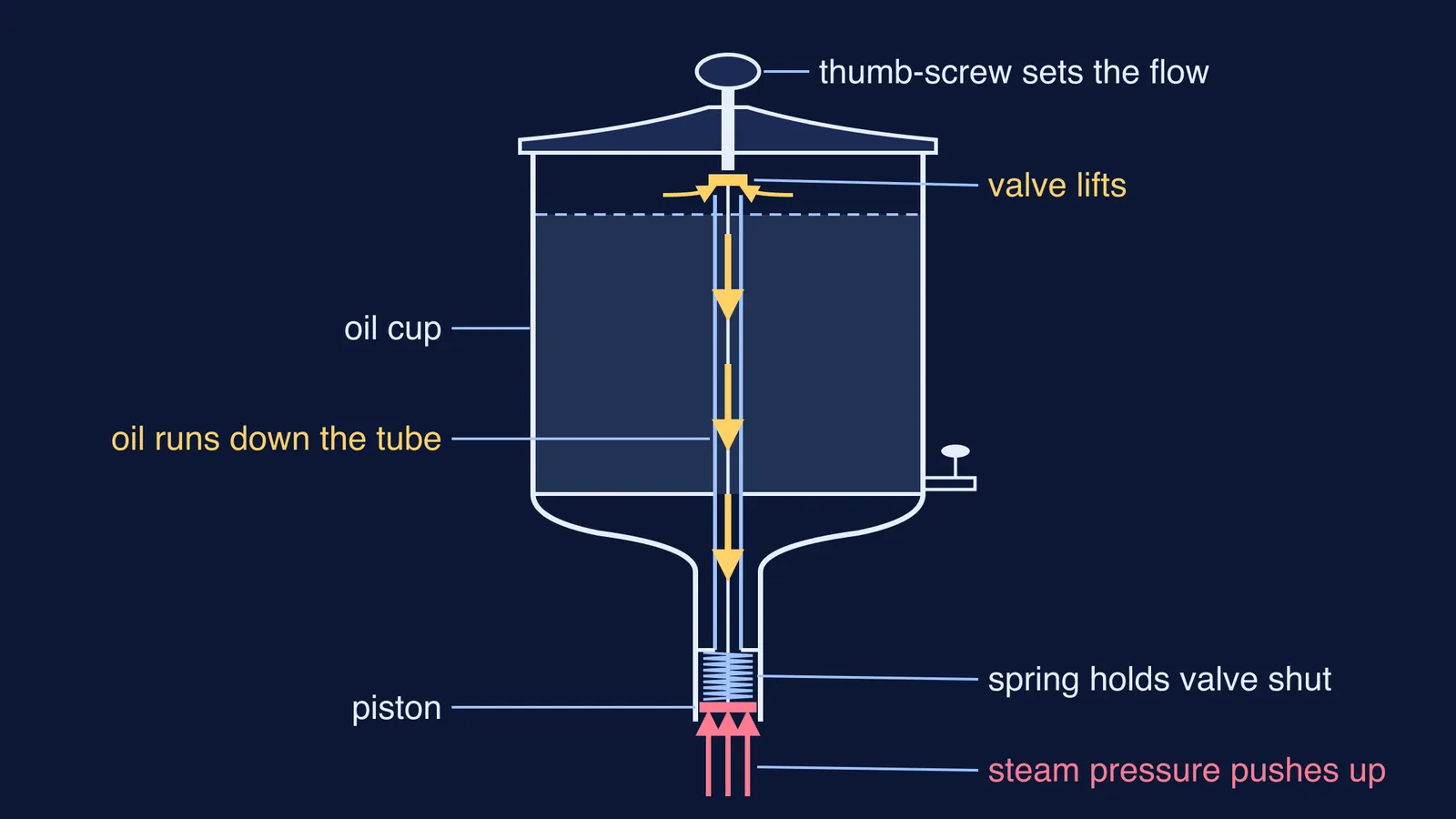
The patent, US 129,843, "Improvement in Lubricators for Steam-Engines", is dated 23 July 1872. Its single drawing shows a cut-away cup, and the mechanism is a neat chain of cause and effect:
The oil cup sits on a hollow stem that screws into the place to be oiled, such as a steam cylinder.
A tube runs up through the middle of the cup. A rod inside it carries a valve at the top and a small piston at the bottom.
A spiral spring pushes the rod down, so the valve closes the top of the tube and no oil gets through.
When steam presses on the piston from below, the rod rises, the valve lifts, and oil runs down the tube.
A thumb-screw in the lid, directly above the valve, lets the user regulate the flow. A small tap at the bottom of the cup drains off condensed steam.
In the patent's own words: "When the steam presses upon the piston the valve rises and allows the oil or other lubricating material used to pass out." That is a force balance you meet in Class 11. The valve opens when the steam force on the piston is larger than the spring force holding it down. So the cup feeds oil when there is steam pressure in the engine, and stays shut when there isn't.
Why did it matter that trains no longer stopped for oiling?
Metal sliding on metal without oil wears fast and turns useful work into heat. Our explainer on why a motorcycle engine needs engine oil shows the same problem in a modern engine. In McCoy's day, the National Inventors Hall of Fame notes, engines had to be stopped before they could be oiled. Lemelson-MIT says his automatic cup let trains travel without stopping for oiling, and that it became standard equipment on most locomotives and heavy machinery.
Compare George Stephenson and the friction that made railways work and George Westinghouse's railway air brake of 1869.
Did "the real McCoy" really come from his invention?
Probably not. The popular story says engineers, wary of inferior copies, asked for "the real McCoy". The National Inventors Hall of Fame tells it, and Lemelson-MIT says many believe it. But the Wikipedia article on the phrase records a Scottish form, "the real MacKay", in a poem published in Glasgow in 1856, sixteen years before McCoy's patent. Robert Louis Stevenson wrote "He's the real Mackay" in an 1883 letter. The same article traces the first printed claim linking the phrase to Elijah McCoy to an advertisement in the December 1966 issue of Ebony magazine.
McCoy and his lubricator are well documented; the claim that his cup named the phrase is not.
Test yourself: can you predict what the cup does?
Break the mechanism in your head. Answer each question out loud before reading the answer.
The thumb-screw is turned right down onto the valve. The valve cannot lift, so no oil reaches the engine, even with full steam pressure.
The spring breaks. Nothing presses the valve shut any more, so the cup can no longer reliably hold its oil back between steam pushes.
The piston is made with twice the area. The same steam pressure now gives twice the force, so the valve opens at a lower pressure.
Water builds up in the cup. That is condensed steam, and the tap at the bottom is there to drain it.
If pressure, force and area still feel shaky, the Fermi Concept Library has a lesson for each idea in physics. For mechanisms that are easier to see than to read, the Fermi Simulation Lab has interactive simulations you can try.
Next time someone says "the real McCoy", you can tell them the inventor was real, the lubricator was real, and the phrase is probably Scottish.