

On this page
In the 1860s, stopping a train was a manual and highly dangerous job. When the locomotive engineer blew a signal whistle, a team of "brakemen" had to run along the roofs of moving carriages to turn individual hand wheels. They applied the brakes car by car, a process that was slow, uncoordinated, and often fatal in bad weather. Because it took so long to halt a heavy train, railways were restricted to short trains and low speeds.
That changed on April 13, 1869, when George Westinghouse received a patent for the first railway air brake. By using compressed air instead of human muscle, Westinghouse gave the engineer the power to stop the entire train simultaneously from the locomotive cab. This invention ended the era of hand brakemen and laid the foundation for modern railway safety.
How did the 1869 straight air brake work?
The original 1869 "straight" air brake system relied on a steam-driven air compressor located on the locomotive. A continuous iron pipe ran the length of the train, connecting to air cylinders mounted on each individual car. When the engineer opened a valve in the cab, pressurized air rushed down the pipe and pushed a piston inside every cylinder. This mechanical force then pushed the brake shoes tightly against the steel wheels.
This invention was an immediate success. During its first major test run on the Steubenville (Panhandle) Railroad in September 1868, the train was travelling at full speed when the engineer spotted a horse-drawn wagon stuck on a crossing. He immediately applied the new air brake to perform an emergency stop, halting the train just feet from the wagon and proving the system's stopping power. To meet the sudden demand for his invention, Westinghouse founded the Westinghouse Air Brake Company (WABCO) in 1869. His drive for engineering was relentless; he would go on to establish 61 companies and receive 360 patents in his lifetime, working across the fields of rail, natural gas, and alternating current electricity.
How does the fail-safe automatic air brake work?
The 1869 straight air brake was a major advance, but it had a fatal design flaw. It relied on positive air pressure from the locomotive to apply the brakes. If a car accidentally detached, or if the main air pipe ruptured between carriages, all the compressed air would instantly escape into the atmosphere. The engineer would lose all braking power, meaning the brakes would fail exactly when they were needed most.
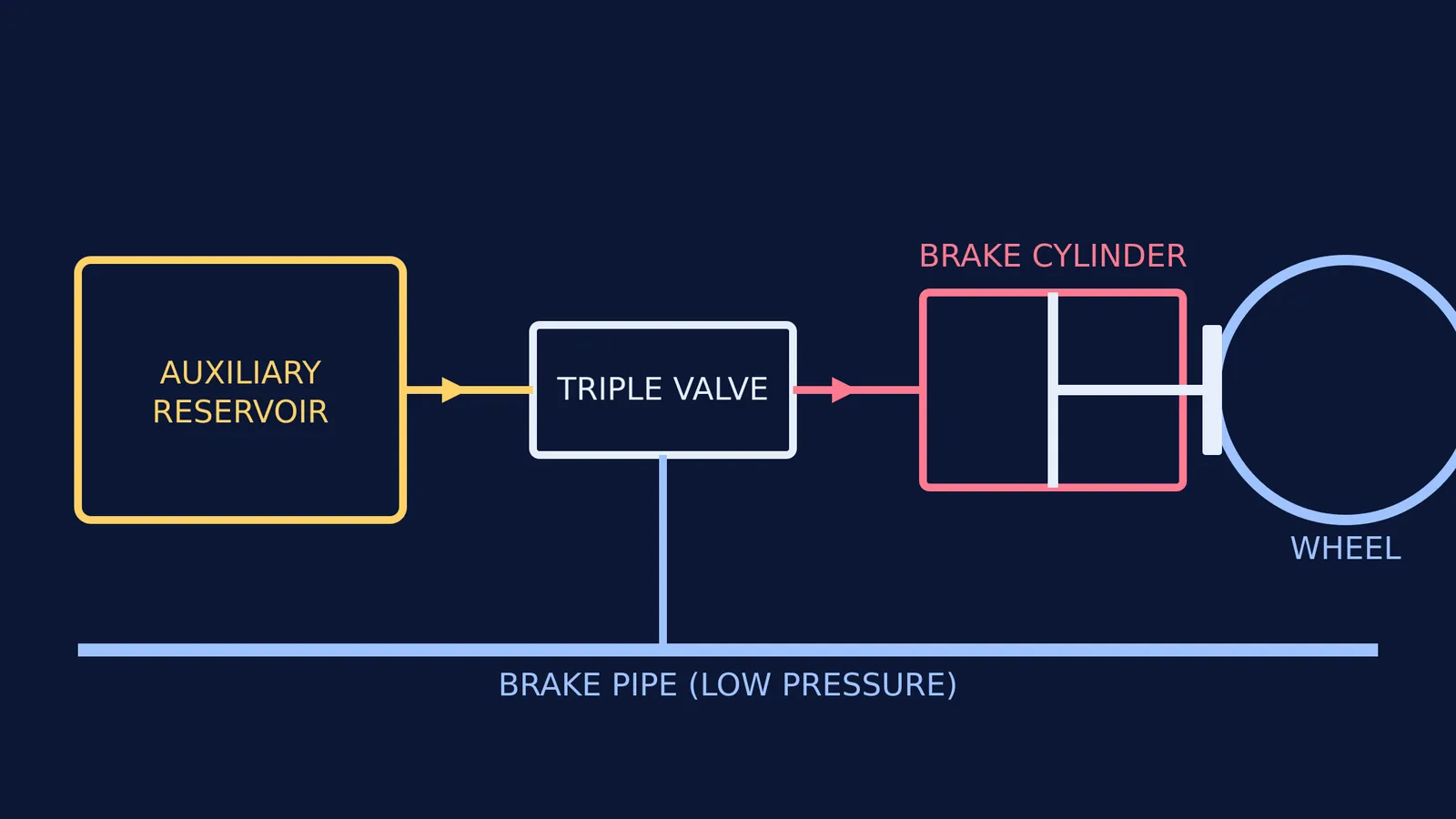
To solve this critical problem, Westinghouse inverted the system's logic. In 1872, he patented the automatic air brake, which added a local air reservoir to every single car and introduced a device called the triple valve.
Instead of sending air down the pipe to *apply* the brakes, the locomotive now kept the main pipe fully pressurized at all times just to keep the brakes *off*. If the pipe pressure dropped—whether the engineer vented it intentionally to slow down, or a hose broke in an accident—the triple valve responded to the pressure difference. It automatically released high-pressure air from the local auxiliary reservoir directly into the brake cylinder.
Once the pipe was repaired and the engineer recharged it with compressed air, the triple valve shifted back. It released the air from the brake cylinder and opened a path to recharge the local reservoir, releasing the brakes and readying the train to move again.
Why did air brakes change the railway industry?
By making reliable, rapid stops possible, the automatic air brake transformed the economics and safety of the transportation industry. Trains no longer had to creep along to avoid collisions. They could now travel safely at much higher speeds, carry far heavier freight loads, and string together many more cars.
Recognizing its importance to public safety, the United States government passed the Railroad Safety Appliance Act of 1893, which made power brakes mandatory on all American trains. The underlying principle of Westinghouse's 1872 automatic air brake—using a drop in air pressure to trigger a local stopping force—remains the universal standard for freight and passenger railways worldwide today.
Understanding how pressure differences create forces is a central part of studying physics, whether you are exploring Pascal's law in hydraulic machines or calculating the normal force on a car over a hump. If you are practising mechanics and not getting the right answers, Fermi's AI tutor can work out what you already know and build a plan for the session, so you sit down to a clear next step. To see full worked solutions, the Fermi Problem Library has a step-by-step solver that explains the reasoning rather than just printing an answer.


