

On this page
Track cyclists and road racers are famous for riding on extremely thin tyres pumped to incredibly high pressures. This is a stark contrast to the fat, soft tyres seen on mountain bikes or everyday commuters. The reason comes down to a delicate balance of physics: managing rolling resistance, understanding pressure limits, and fighting aerodynamic drag.
Why do racing bicycles have thin hard tyres?
To understand this, we first need to look at what happens where the rubber meets the road. This small area is called the contact patch. The size of this patch is governed by a fundamental rule of mechanics: the contact area roughly equals the load (the combined weight of the bike and rider) divided by the air pressure inside the tyre.
Every time the wheel rolls forward, the rubber casing bends flat at the bottom to form this patch, and then springs back to its round shape at the top. This continuous bending creates internal friction—a process known as hysteresis. Hysteresis is distinct from the sliding friction you might study using the angle of friction. Instead of surfaces sliding past each other, hysteresis steals energy from your pedalling by turning it into heat inside the rubber itself.
By pumping the tyre to a very high pressure, racers minimize this bending. Because the pressure is high, the tyre does not need to squash down as much to support the rider's weight. The tyre stays rounder, it flattens less, and far less energy is lost to rolling resistance. You can see similar pressure principles at work when studying Pascal's law and how pressure transmits force.
Why does the shape of the contact patch matter?
You might wonder why racers don't simply put high pressure into a wide tyre to get the best of both worlds.
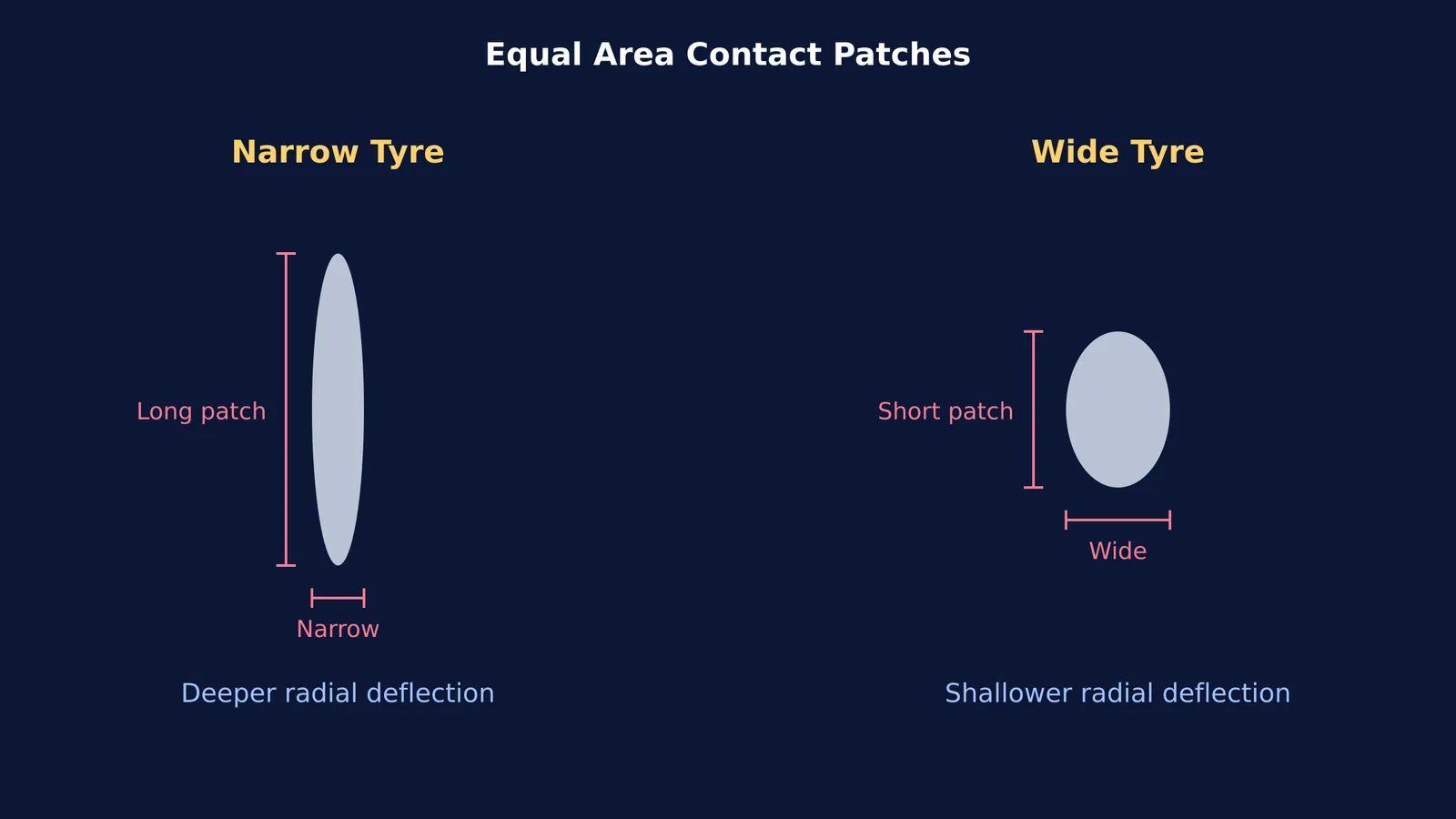
If you put the exact same pressure into both a narrow tyre and a wide tyre, they will have the exact same contact patch area to support a given rider's weight. However, the *shapes* of those patches differ significantly. A wide tyre creates a short, wide patch, while a narrow tyre creates a long, thin patch.
To create a long patch, a narrow tyre must flatten over a longer section of its circumference. This means it has to deflect deeper radially, causing more hysteresis. At identical pressures, a wider tyre is actually the more efficient option. In fact, tyre manufacturer Schwalbe points out that a 60 mm wide tyre at 2 bar rolls as easily as a 37 mm tyre pumped to 4 bar.
However, a wide tyre cannot safely hold maximum racing pressures without blowing off the rim, because the casing tension would be too immense. Narrow tyres are built to safely hold these extreme pressures. This allows track racers to achieve the stiffest possible wheel on perfectly smooth velodromes, minimizing energy loss.
When does air resistance take over?
The other major reason for thin tyres is aerodynamic drag.
As you ride faster, the air pushes back harder. The force of air resistance increases with the square of your speed, making it the greatest hurdle for any sprinter. According to Schwalbe, at a speed of approximately 20 km/h on level ground, air resistance has already become the main resistance force opposing the rider. Because the power needed to overcome this drag increases with the cube of speed, aerodynamics becomes critical at race speeds.
A narrow racing tyre has a significantly smaller frontal area than a wide one. The industry standard width of 23 mm is slowly shifting, but even as professional road racers move to tyres with widths of 24 mm or 25 mm, they remain extremely thin to slice cleanly through the air. When a racer is sprinting toward the finish line at high speeds, the energy saved against wind resistance far outweighs any minor bumps felt from the rock-hard tyre.
How can I visualise these forces?
Understanding how pressure, area, and energy loss interact can be difficult just by reading static equations. Visualising how these forces shift dynamically is exactly what the Fermi Simulation Lab is built for. Rather than just memorising formulas, you can change variables in an interactive environment to instantly see how the contact patch and energy loss respond in real time.
If you find yourself stuck on mechanics or friction problems during your exam prep, it often helps to have a guide. Fermi's AI tutor teaches rather than answers; it holds a line of reasoning across a session, notices where you are stuck, and draws the figure on a board to help you grasp the underlying principles.


