On this page
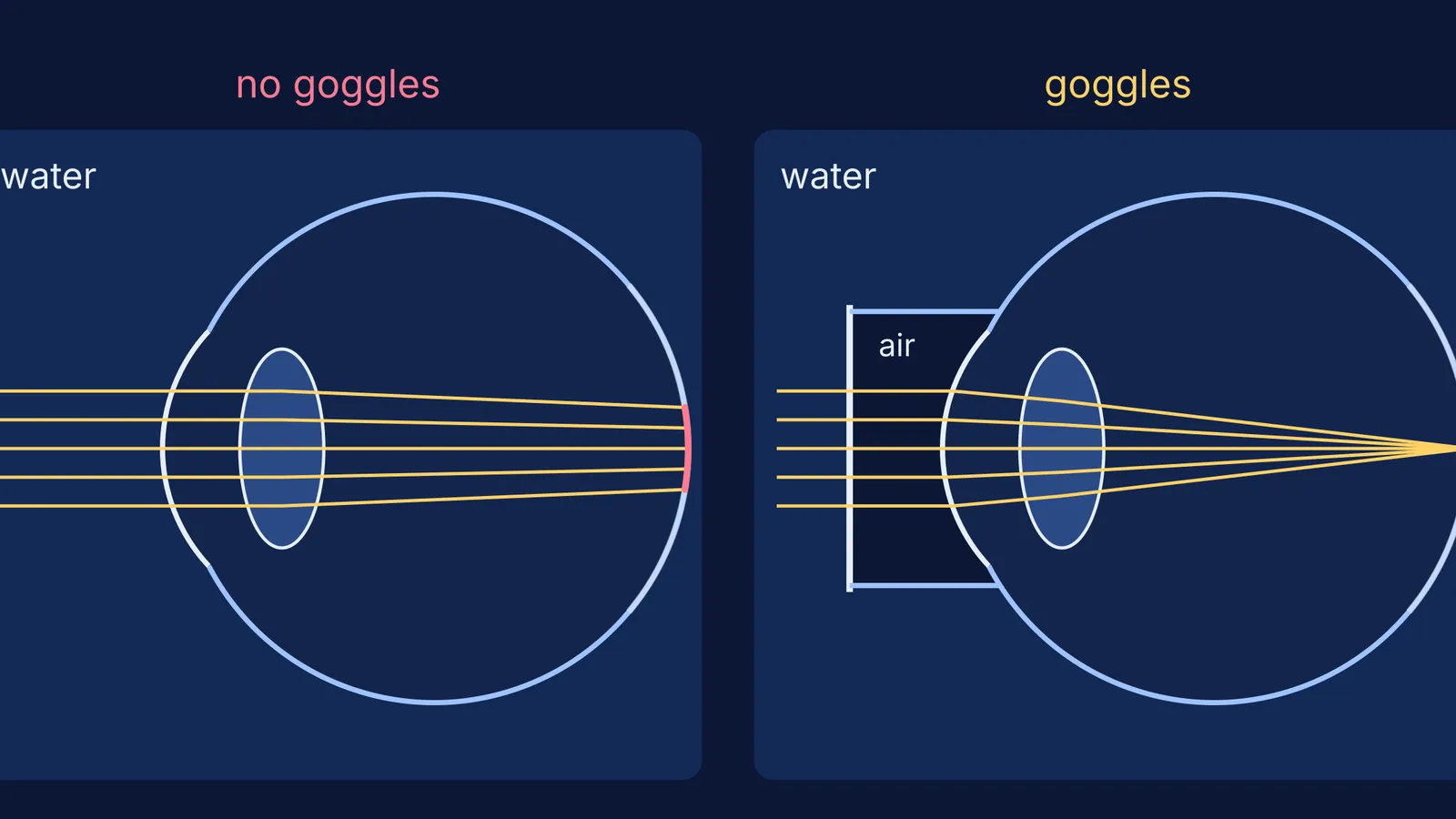
Open your eyes in a swimming pool and the tiles on the bottom turn into a soft blur. Your eyes are fine. The cause is a Class 10 idea: how much light bends at a boundary depends on how much the refractive index changes across it.
Why can't we see clearly underwater without goggles?
Your NCERT textbook puts it plainly: “Most of the refraction for the light rays entering the eye occurs at the outer surface of the cornea. The crystalline lens merely provides the finer adjustment of focal length required to focus objects at different distances on the retina” (NCERT Class 10 Science, Chapter 10).
In air, that surface separates air (refractive index 1.00) from the cornea, whose refractive index is about 1.376, according to the American Academy of Ophthalmology. The same AAO page gives the relaxed eye a total power of about 60 dioptres (D), with the cornea supplying about 40 D, or two-thirds.
The refractive index of water at 20 °C for visible light is 1.33 (optical properties of water, citing the CRC Handbook). The fluid just behind the cornea, the aqueous humour, is about 1.3335 (AAO). Underwater, light passes from water to cornea to eye fluid with almost no change in refractive index, so it barely bends. (Hazy on the parts? Revise the cornea, iris, pupil and retina first.)
How much focusing power does the cornea lose in water?
A curved surface's power is proportional to the refractive index difference across it (P = (n2 − n1)/R, from Class 12 ray optics). R stays the same underwater, so compare the differences.
In air: 1.376 − 1.000 = 0.376.
In water: 1.376 − 1.333 = 0.043.
Ratio: 0.043 ÷ 0.376 ≈ 0.11.
So the cornea's front surface keeps only about 11% of its power. (Its back surface faces eye fluid either way, so it does not change.) An ophthalmology handbook from the Portuguese Society of Ophthalmology (SPO) puts the loss in dioptres: “We lose approximately 43 diopters of refractive power when the eyes are underwater” (SPO, Underwater vision).
Take 43 D from the eye's 60 D (AAO) and under 20 D is left, so light focuses far behind the retina. In Class 10 terms, your eye becomes strongly hypermetropic. The SPO chapter calls it “a marked hyperopia since now the eye only practically has the lens to focus the light.” Accommodation tops out at about 15 to 16 D, the known limit of human performance (Gislén et al., 2003), so it cannot make up the loss. The same idea explains why a convex lens can act like a concave lens in a liquid: a lens's power depends on the medium around it.
Can anyone see clearly underwater without goggles?
In a 2003 study in Current Biology, Anna Gislén and colleagues at Lund University noted that “the curved corneal surface accounts for two-thirds of the eye's refractive power, and this is lost when air is replaced by water” (Gislén et al., 2003). They tested children of the Moken, sea nomads in Southeast Asia who live largely off the sea.
The Moken children's underwater acuity was 6.06 cycles per degree, more than twice the 2.95 of European children. They constricted their pupils to 1.96 mm (against 2.50 mm for the European children) and accommodated to 15 to 16 D. A smaller pupil works like a pinhole, shrinking the blur spot on the retina. It reduces the blur but does not bring back the cornea's lost power.
Why do goggles fix underwater blur?
Goggles and diving masks trap a pocket of air against your face. “With the use of a diving mask, the air/cornea interface on the anterior surface of the cornea is restored,” the SPO chapter explains (SPO, Underwater vision). The flat front window adds no focusing power of its own, but light that crosses from water into the air at an angle does bend, the same effect behind apparent depth problems. That is why, through a mask, objects look about 25 to 30% bigger and about 25% closer than they are (SPO).
If ray diagrams are hard to picture, the Fermi Simulation Lab has interactive simulations for ideas that are easier to see than to read.
How do you write this as a 3-mark board answer?
Four points, in this order:
Most refraction in the eye happens at the outer surface of the cornea.
Bending depends on the refractive index difference: large for air (1.00) to cornea (about 1.38), small for water (1.33) to cornea.
Underwater the cornea loses most of its power, so the image forms behind the retina and vision blurs.
Goggles keep air in front of the cornea, restoring that boundary, so the image forms on the retina again.
Follow-up: why do fish see clearly? In fish, “the cornea plays no role in focusing light” (Cornea), so the lens has to do the focusing.
To connect this Class 10 chapter with Class 12 ray optics, the Fermi Concept Library gives every physics concept its own lesson and shows where it fits in the map.