

On this page
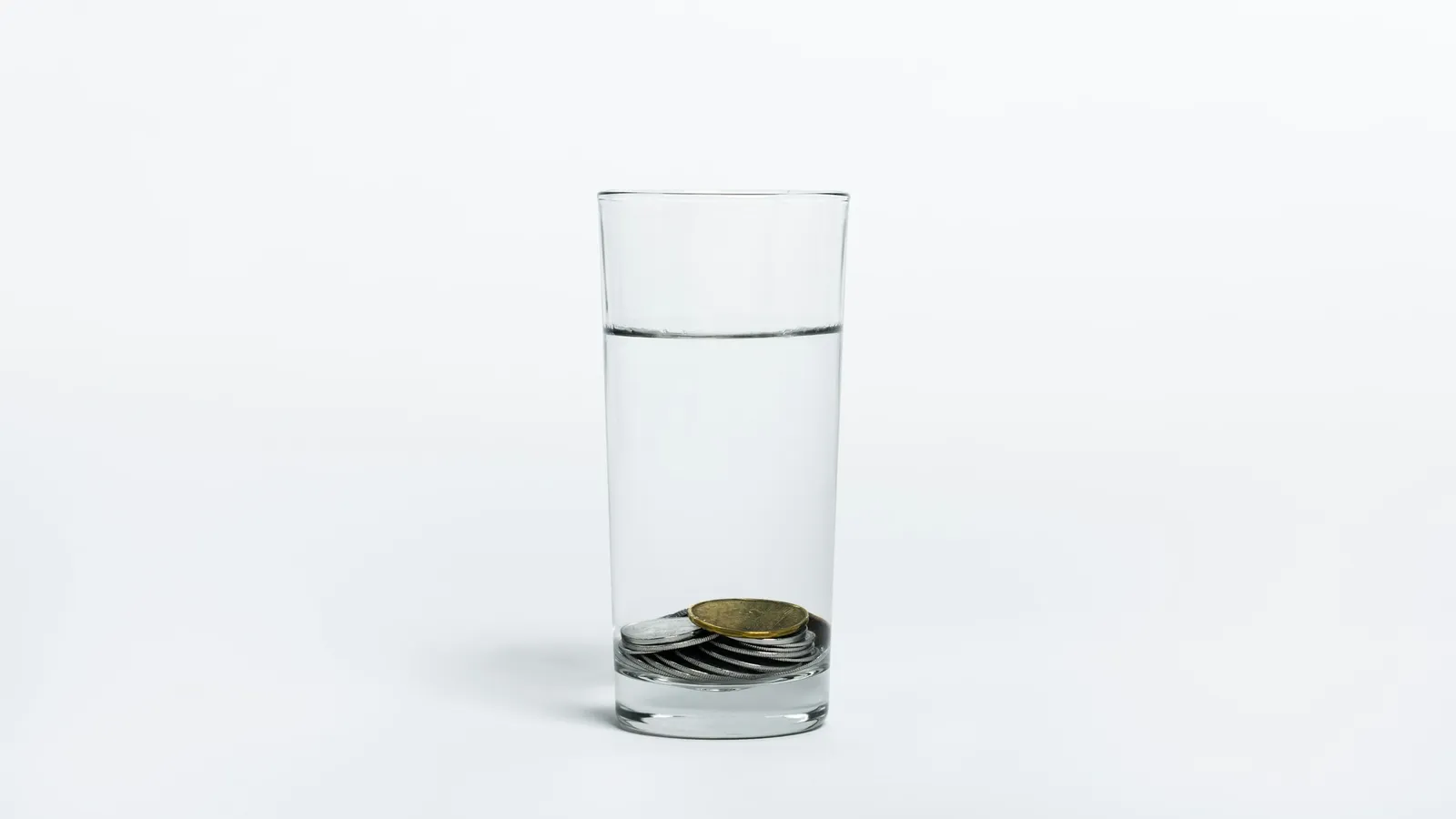
A coin at the bottom of a bucket looks closer than it is, and a pool looks shallower than it is. Exam questions on this look simple, but students lose marks by using the wrong ratio, forgetting which way the image moves, or applying the formula at a slant. This post derives the two results you need, works four problems with numbers, and lists the traps.
What does the syllabus say?
The NCERT Class 12 chapter Ray Optics and Optical Instruments says that the bottom of a tank filled with water "appears to be raised" (Fig. 9.10), and that for viewing near the normal, the apparent depth is the real depth divided by the refractive index of the water. The JEE (Main) 2026 syllabus lists "refraction of light at plane and spherical surfaces", and the JEE (Advanced) 2026 brochure lists "reflection and refraction at plane and spherical surfaces". The CBSE Physics curriculum for 2026-27 includes refraction of light under Ray Optics. Check your own exam year's syllabus.
Why does the bottom look raised?
Take a point O on the floor of a tank, depth h below the surface. A ray from O meets the surface at a small distance x from the point straight above O. Inside the water it makes angle r with the normal. In air it bends away from the normal to angle i, because light speeds up. Your eye traces the ray back in a straight line and sees it coming from a point I, at apparent depth h'.
From the geometry, tan r = x/h and tan i = x/h'. Snell's law, with water of refractive index n, gives sin i = n sin r. For rays close to the normal, sin ≈ tan, so x/h' = n(x/h), which gives
h' = h/n, or real depth ÷ apparent depth = n.
The image is raised by h − h' = h(1 − 1/n). That rise is called the normal shift.
Worked example 1: finding n from a microscope reading
This is an NCERT exercise. A tank holds water to 12.5 cm. A microscope focused on a needle at the bottom reads an apparent depth of 9.4 cm. Find n. Then the water is replaced by a liquid of n = 1.63 to the same height. How far must the microscope move?
n = real ÷ apparent = 12.5 ÷ 9.4 ≈ 1.33. This matches the value NCERT's Table 9.1 gives for water.
New apparent depth = 12.5 ÷ 1.63 ≈ 7.67 cm.
The image is now 9.4 − 7.67 ≈ 1.73 cm higher, so the microscope must be raised by about 1.73 cm.
A denser liquid makes the needle look higher still. That is the sign students most often get wrong.
Worked example 2: a glass slab
Also from NCERT. A pin on a table is viewed from 50 cm above through a glass slab 15 cm thick, held parallel to the table, with n = 1.5. How far does the pin appear raised, and does it depend on where the slab is?
Only the slab changes the path, so only its thickness matters:
Shift = t(1 − 1/n) = 15 × (1 − 1/1.5) = 15 × (1/3) = 5 cm.
The pin appears 5 cm closer. The answer does not depend on where the slab sits between the pin and the eye, because the rays travel the same in the air gaps either way. The 50 cm is a distractor.
Worked example 3: two liquids in layers
A beaker holds 8 cm of water (n = 4/3) with 3 cm of oil (n = 1.5) floating on top. Viewed from above near the normal, how deep does the bottom look?
Each layer contributes its thickness divided by its own refractive index:
Apparent depth = 3/1.5 + 8/(4/3) = 2 + 6 = 8 cm.
The real depth is 3 + 8 = 11 cm, so the bottom looks 3 cm raised. A common error is to divide the total 11 cm by one "average" index.
Worked example 4: looking out from the water
A fish is 12 cm below the surface and a bird is 30 cm above it, directly overhead. Take n = 4/3 for water. How far away does the bird appear to the fish?
Now the observer is in the denser medium, so the object in air looks further away. The apparent height above the surface is n × 30 = (4/3) × 30 = 40 cm. The fish judges the distance as 40 + 12 = 52 cm.
A safe rule for direction: if light goes from the object into a denser medium before reaching your eye, the object looks further away; if it goes into a rarer medium, the object looks closer.
Which traps do examiners set?
Inverting the ratio. n = real ÷ apparent when you view from the rarer side. If you get n below 1 for water, you have flipped it.
Wrong direction for the microscope. A raised image means the microscope moves up.
Using the slab's position. The shift t(1 − 1/n) is independent of where the slab is.
Averaging indices for layers. Add t/n for each layer.
Applying h/n at steep angles. It holds near the normal only.
For refraction at curved surfaces, where the same idea gives a formula with radii and sign rules, see our post on refraction at a single spherical surface. For the history of the sine law itself, read about Willebrord Snell.
A practice routine
Day 1: Derive h' = h/n from Snell's law without notes.
Day 2: Solve the two NCERT exercises above again, then change the numbers.
Day 3: Do three layered-liquid problems with different indices.
Day 4: Do two "observer in water" problems.
Day 5: Mix five refraction problems from different subtopics and solve them without looking at headings. Mixing problem types is one of the practice methods reviewed by Dunlosky and colleagues (2013), who rate practice testing and spaced practice highest.
If the ray diagram is what you cannot picture, the Fermi Simulation Lab has interactive simulations for ideas that are easier to see than read.
Put a coin in a glass of water tonight, measure the real depth with a ruler, and estimate the apparent depth from the formula.


