On this page
On a January morning in Punjab, Haryana or the Uttarakhand foothills, mustard fields can wake up under a white crust. That crust is not always frozen dew. When the air is dry enough, it is water vapour that skipped the liquid stage and turned straight into ice on a leaf colder than 0 °C.
What exactly is frost?
In the FAO's grower guide Frost Protection: fundamentals, practice and economics, a frost is an air temperature of 0 °C or lower, measured 1.25 to 2.0 m above the soil inside a weather shelter.
The white coating you see is what the same guide calls hoar frost: water vapour depositing onto a surface as ice. If the temperature drops below 0 °C but the air is too dry for ice to form, the guide calls it a black frost. Because heat is released as ice is deposited, hoar frosts usually do less damage than black frosts.
Why do clear, calm nights bring frost?
Every surface radiates heat as infrared light. At night what matters is how much comes back.
Clear sky: the sky's apparent temperature is far colder than the ground, so net long-wave radiation from the ground is negative (FAO, chapter 3). Clouds send part of that radiation back down, so cloudy nights stay milder.
Calm air: wind mixes warmer air down and thins the still air around each leaf, speeding heat transfer to it. Without wind, the coldest air stays on the field.
An inversion: temperature increases with height above the ground, and the top of this inversion is generally 9 to 60 m up (FAO, chapter 1).
The FAO recipe for a radiation frost is a clear sky, little wind, an inversion, low dew points, and air below 0 °C at night but above it by day. Because the coldest layer hugs the ground, a leaf can be below 0 °C while the shelter thermometer reads above it. The same cold, still air also feeds the dense fog that covers north India on winter mornings.
When does water vapour turn into ice on a leaf?
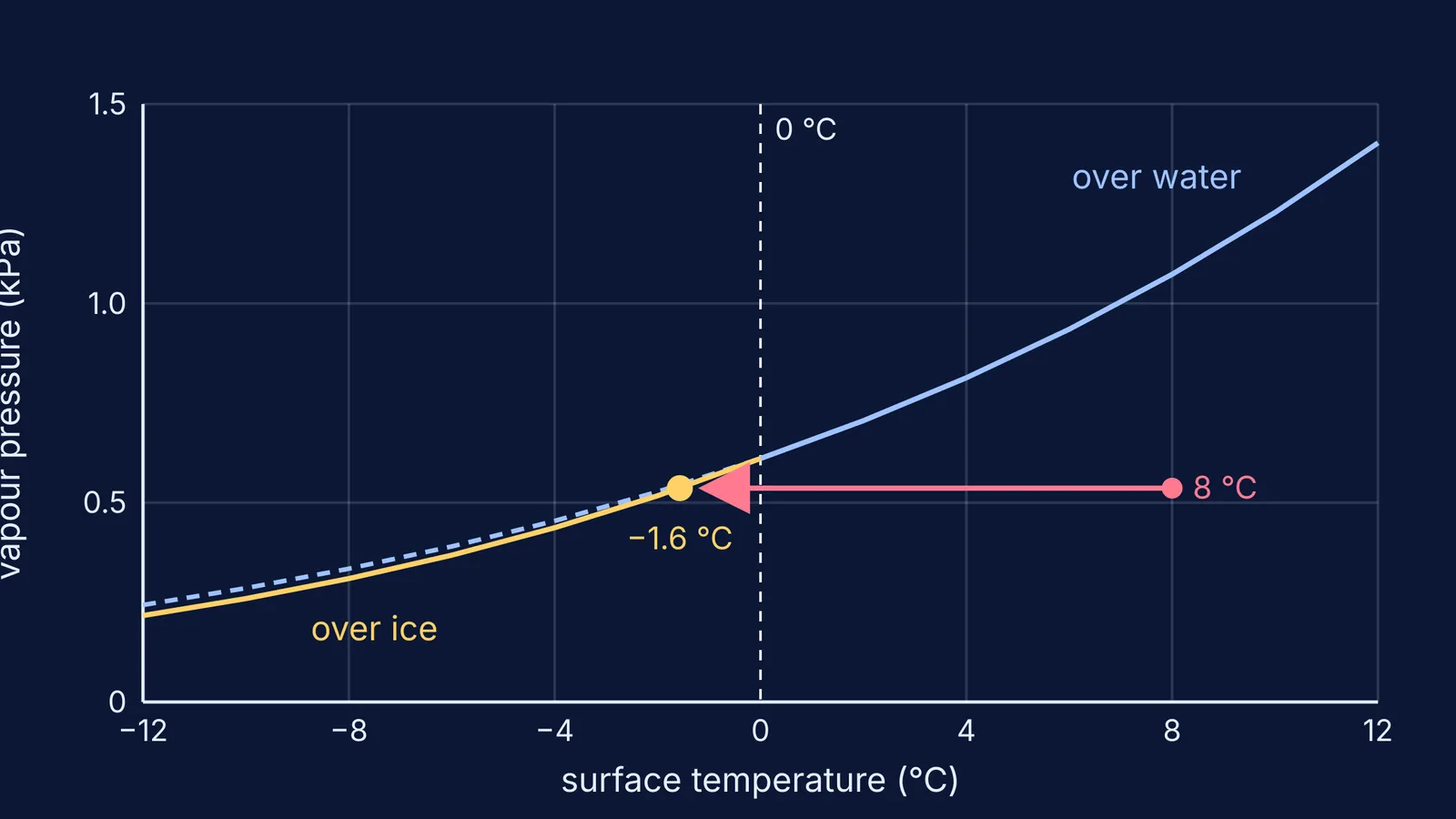
You can work this out with two formulas from chapter 3 of the FAO guide. Saturation vapour pressure over water is e = 0.6108 exp(17.27T / (T + 237.3)) kPa. Over ice, from Tetens (1930), it is e = 0.6108 exp(21.875T / (T + 265.5)) kPa, with T in °C.
Evening air at 8 °C is saturated at 1.073 kPa, so at 50% relative humidity its vapour pressure is about 0.536 kPa.
Overnight the leaf cools; the vapour above it stays roughly the same.
Solve the ice formula for e = 0.536 kPa: T ≈ −1.6 °C. That is the ice point (frost point), below which vapour deposits as ice.
Solve the water formula for the same e: T ≈ −1.8 °C, the dew point.
Below zero, saturation vapour pressure over ice is lower than over water, so the leaf reaches the ice point first and grows ice crystals before any dew appears. The same deposition builds frost inside your freezer, and the water phase diagram shows why vapour can turn straight to ice at low pressure.
Why do farmers irrigate fields lightly to protect crops?
A district agromet bulletin says it plainly. A 9 January 2026 Gramin Krishi Mausam Sewa bulletin for Nainital district, issued by G.B. Pant University of Agriculture and Technology with an IMD yellow warning for ground frost, said "light irrigation is a must to maintain temperatures and save freezing injury in the crops." It advised light irrigation for chickpea, lentil, mustard and barley, and protective nets for leafy vegetables and capsicum.
The physics is in the soil. The FAO guide's chapter on recommended methods explains that dry soil has more air spaces, and air conducts and stores heat poorly, so wetting dry soil improves frost protection. Most daily heat storage happens in the top 30 cm, so there is no need to soak deep. Soil a day or two after wetting, near field capacity, best takes in the Sun's heat by day and gives it back at night.
If water does freeze, it helps again. Each gram of water that freezes releases 334.5 J of latent heat, and each gram of vapour deposited as ice releases 2,835.5 J (FAO, chapter 3). That heat slows the fall in temperature.
A frost-week checklist for farming families
When nights turn clear and still, check your district bulletin on the Meghdoot or Mausam app.
If ground frost is forecast and the soil is dry, irrigate lightly before the cold nights, so the Sun can warm the wet soil.
Freshly tilled soil holds air; the FAO guide suggests firming and watering it.
Cover nurseries and tender vegetables with nets.
If latent heat or vapour pressure feels shaky, the Fermi Concept Library covers every concept in physics, chemistry, biology, mathematics and computing, each with its own lesson and its place in the map. Then rerun the worked example with your own town's evening weather.