On this page
Open a manual-defrost freezer during a Mumbai monsoon and a white fur creeps over the walls. That fur is not spilled water that froze. It is water vapour from your kitchen air that turned directly into ice.
Why does frost build up inside the freezer?
"Open doors allow cold air to escape and warm air to enter," notes the Minnesota Department of Commerce home energy guide. That warm air carries invisible water vapour.
Inside, the air touches walls, food packets and the cooling coils (the evaporator), all well below 0 °C. It cools until it can no longer hold all its vapour. Below freezing, the extra vapour does not form droplets first: it sticks to the cold surface as ice crystals, and more grow on top each time the door opens.
Frost is "the formation of thin ice crystals on the ground or other surfaces in the form of scales, needles, feathers, or fans," according to the US National Weather Service glossary.
What is deposition, and how is it different from freezing?
Deposition is the change of state from gas straight to solid, while condensation is gas to liquid, as the aviation safety reference SKYbrary explains. The frost point is the temperature to which humid air must be cooled for its vapour to be deposited on a surface as ice without passing through the liquid phase; the National Weather Service calls it simply a "dew point below freezing."
Freezer frost is the same process as hoarfrost on winter grass, where, in an NWS account, vapour "bypasses the liquid stage" and is deposited as ice crystals.
Freezing is different: liquid to solid. Spilled water freezes into a smooth, solid sheet. Frost is white and feathery because it grows crystal by crystal from vapour, with air trapped between.
Deposition is the reverse of sublimation, the solid-to-gas change behind why camphor burns without leaving ash. Ice leaving food as vapour is the story of what causes freezer burn.
How much water does one door opening bring in?
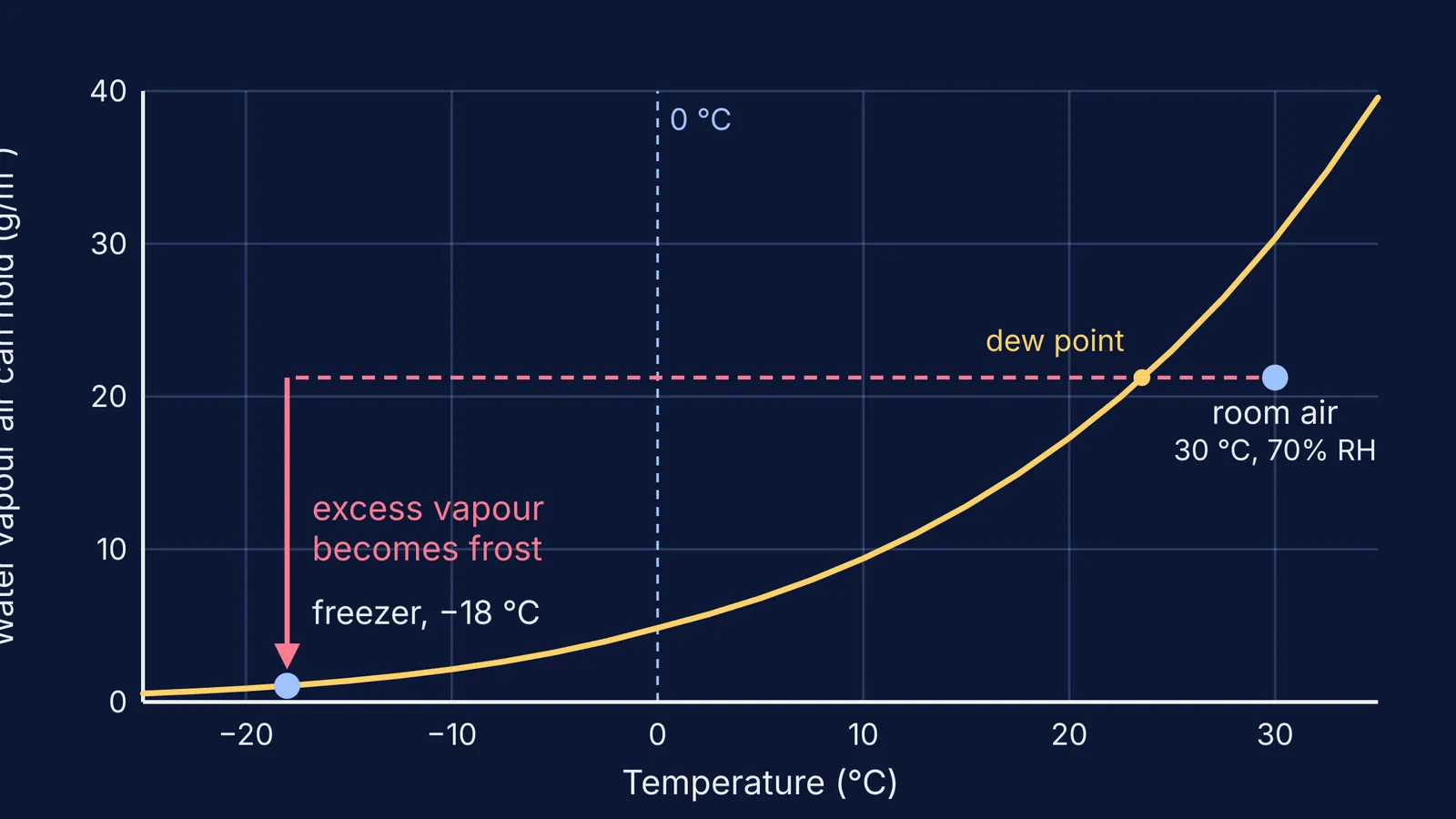
Relative humidity is the amount of moisture in the air compared with the amount it would hold if it were saturated, as defined in the NWS glossary. The amount air can hold falls steeply as it cools:
At 30 °C, saturated air holds 30.4 g of water vapour per cubic metre, according to the NIST steam tables and HyperPhysics.
At 0 °C, it holds 4.85 g per cubic metre (HyperPhysics).
At −18 °C (0 °F), the freezer setting in a Virginia Cooperative Extension factsheet, air over ice holds about 1.06 g per cubic metre, which we calculated from the Buck vapour-pressure equation.
A rough worked example with those numbers (an upper limit, since a real door opening swaps only part of the air):
Kitchen air at 30 °C and 70% relative humidity carries 0.70 × 30.4 ≈ 21.3 g of vapour per cubic metre.
Cooled to −18 °C, it can keep only about 1.1 g per cubic metre.
So each cubic metre leaves about 20 g of water behind as frost.
If a 100-litre (0.1 m³) freezer swapped all its air at one opening, that is up to about 2 g.
Ten openings a day for 30 days: up to about 600 g of ice.
Drier air means slower frost. Air cooled past the point where it can hold its vapour also explains the dense fog that covers north India on winter mornings, where the vapour condenses into droplets instead of ice.
If vapour, liquid and solid trading places is hard to picture, the Fermi Simulation Lab has interactive simulations for ideas that are easier to see than to read.
Why don't frost-free freezers build up frost?
They do, but they clear it away. A heater briefly warms the evaporator coil to melt the frost, and the water drains out through a duct at the back (auto-defrost). That costs electricity: Virginia Cooperative Extension notes that manual-defrost models consume 35 to 40 percent less energy than comparable automatic-defrost ones.
How do you slow frost build-up in a manual-defrost freezer?
The same Virginia Cooperative Extension factsheet warns that ice build-up can significantly decrease a freezer's efficiency, and recommends defrosting so there is never more than a quarter inch (about 6 mm) of ice. Each step below cuts the vapour reaching the cold walls:
Decide what you need before opening the door, and close it quickly.
Check the rubber door seal for cracks or gaps; the Minnesota guide notes that worn gaskets can be replaced or tightened.
Let cooked food cool and cover it before it goes in, so its moisture does not end up on the walls.
Defrost before the ice reaches a quarter inch.
Keep the freezer at about −18 °C rather than colder; the Minnesota guide says colder settings are not needed for food safety and use more electricity.
For a lesson on each change of state, the Fermi Concept Library covers every concept in physics and chemistry. Next time you see freezer frost, you are looking at your kitchen's humidity.