

On this page
Light a camphor tablet during an aarti and it shrinks, flames brightly and then is simply gone. There is no grey heap like the one a matchstick or incense stick leaves. Two ideas from your chemistry syllabus explain this: sublimation and combustion. Together they give you a neat three-mark answer.
What is camphor made of?
Camphor is a small organic molecule with the formula C10H16O, according to its PubChem record. That formula is the whole story in short form: carbon, hydrogen and oxygen, and nothing else.
The International Chemical Safety Card for camphor (ICSC 1021) lists it as colourless or white crystals that are combustible. The same card gives a melting point of 180 °C and a flash point of 66 °C. The flash point is the lowest temperature at which the vapour above a substance can catch fire.
Why does camphor turn into vapour so easily?
Sublimation is the change of state from a solid straight to a gas, without passing through the liquid state, as LibreTexts Chemistry/13%3A_States_of_Matter/13.12%3A_Sublimation) defines it.
Camphor sublimes at room temperature, and its vapour pressure at 20 °C is 27 Pa, according to ICSC 1021. That is why a camphor block kept in a cupboard slowly gets smaller and why you can smell it across the room. Molecules are leaving the solid all the time.
This matters for burning. A substance only gives a flame when its vapour burns. Wax has to melt and then evaporate first. Camphor gives off vapour readily, so a match is enough to light it, and the heat of the flame keeps turning more solid into fuel.
Why does camphor burn without leaving any ash?
Ash is what is left when something burns but part of it cannot burn. In wood, that part is minerals. A 2016 study of plantation-grown trees in BioResources explains that trees take up inorganic substances from the soil through their roots. Ash from burning wood is mostly oxides of elements such as calcium, potassium and magnesium. The same study found that young wood burnt at 500 °C left ash equal to 0.74% of its dry mass, and young bark left 6.88%.
Pure camphor has none of these minerals. When it burns completely, every carbon atom joins oxygen to make carbon dioxide and every hydrogen atom ends up in water vapour. Both are gases, so they float away and nothing solid is left on the plate.
One caution. If the flame runs short of oxygen, some carbon escapes unburnt as soot. That is the black smudge you sometimes see above a camphor flame. Soot is unburnt fuel, not ash. And if a camphor tablet leaves a pale residue, it most likely contained something other than camphor.
A worked example: where does 1 g of camphor go?
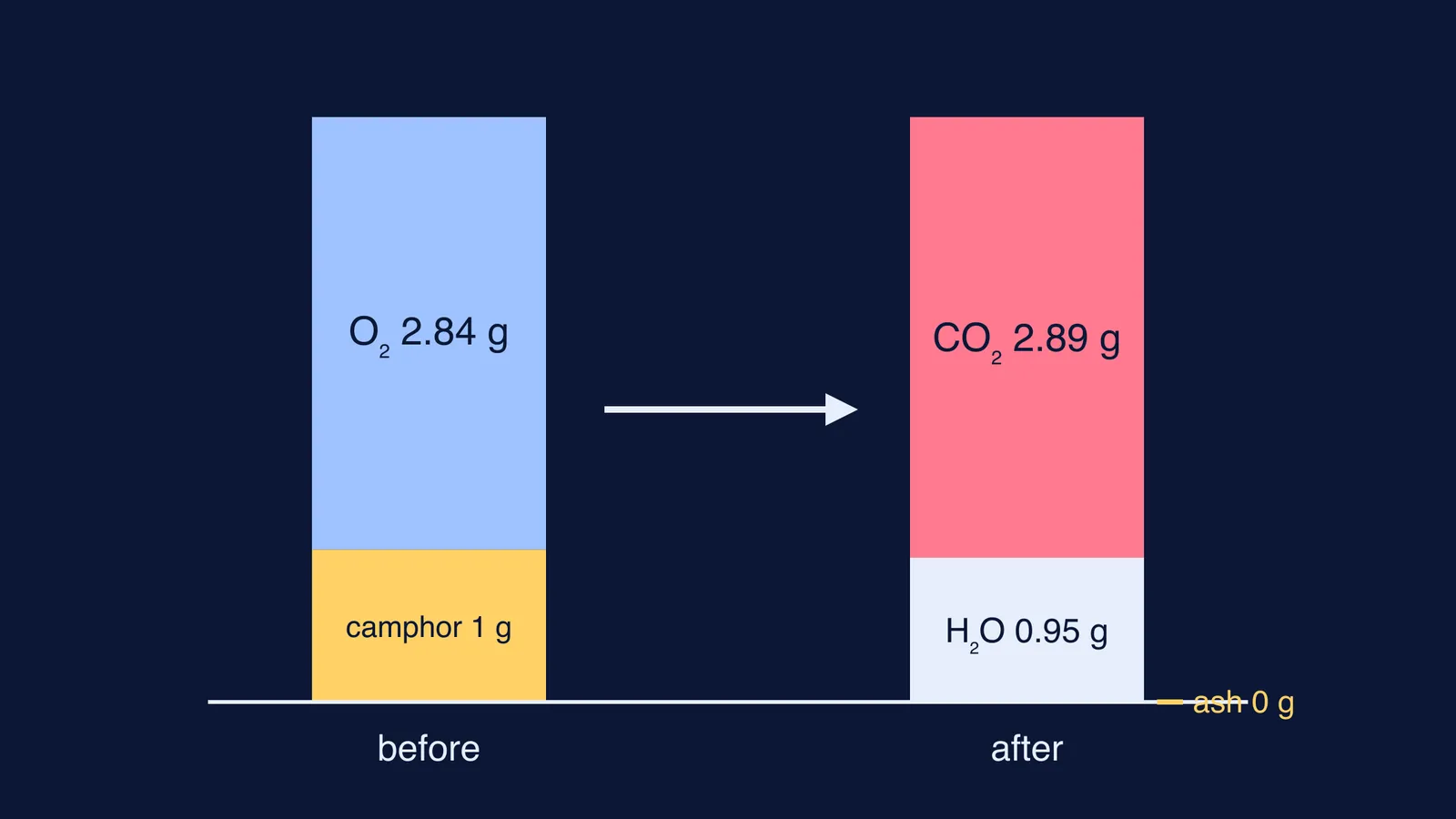
This mass balance shows that the camphor does not simply vanish. Balance the equation first:
2 C10H16O + 27 O2 → 20 CO2 + 16 H2O
Now follow 1 g of camphor, using the molar mass of 152.23 g/mol from PubChem.
Moles of camphor: 1 ÷ 152.23 = 0.00657 mol.
Carbon dioxide: 10 × 0.00657 × 44.01 = 2.89 g.
Water: 8 × 0.00657 × 18.02 = 0.95 g.
Oxygen used: 13.5 × 0.00657 × 32.00 = 2.84 g.
Check: 1 g + 2.84 g in, 2.89 g + 0.95 g out. Both sides come to about 3.84 g, and none of it is solid.
So the camphor did not vanish. It became nearly four times its own mass of invisible gas, because it took oxygen from the air. The NIST Chemistry WebBook gives its enthalpy of combustion as about 5,900 kJ per mole of solid camphor, which works out to roughly 39 kJ for every gram that burns.
How to write this in an exam
Use this checklist for a short answer:
Name the property: camphor sublimes, so its vapour burns readily.
Give the composition: only carbon, hydrogen and oxygen.
Name the products: carbon dioxide and water vapour, both gases.
Define ash: the non-combustible mineral part of a fuel, which camphor lacks.
Contrast: wood leaves ash because it contains minerals from the soil.
If separating mixtures is on your syllabus, the same idea is behind separating ammonium chloride and salt by sublimation. For the names of every change of state, see sublimation, evaporation and deposition explained. And for why a flame is burning vapour, see Faraday's Chemical History of a Candle, a well-known set of flame demonstrations.
Some ideas about states of matter are easier to see than to read. The Fermi Simulation Lab has interactive simulations for ideas like these. If the definitions themselves feel shaky, the Fermi Concept Library gives each chemistry concept its own lesson.


