On this page
A classic school chemistry question asks you to separate a mixture of common salt and ammonium chloride, and the answer is sublimation. Here is how the set-up works, why only one of the two solids moves, and what to write in your practical file.
What is sublimation, and why does it separate these two solids?
NCERT defines sublimation as a change from solid to vapour on heating "without passing through liquid state", used "to separate sublimable compounds from non-sublimable impurities" (NCERT Class 11 Chemistry, Unit 8, section 8.8.1). For the names of every change of state in one place, see our post on sublimation, evaporation and deposition.
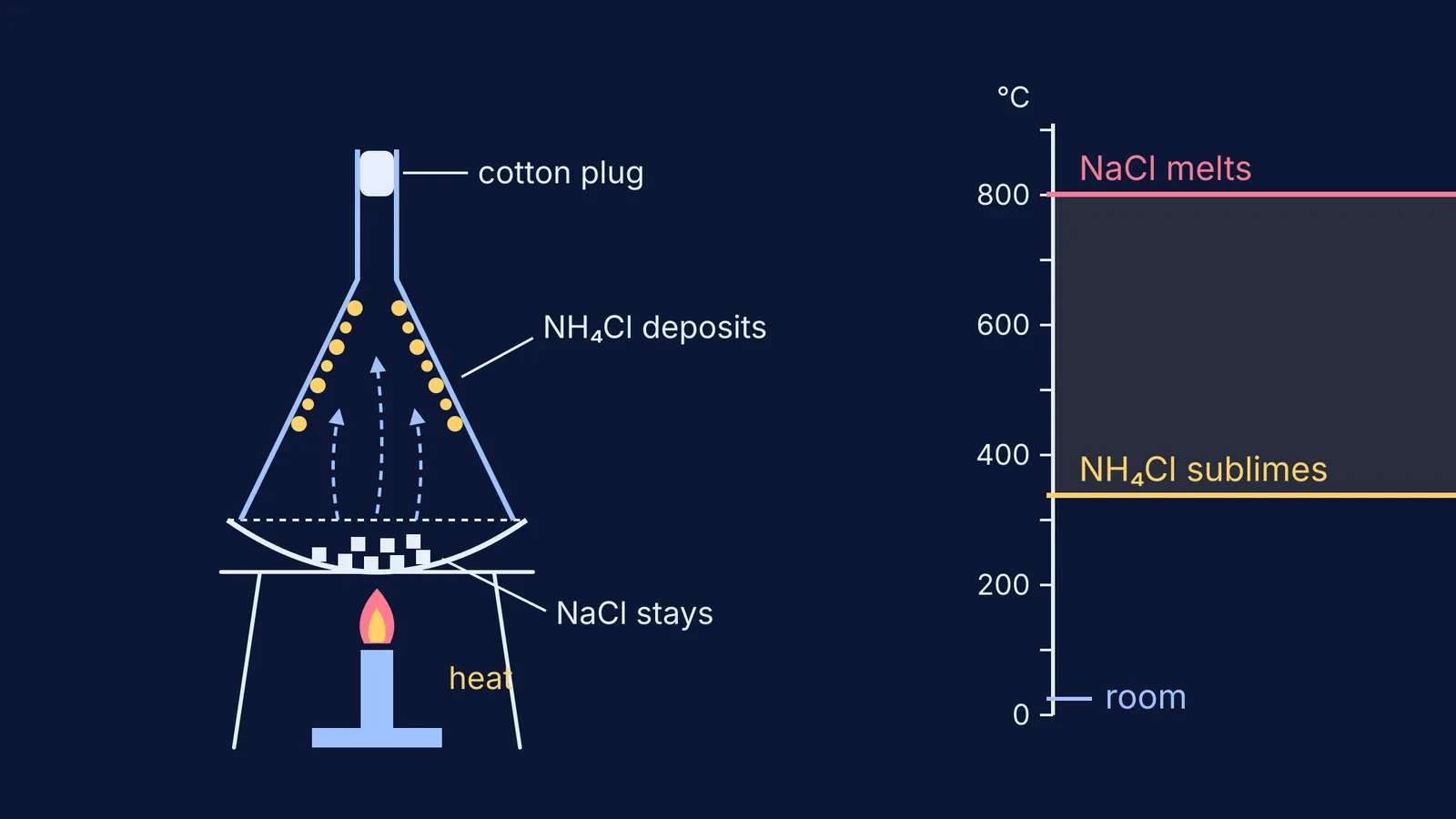
The method works because the two solids respond to heat at very different temperatures. PubChem lists about 338 °C for ammonium chloride, from US Department of Energy data, and its other entries note that the solid sublimes rather than melts. The NIOSH Pocket Guide gives 662 °F (350 °C), marked "Sublimes". Sodium chloride does not even melt until 800.7 °C (PubChem, citing the CRC Handbook). That leaves a gap of more than 400 degrees: heating that drives off the ammonium chloride leaves the salt, nowhere near its melting point, in the dish.
How do you separate ammonium chloride and salt by sublimation?
Put the powdered mixture in a china dish on a wire gauze over a tripod stand.
Cover the dish with an inverted glass funnel so its rim sits on the dish.
Push a loose plug of cotton into the top of the funnel stem so the vapour cannot escape into the room.
Heat gently with a burner. White fumes rise from the mixture.
Watch the cooler upper walls of the funnel. A white solid collects there: this is the ammonium chloride, called the sublimate.
Stop heating when no more fumes appear. Let everything cool, lift the funnel and scrape the white solid onto paper.
The solid left in the dish is common salt.
The funnel matters because vapour needs a cool surface to turn back into a solid, and the glass well above the flame is much cooler than the dish.
What actually happens to ammonium chloride when you heat it?
The vapour above hot ammonium chloride is not ammonium chloride. As chemguide puts it, ammonium chloride "sublimes because it breaks into ammonia and hydrogen chloride on heating, and recombines again when it cools further up the tube".
As an equation: NH4Cl(s) ⇌ NH3(g) + HCl(g). The reaction runs forward in the hot dish and backward on the cool funnel. For a school-level answer, "ammonium chloride sublimes" is what the examiner wants. In Class 11, when you meet reversible reactions and equilibrium, the fuller picture explains why the white solid reappears.
If the line between a change of state and a reversible reaction still feels blurry, the Fermi Concept Library has a lesson for every concept in chemistry, each with its place in the map.
Which other solids sublime, and which mixtures can this method separate?
Other solids you will meet in exams:
Iodine: PubChem notes it "readily sublimes at room temperature, forming violet corrosive vapor" (PubChem, iodine).
Naphthalene, the mothball chemical: "white crystals that sublime at room temperature" (PubChem, naphthalene).
Camphor: raw camphor is "purified by sublimation or crystallization" (PubChem, camphor).
Use this two-question test on any mixture a question gives you:
Does exactly one component sublime? Then sublimation works. Salt and ammonium chloride, sand and iodine, salt and camphor all pass.
Do both sublime, or neither? Then choose another method. Iodine and ammonium chloride both sublime, so heating moves both. Sand and salt: neither sublimes, so dissolve the salt in water, filter, then recover it.
For more pairs, see our post on asking AI which method separates each mixture, then checking it.
A worked example for your practical file
These are made-up numbers to show the working. You start with 10.0 g of mixture. After heating, the dish holds 6.5 g of salt, and you scrape 3.1 g of white solid from the funnel.
Ammonium chloride in the mixture: 10.0 − 6.5 = 3.5 g, so the mixture was 35 per cent ammonium chloride by mass.
Recovered from the funnel: 3.1 ÷ 3.5 × 100 ≈ 89 per cent.
The missing 0.4 g escaped past the cotton, stayed stuck to the glass, or was lost as fumes before the funnel was in place.
That last line is your source of error. Our guide on writing precautions and sources of error in practicals shows how to phrase it.
To practise the calculation with other numbers, the Fermi Problem Library has worked problems with a step-by-step solver that explains the reasoning rather than printing an answer.