

On this page
Separation questions look easy until a mixture has three parts, or two methods both seem to work. An AI chatbot will happily name a method for every mixture you give it. The useful part is making it say why, and then checking that reason against the book your exam is set from.
Which method separates each mixture, and why?
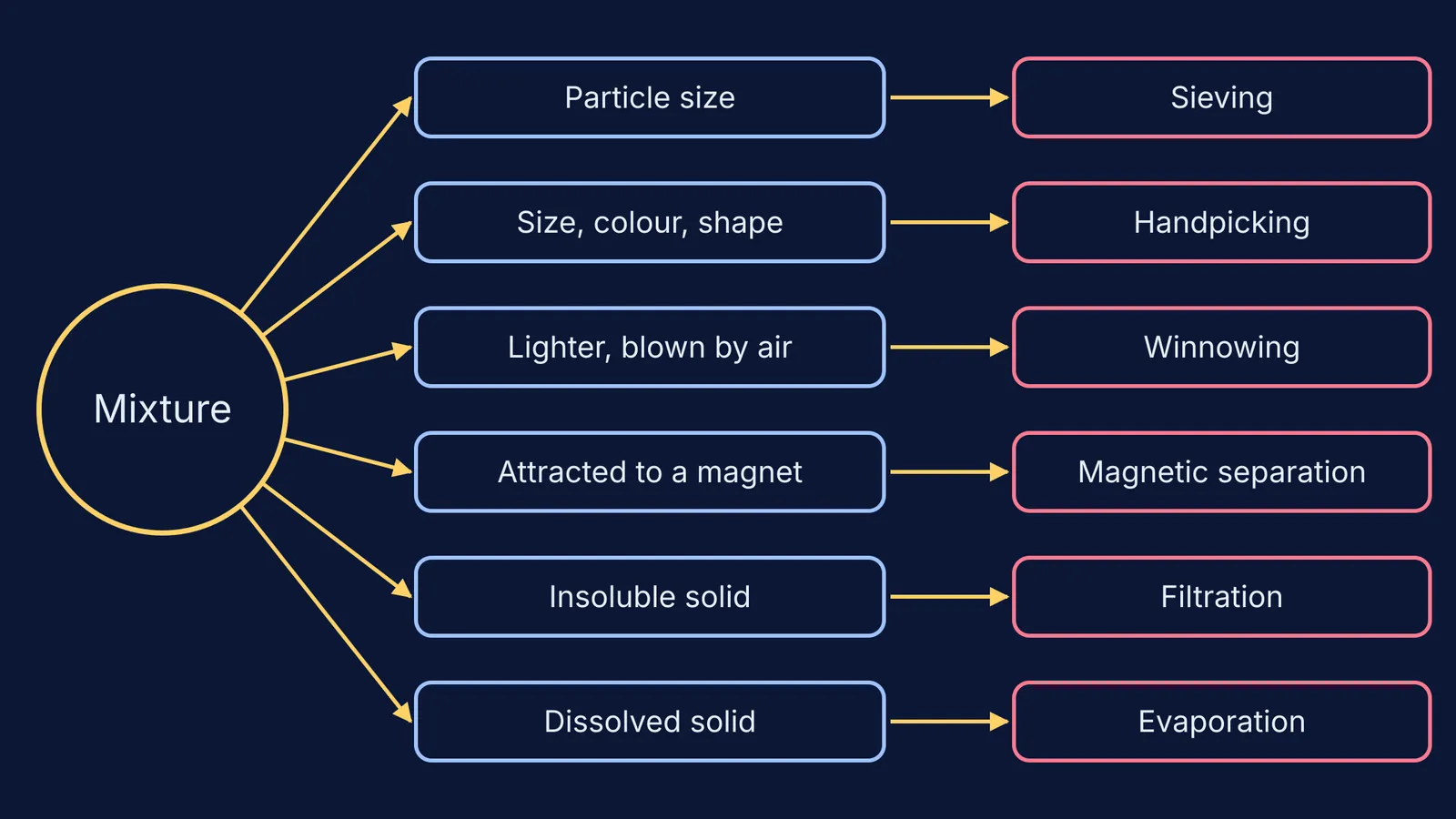
Every separation method works because the parts of a mixture differ in one property. NCERT's Class 6 science chapter Methods of Separation in Everyday Life spells out the pairings in its summary:
Handpicking separates solids that differ in size, colour and shape.
Winnowing separates lighter husk from heavier grain using wind or blowing air.
Sieving separates solids by particle size.
Evaporation separates a solid dissolved in a liquid.
Sedimentation lets a heavier insoluble part settle at the bottom; decantation then removes the liquid by tilting the vessel.
Filtration separates insoluble solids from a liquid.
Magnetic separation pulls magnetic substances, such as iron, away from non-magnetic ones.
The chapter also gives a hint worth remembering: a mixture with more than two components needs a combination of methods.
So a full answer to “which method?” always has two parts: the method, and the property that differs.
How do you ask AI to pick a method for each mixture?
Ask in a way that forces the reason out. Paste this, and swap in your own list:
“Here are mixtures from my Class 6 science chapter. For each one, name one separation method, the property that differs between the parts, and one reason another method would not work as well. Use only these methods: handpicking, threshing, winnowing, sieving, evaporation, sedimentation, decantation, filtration, churning, magnetic separation. If two methods could work, say so.”
The last two lines matter. Without the list, an AI may jump to apparatus your book has not introduced yet. Asking “if two methods could work” stops it pretending there is only one answer when your book itself asks you to compare.
What does a good AI answer to the book's matching question look like?
Question 5 in the chapter's end-of-chapter section, Let us enhance our learning, asks you to match five mixtures to five methods. Here is what a good AI answer should contain, and how to check each line.
Gram flour mixed with black gram: sieving, because the grains are much bigger than the flour particles. Check: the summary links sieving to particle size.
Chalk powder mixed with water: filtration, because chalk does not dissolve. Letting it settle and decanting also works, but leaves some powder behind. Check: Question 6 in the same section asks when you would choose decantation over filtration, so the book wants you to see both.
Corn mixed with potatoes: handpicking, because the pieces clearly differ in size and shape and are easy to pick out.
Iron powder mixed with sawdust: magnetic separation, because iron is attracted to a magnet and sawdust is not.
Oil mixed with water: decantation, because oil does not mix with water and forms a separate layer. Check: the chapter asks this exact question in a side box.
Then try Question 9, a three-part mixture of potatoes, salt and sawdust. One sound plan: handpick the potatoes, stir the rest into water so the salt dissolves, filter out the sawdust, then evaporate the water to get the salt back. If the AI's order differs, ask it why. If its reason uses a property your chapter does not mention, mark that step to ask your teacher.
Why check an AI's answer against your textbook?
Because an AI can be impressive and still wrong on simple things. In a 2025 Nature Chemistry paper, researchers built ChemBench, a set of more than 2,700 chemistry question–answer pairs, and tested leading AI models against chemists. The best models, on average, outperformed the best human chemists in the study. The same paper found the models struggle with some basic tasks and give overconfident predictions.
So a confident tone is not evidence. Your textbook is what your exam follows, so it gets the final word.
Run this quick check on every AI answer:
Is the method named in your chapter?
Does the stated property match what your book says that method uses?
For three or more parts, is every part recovered, in an order that works?
Did it flag the mixtures where two methods could work?
If the shaky part is the idea of a mixture itself, read our explainers on why water is a compound and not a mixture and why an alloy counts as a mixture. To check a whole exercise this way, see how to check your NCERT exercise answers with AI.
When the gap is a concept rather than one answer, Fermi's AI tutor works out what you already know and decides whether to explain, ask or show, so you build the reason yourself instead of copying it.
Next time you meet a separation question, write the property first. The method usually follows.


