

On this page
When you begin Class 9 chemistry, one question appears on almost every exam paper: is water a compound or a mixture? According to the NCERT Class 9 Science textbook (Chapter 2, "Is Matter Around Us Pure?"), a compound is a substance composed of two or more elements chemically combined in a fixed proportion. Pure water satisfies every part of this definition. It is a chemical compound because hydrogen and oxygen combine in an unalterable mass ratio, create brand-new properties, and only separate through chemical reactions like electrolysis.
Why is water classified as a compound and not a mixture?
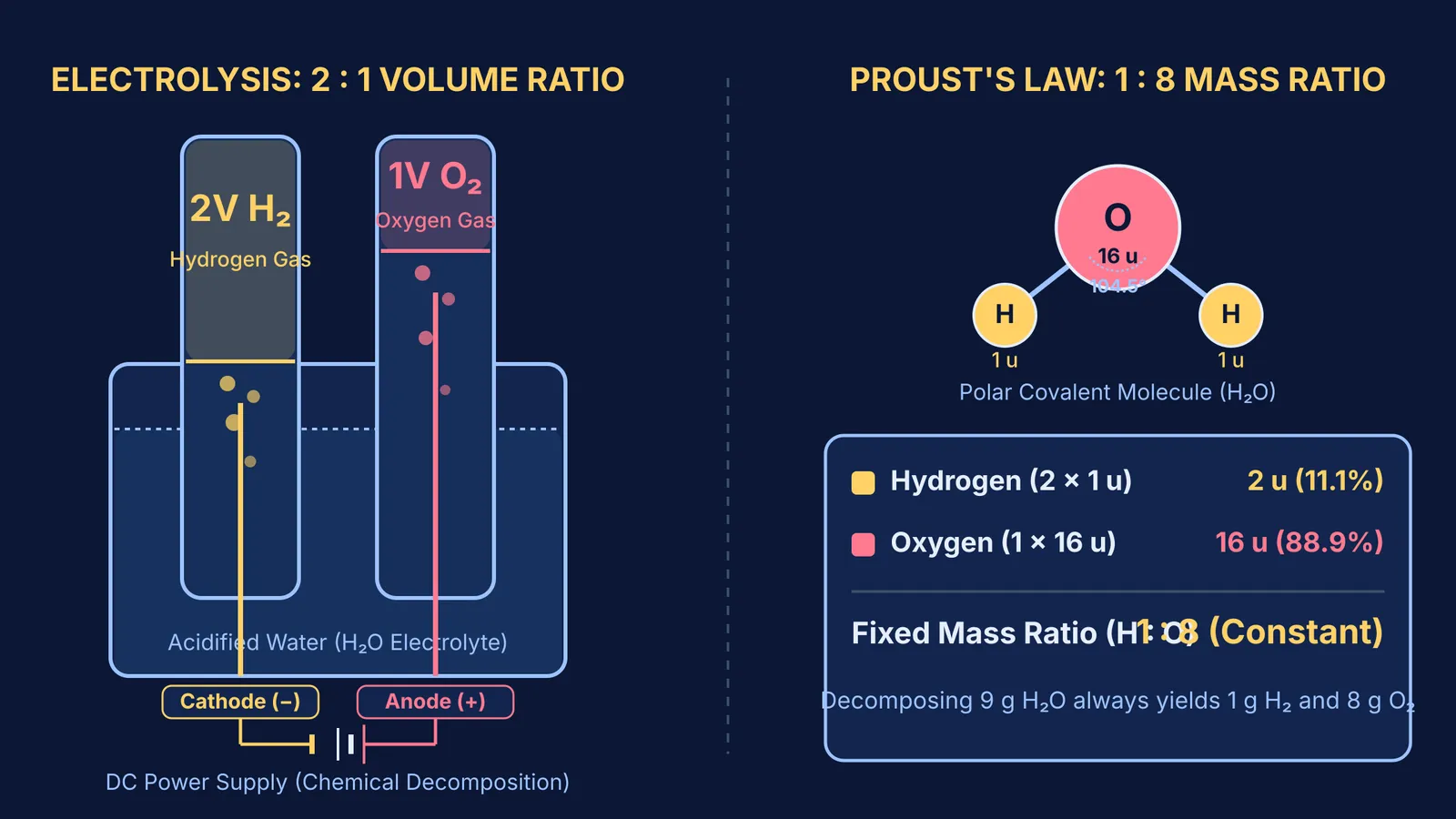
The primary test of a compound is constant composition. In 1799, French chemist Joseph Proust established the Law of Definite Proportions, proving that a pure chemical compound always contains its elements in a fixed ratio by mass.
In a water molecule, two hydrogen atoms bond to one oxygen atom. Because hydrogen has an atomic mass of roughly 1 u and oxygen has an atomic mass of 16 u, the elements combine in a 2 : 16 mass ratio, which simplifies strictly to 1 : 8. As explained in the NCERT Class 9 Science textbook on atoms and molecules, decomposing 9 g of pure water always yields 1 g of hydrogen and 8 g of oxygen, regardless of the water's source.
In contrast, a mixture has no fixed ratio. You can dissolve one or three spoons of sugar in a cup of water, and both remain sugar solutions. If you mix 3 g of hydrogen with 8 g of oxygen and ignite them, only 1 g of hydrogen reacts; the remaining 2 g stays unreacted. To see how this contrasts with physical mixtures that retain variable proportions, read our guide on the difference between a mixture and a compound using iron and sulphur.
How do the properties of water differ from its constituent elements?
In a mixture, constituents keep their original properties. In air, oxygen still supports combustion just as pure oxygen gas does. When a compound forms, chemical bonds create a substance with entirely new properties.
Water behaves nothing like the elements that create it:
Hydrogen gas is combustible and burns explosively with a pop sound.
Oxygen gas supports combustion and reignites a glowing wooden splint.
Water (H₂O) is a liquid at room temperature that does not burn and does not support combustion; it extinguishes fire.
Water also has fixed physical constants. Data from the NIST Chemistry WebBook shows that pure water freezes at 0 °C (273.15 K) and boils at 100 °C (373.15 K) at 1 atmosphere of pressure (101.325 kPa). Mixtures do not have sharp boiling points; salt water boils across a rising temperature range. How atoms join into set formulas connects directly to valency; see our guide on how to write chemical formulas using valency in Class 9.
Why can water only be separated by electrolysis?
Mixtures separate through simple physical methods such as filtration, evaporation, or magnetic attraction. Boiling muddy water leaves soil behind. But boiling pure water produces steam that is still H₂O; no physical method can separate hydrogen from oxygen.
Separating water requires breaking strong polar covalent bonds. In 1800, English scientists William Nicholson and Anthony Carlisle achieved the first electrolysis of water using a voltaic pile. When an electric current passes through acidified water, it decomposes into gases: 2H₂O(l) → 2H₂(g) + O₂(g)
Hydrogen collects at the cathode (negative electrode) and oxygen at the anode (positive electrode) in a 2 : 1 volume ratio, reflecting its molecular formula. If you want to explore each principle in its place on the subject map, the Fermi Concept Library covers every concept in physics, chemistry, biology, mathematics and computing. For broader classification rules, see how to classify substances into elements, compounds and mixtures.
What is the four-point exam framework for Class 9?
For full marks in school examinations, summarise your answer using four clear criteria:
Composition: Hydrogen and oxygen combine in a fixed 1 : 8 mass ratio under the law of constant proportions.
Properties: Water displays unique properties (extinguishing fire) unlike combustible hydrogen and combustion-supporting oxygen.
Separation: Constituents cannot be separated physically; they require chemical decomposition by electrolysis.
Energy change: Heat and light are released during formation, confirming chemical bonding.
Consider this classic NCERT Class 9 Chemistry numerical problem: what mass of oxygen reacts with 6 g of hydrogen, and what mass of water forms? Using the 1 : 8 mass ratio: Mass of oxygen = 6 g × 8 = 48 g. Mass of water formed = 6 g + 48 g = 54 g. Even if 60 g of oxygen were provided, only 48 g would react, leaving 12 g of oxygen behind.
When working through stoichiometry problems or balancing chemical equations, the Fermi Problem Library provides worked problems with a step-by-step solver that explains the reasoning rather than printing an answer.


