

On this page
If you are a Class 8 student starting on the nature of matter, telling an element from a compound or a mixture can feel like a word game. But chemistry relies on these three categories to make sense of the world. Understanding fixed composition and how things separate gives you a reliable way to sort any substance you encounter, whether you are in the laboratory or just looking at items in your kitchen.
What are elements and compounds?
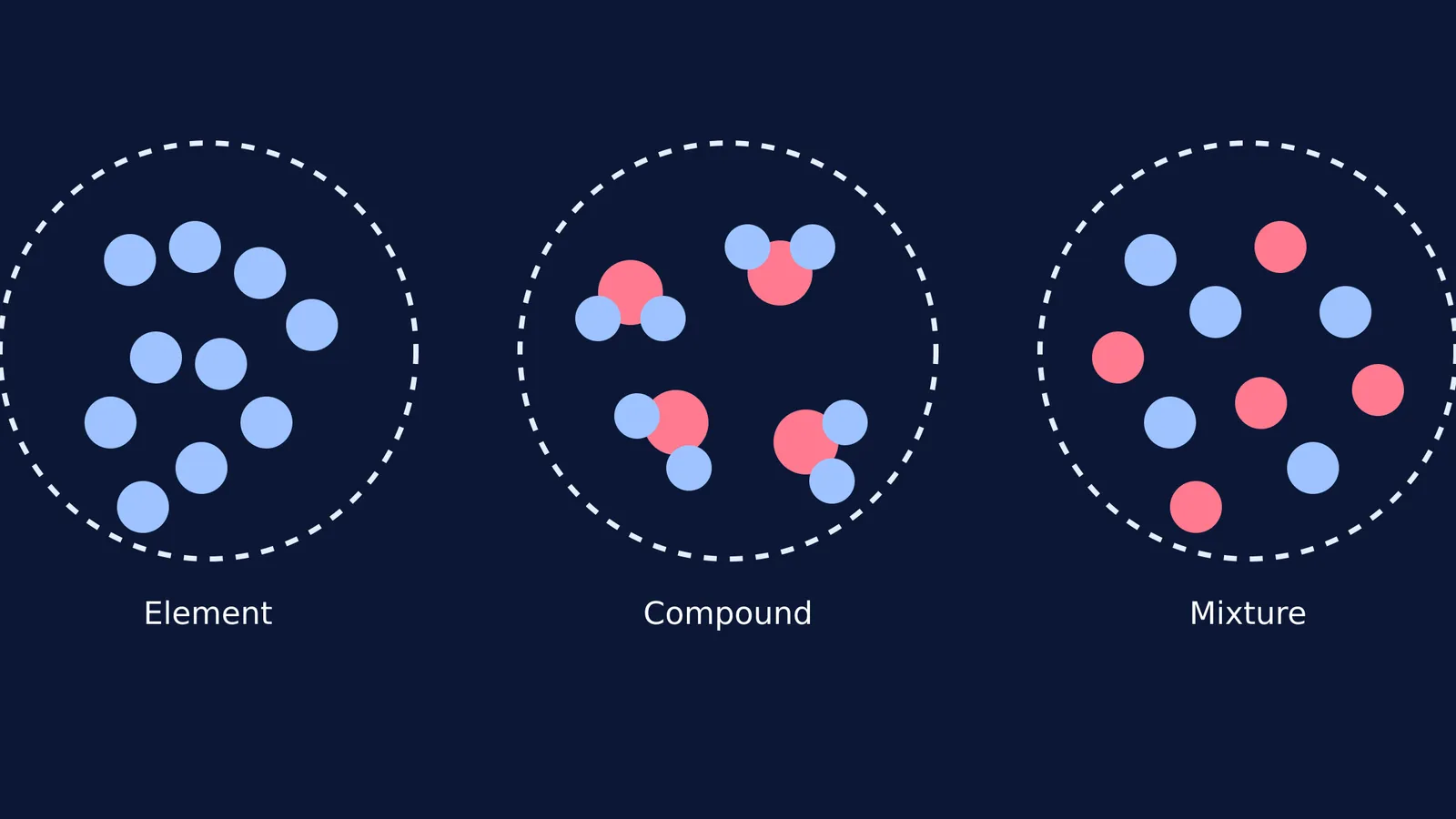
According to Wikipedia's definition of a chemical substance, an element is a unique type of matter that cannot be broken down further, while a compound combines two or more elements in a fixed ratio.
For example, oxygen is an element. If you examine pure oxygen gas, its molecules contain only oxygen atoms. You cannot break it apart into anything simpler. On the other hand, water is a compound. Every single water molecule in the universe has exactly two hydrogen atoms for every one oxygen atom. This is a fixed ratio that never changes, giving water a strict chemical formula.
Crucially, a compound's properties are entirely different from the elements that make it up. Hydrogen is a highly flammable gas and oxygen is the gas that supports burning. Yet, when they bond chemically to form water, the resulting compound extinguishes fire. You cannot split water back into hydrogen and oxygen by physical means like filtering, boiling, or freezing; it requires a chemical change, such as passing an electric current through it.
What is a mixture?
A mixture is a material composed of two or more substances that are physically combined rather than chemically bonded.
Because there are no chemical bonds holding the different parts together, a mixture does not have a fixed composition. Think about the air in your classroom. It contains nitrogen, oxygen, argon, and carbon dioxide. It has more carbon dioxide when all the windows are closed and the room is full of students than it does when the room is empty, but it is still classified as air.
The lack of chemical bonds also means you can separate a mixture by physical methods. If you dissolve salt in water, you create a mixture. You can simply boil the salt water to evaporate the liquid, leaving the solid salt behind. If you mix iron filings with sand, you can use a magnet to pull the iron out. In every mixture, each part keeps its original, individual properties.
Can a mixture look like a pure substance?
One of the most confusing things for students is that mixtures can sometimes look perfectly uniform. These are called homogeneous mixtures.
When you dissolve sugar in a glass of water, the sugar completely disappears into the liquid. It looks exactly like pure water. However, it is still a mixture because the sugar and water are not chemically bonded, the sweetness can vary depending on how much sugar you add (no fixed composition), and you can separate them by boiling off the water.
Heterogeneous mixtures, like a bowl of mixed nuts or muddy water, are much easier to spot because you can see the different components with your naked eye. But whether a mixture is homogeneous or heterogeneous, the rule of separability by physical means always applies.
How to sort air, water, brass, salt and oxygen?
Let us use the rules of composition and separability to classify five common substances that frequently appear in chemistry exams:
Oxygen: It is made of only one type of atom. It cannot be broken down by any physical or chemical means into a simpler substance. It is an element.
Water (H₂O): Hydrogen and oxygen are chemically bonded in a strict 2:1 ratio. Because you cannot separate it by physical means and its properties differ from its constituent gases, it is a compound.
Salt (NaCl): Sodium (a highly reactive metal) and chlorine (a toxic gas) are chemically bonded in a fixed 1:1 ratio to form common table salt. It is a compound.
Air: A physical blend of nitrogen, oxygen, and other gases. It has no fixed chemical formula and can be separated by cooling it into a liquid and boiling it off in stages (a physical method known as fractional distillation). It is a mixture.
Brass: An alloy made by melting copper and zinc together. Because the amounts of copper and zinc can vary depending on what the brass is used for, and no new chemical bonds form to create a new molecule, brass is a mixture.
When you meet a new substance in your science class, always ask yourself if its recipe is strictly fixed and if you could theoretically pull it apart without a chemical reaction. As you progress to higher classes, you will build on these foundational ideas, learning about electron dot structures of covalent molecules in Class 10 and naming carbon compounds in Class 10. If you find yourself stuck on classification questions now, the Fermi Problem Library provides worked problems with a step-by-step solver that explains the reasoning rather than printing an answer, helping you apply these rules correctly.


