

On this page
When you stir grey iron filings and yellow sulphur powder together in a dish, you get a greenish-yellow pile of dust. But if you take a bunsen burner and heat that same pile in a test tube until it glows red, it turns into a hard, black lump. Even if you remove the heat, the mixture will continue to glow brightly as the reaction races to completion.
This classic chemistry experiment shows the fundamental difference between a physical mixture and a chemical compound. By testing both piles with a magnet and a few drops of dilute acid, we can prove that heating the elements creates an entirely new substance, rather than just changing how they look.
Is iron and sulphur a mixture or a compound?
Before heating, the iron filings and sulphur powder form a mixture. In a physical mixture, the elements are simply jumbled together in the same space but are not chemically bonded to each other. You could, in theory, pick them apart with tweezers. Both iron and sulphur retain their original physical and chemical properties. You can mix them in any proportion, and they will still just be a mixture of iron and sulphur.
After heating, the two elements undergo a chemical synthesis reaction to form iron(II) sulphide (FeS). This new black solid is a chemical compound. Its elements are bonded together in a fixed ratio. The new compound has completely different physical and chemical properties from the elements that made it; for instance, it is a hard black solid that melts at 1,194 °C_sulfide).
If you are trying to picture how atoms rearrange themselves during these changes, it can be hard to visualize from a textbook page. This is where the Fermi Concept Library helps; you can explore the structure of elements and compounds, while Fermi's AI tutor draws the atomic bonds on a board to show exactly what happens when heat is applied.
How do you test the mixture?
To prove that the unheated powder is just a mixture, we can test its physical and chemical properties using tools that affect iron but not sulphur.
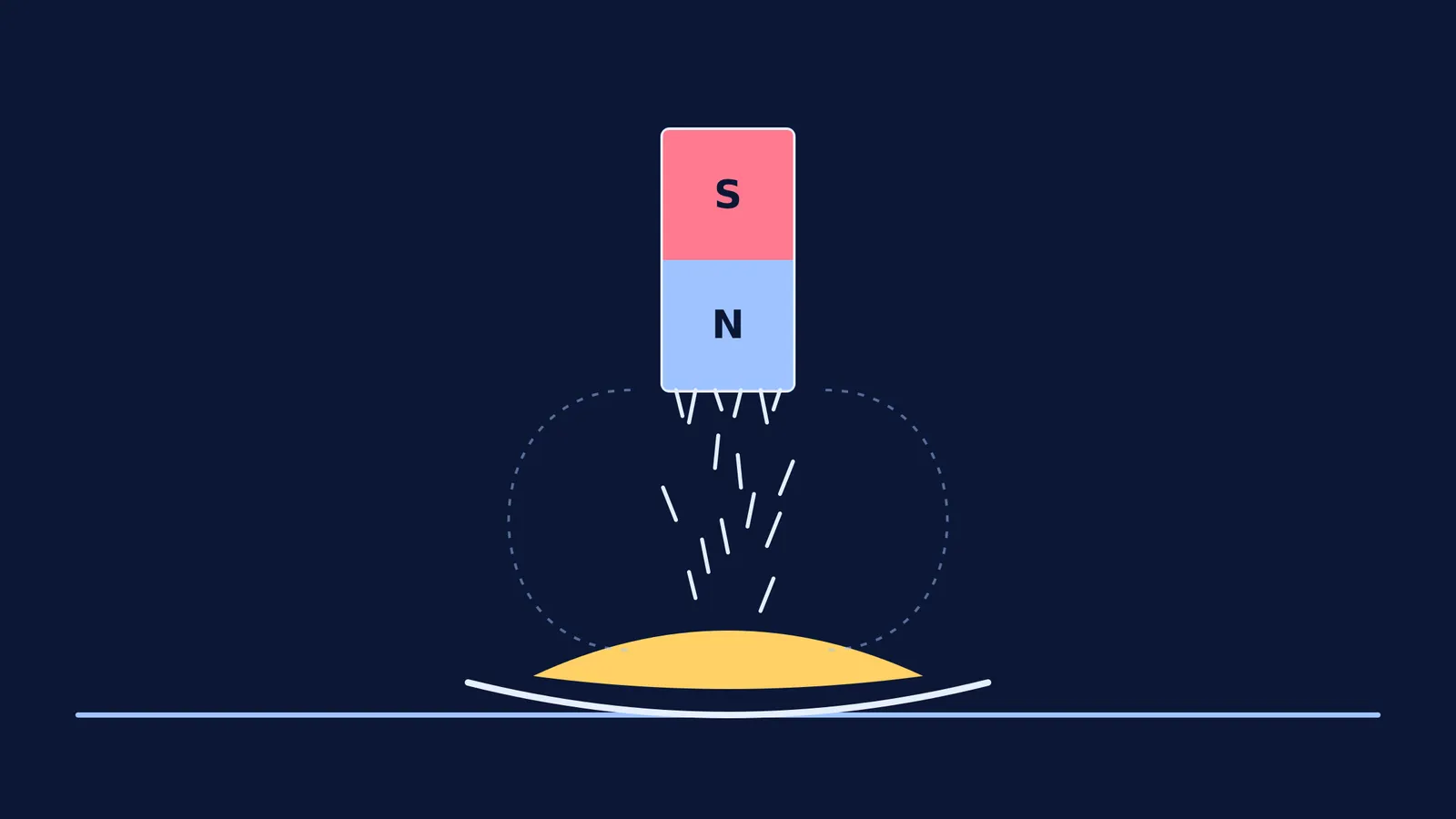
The magnet test: If you hover a bar magnet over the mixture, the iron filings will leap up and cling to the magnet, leaving the yellow sulphur powder behind in the dish. Iron is a magnetic metal, while sulphur is a non-magnetic non-metal. Because they are not bonded, the physical force of the magnet easily pulls them apart.
The acid test: If you add dilute hydrochloric acid (HCl) to the mixture in a test tube, the iron reacts to produce bubbles of hydrogen gas (H₂). You can confirm this is hydrogen by holding a lit splint to the mouth of the tube, which will produce a characteristic "pop" sound. The chemical equation for this is Fe + 2HCl → FeCl₂ + H₂. The sulphur simply floats in the acid without reacting, demonstrating that the two elements act independently.
Understanding how to predict these outcomes is a core skill in exams. For more on how elements behave, you can read our guide on Metals and non-metals in Class 10: reactivity series and ionic bonds.
How do you test the iron sulphide compound?
Once the mixture is heated and turns into the compound iron(II) sulphide, those same two tests yield completely different results. The original elements have lost their individual identities and their original properties.
The magnet test: The black lump of iron sulphide is no longer magnetic. The iron atoms are chemically bonded to the sulphur atoms in an ionic lattice, which changes their electron arrangement and removes their magnetic properties. The magnet will not pick it up, proving that the iron is no longer free.
The acid test: When dilute hydrochloric acid is added to the compound, it no longer produces hydrogen gas. Instead, the reaction produces hydrogen sulphide gas (H₂S). This gas is colourless but has a very strong, distinct smell of rotten eggs. The chemical equation is FeS + 2HCl → FeCl₂ + H₂S.
If you are confused by how to write the chemical equations for these acid tests, you are not alone. The Fermi Problem Library has a step-by-step solver that explains the reasoning behind balancing equations rather than just printing the final answer. You can also review the rules in our article on Types of chemical reactions in Class 10: balancing and examples.
By comparing the mixture and the compound, this simple activity proves that a chemical reaction doesn't just mix things up—it creates something entirely new.


