

On this page
If you melt copper and zinc together, you get brass. However, brass does not have a chemical formula like water (H₂O) or carbon dioxide (CO₂). According to the IUPAC Compendium of Chemical Terminology, an alloy like brass is a mixture, not a chemical compound.
Understanding the difference between mixtures and compounds is a core part of chemistry, and it explains why we can tailor metals for everything from ship propellers to musical instruments.
What is the difference between a mixture and a compound?
The distinction comes down to how the elements interact and whether they form something entirely new.
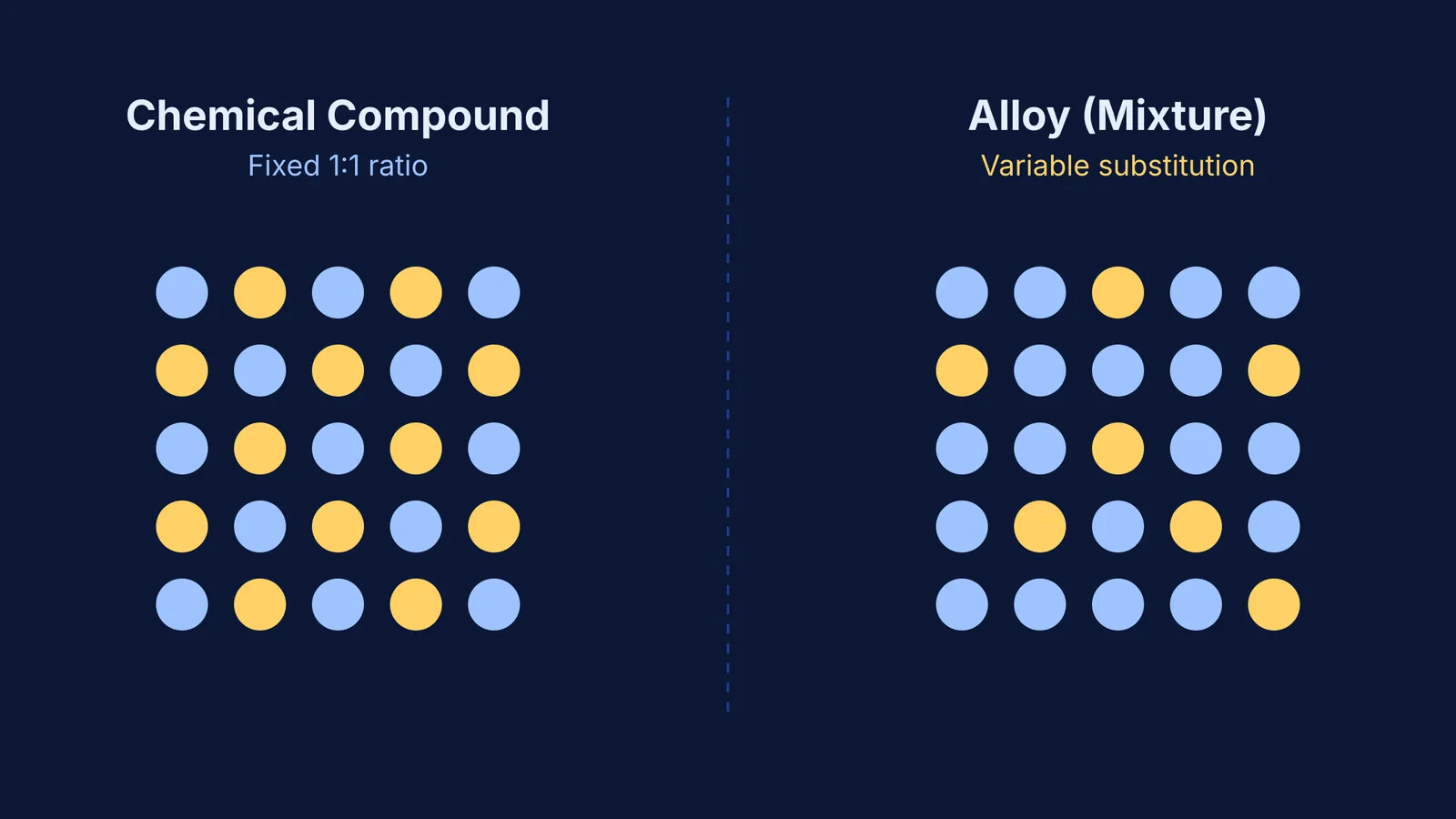
In a chemical compound, elements bond together in a fixed, unchangeable ratio. For instance, water is always formed by two hydrogen atoms and one oxygen atom. A chemical reaction has taken place, and the elements lose their original properties. Hydrogen is an explosive gas and oxygen fuels fire, but together they form a liquid that extinguishes flames.
A mixture, on the other hand, is a physical blend of two or more substances. According to the IUPAC Gold Book, the components of a mixture do not undergo a chemical reaction to create a new substance. Because they are not chemically bonded in a strict stoichiometry, you can change the proportions of the ingredients without violating the fundamental laws of chemistry.
Why is an alloy a mixture?
The NCERT Class 10 Science textbook formally defines an alloy as a homogeneous mixture of two or more metals, or a metal and a non-metal. When scientists and engineers classify alloys as mixtures (specifically, solid solutions), they rely on two main chemical facts:
Variable composition: You can change the percentages of the elements involved to create different grades of the same alloy.
Retained properties: The elements do not form new chemical bonds that destroy their metallic nature; they continue to act as metals.
If you have concept gaps about how atoms pack together in solid solutions versus compounds, the Fermi Concept Library offers a lesson for every concept in chemistry and its place in the map.
How does variable composition work in alloys?
Because alloys are mixtures, you can tweak the recipe to get the exact physical properties you need. If alloys were true chemical compounds, attempting to change their atomic ratio would simply fail or produce an entirely different compound.
Brass: This alloy of copper and zinc has no single formula. According to Wikipedia, standard cartridge brass is typically 70% copper and 30% zinc, which provides an ideal balance of strength and ductility. However, naval brass is made with roughly 60% copper, 40% zinc, and 1% tin to resist seawater corrosion.
Steel: Steel is a vital alloy of iron and carbon. Engineering data from Xometry states that mild (low-carbon) steel contains between 0.05% and 0.30% carbon, making it ductile and easy to weld. Conversely, high-carbon steel contains up to 2.1% carbon, which makes it incredibly hard and suitable for cutting tools.
Bronze: Traditionally a mixture of copper and tin, modern bronze varies widely by its intended use. Bell metal, used for casting highly resonant bells, typically contains 75 to 80% copper and 20 to 25% tin, according to Britannica.
Do elements in an alloy keep their properties?
Yes, the constituent elements retain their fundamental metallic properties. When you melt copper and zinc together, they do not undergo a chemical reaction to become a new, non-metallic molecule.
Instead, they form a shared metallic lattice. In a substitutional alloy like brass, zinc atoms simply replace some of the copper atoms randomly in the crystal structure. The "sea of electrons" that allows metals to conduct electricity and heat remains perfectly intact. While an alloy's electrical conductivity and melting point are generally lower than those of the pure host metal, the material still behaves fundamentally as a metal.
A checklist for mixtures vs compounds
If you face an exam question asking you to classify a material as a mixture or a compound, you can use this simple three-step framework:
Can the ratio change? If you can vary the composition continuously (like changing zinc from 10% to 30% without issue), it is a mixture.
Did a chemical reaction happen? If the elements just dissolved into one another physically and can theoretically be separated by physical means (like selective melting), it is a mixture.
Are the original properties gone? If the resulting material still looks, feels, and acts like its constituent metals, it is an alloy and therefore a mixture.
To build on these core chemistry concepts, review the differences between ionic vs covalent compounds or explore the distinct properties of why metals bend and ionic crystals shatter. You might also enjoy reading the history of how Al-Khazini measured density and alloys in the 12th century using his remarkable balance of wisdom.


