

On this page
If you hit a piece of copper wire with a hammer, it flattens into a thin sheet. If you hit a large crystal of table salt with the same hammer, it shatters into a powder. Both are solid structures held together by chemical bonds, so why do they react to force so differently?
The answer lies in how their atoms share electrons, and it explains everything from why we build bridges out of steel to why salt crystals grind so easily in a pepper mill.
Why are metals malleable?
Metals are malleable—meaning they can be bent, shaped or hammered into sheets without breaking—because of the unique nature of the metallic bond. They are also ductile, meaning they can be drawn into thin wires. Both properties rely on the same internal mechanism.
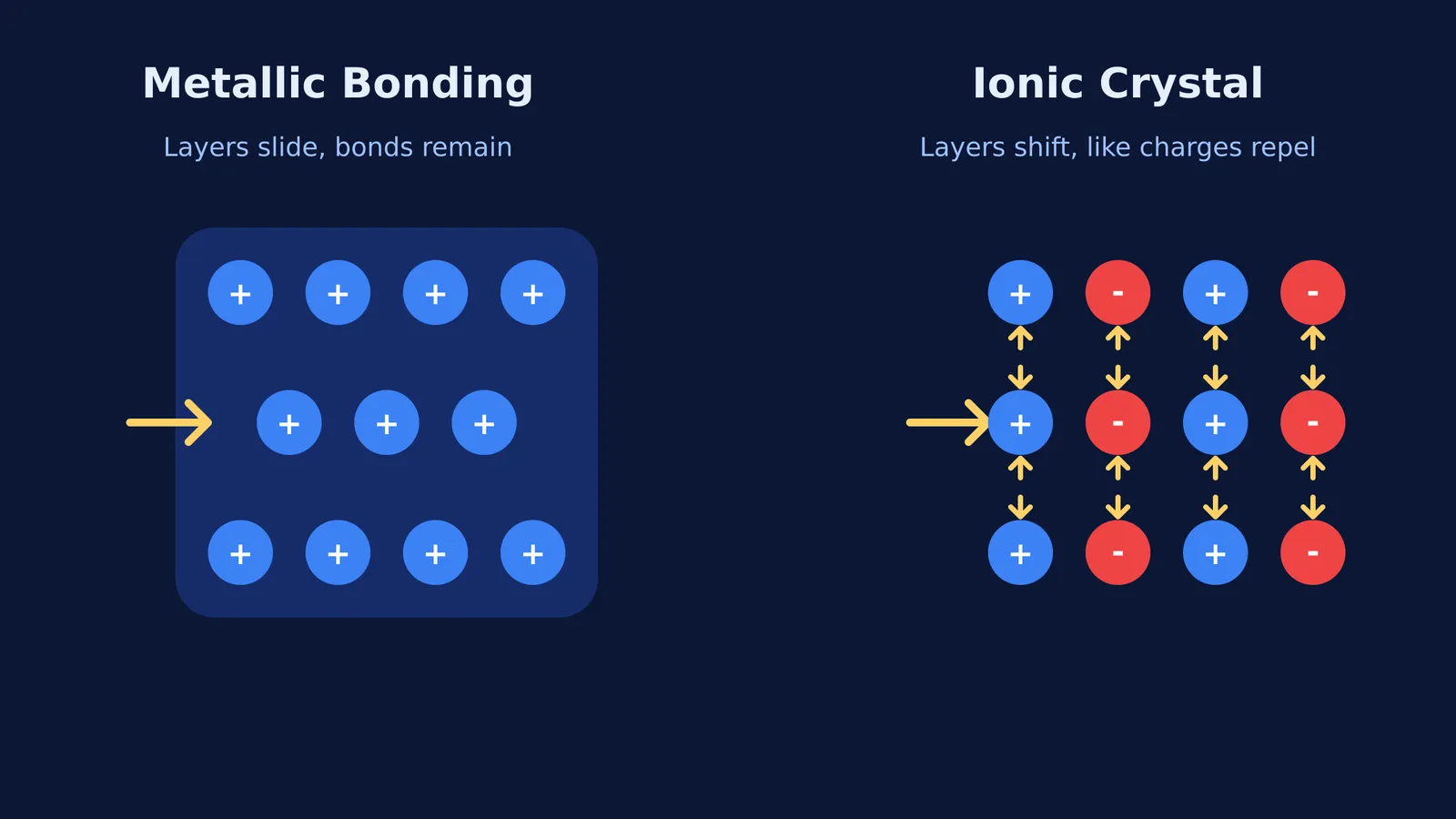
In a metal, the valence electrons are not bound to specific atoms but are delocalized, forming a "sea" of mobile electrons that surrounds a lattice of positive metal cations (OpenStax Chemistry).
When you apply a compressive force to a metal, such as striking it with a hammer, you push layers of these positive ions past one another. Because the electron sea is fluid and non-directional, it simply redistributes itself around the cations in their new positions. The electrostatic attraction between the positive ions and the negative electrons remains intact. This flexible bond acts like a dynamic glue, allowing the metal to deform and hold a new shape permanently without breaking.
Why do ionic crystals shatter?
Ionic solids, such as sodium chloride (table salt), are brittle. They consist of a rigid, three-dimensional lattice made of alternating positive and negative ions.
These ions are locked in place to maximize the strong electrostatic attraction between opposite charges and to minimize the repulsion between like charges. Unlike the flexible electron sea, ionic bonds are highly directional. When a hammer strikes an ionic crystal, it forces a layer of ions to shift downwards or sideways.
If the layer shifts even slightly, the careful arrangement is destroyed. Ions of the same charge (positive next to positive, or negative next to negative) are suddenly forced into direct alignment. The resulting strong electrostatic repulsion pushes the layers apart instantly. Because there are no free electrons to cushion this shift, the crystal shatters along a clean line known as a cleavage plane.
What is the exam checklist for metallic vs ionic properties?
When you are asked to predict or explain the mechanical properties of a material in a physics or chemistry exam, examiners look for specific keywords. Use this checklist to ensure you score full marks for your explanation:
State the internal structure: Always mention the "sea of delocalized electrons" for metals, and the "rigid lattice of alternating opposite charges" for ionic compounds.
Describe the applied force: Explain clearly that an external force causes a "layer of ions to shift or slide" relative to the rest of the structure.
Detail the internal reaction: For metals, state that the non-directional bonds are maintained because the electrons move with the ions. For ionic crystals, state that the shift causes "like charges to align".
Name the physical result: Conclude your answer by stating that the metal deforms (proving it is malleable) while the ionic crystal repels itself apart and fractures (proving it is brittle).
How can I visualise an electron sea simulation?
Reading about shifting atomic layers is one thing; seeing the physics in motion makes it obvious. If you struggle to picture how these microscopic lattices behave under stress, the Fermi Simulation Lab provides interactive simulations for the ideas that are easier to see than to read. You can apply forces to both metallic and ionic structures, watch the electron sea re-glue the metal ions as they slide, and see the exact moment the ionic lattice aligns like charges and repels itself apart.
Fermi's AI tutor can also help you connect these microscopic models to macroscopic properties. If you bring a question about conductivity, melting points, or structural integrity, it works out what you already know, builds a plan for the session, and teaches through it step by step.
You can explore how these forces scale up to the real world in problems like finding the elastic potential energy in a stretched wire, or you can see how free electrons behave differently in other materials by comparing energy bands in conductors, semiconductors and insulators.


