

On this page
When you study carbon and its compounds in Class 10, the first thing you notice is how different they are from salts. Sodium chloride (an ionic compound) is a hard crystal that needs furious heat to melt. Methane (a covalent carbon compound) is a gas at room temperature.
These dramatic differences in melting points, boiling points and electrical conductivity all come down to one thing: what happens to the electrons when atoms bond.
Here is a look at the physical properties of ionic and covalent compounds, and the underlying chemistry that explains them.
What are ionic and covalent compounds?
Atoms bond to reach a stable, full outer shell of electrons. There are two main ways to do this:
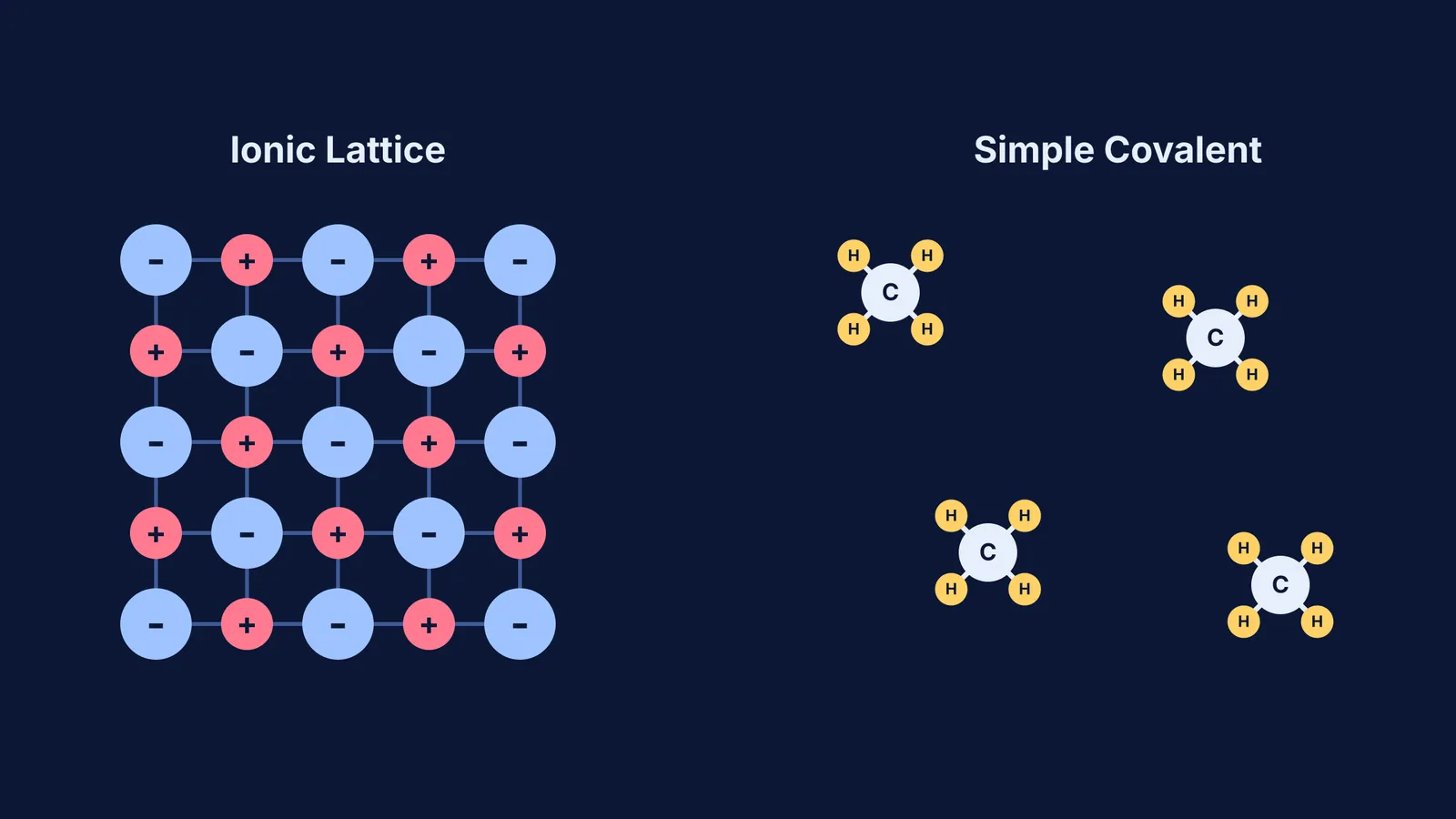
Ionic compounds form when one atom gives up electrons to another. Metals (like sodium) lose electrons to become positive ions, while non-metals (like chlorine) gain them to become negative ions. These opposite charges lock together in a massive, repeating grid called a giant ionic lattice.
Covalent compounds form when non-metal atoms share pairs of electrons. The shared electrons hold the specific atoms together in a discrete bundle called a molecule, as seen in the electron dot structures in Class 10.
Why do ionic compounds have high melting points?
Because ionic lattices are held together by the strong electrostatic attraction between positive and negative ions, breaking them apart takes a large amount of thermal energy. For example, sodium chloride melts at 1074 K (801 °C), according to the NCERT Class 10 textbook.
Covalent compounds, however, do not exist as giant charged lattices. They form distinct, neutral molecules. While the covalent bonds *inside* a water or methane molecule are very strong, the forces *between* one molecule and the next are extremely weak.
When you heat a simple covalent substance, you only need to overcome these weak intermolecular forces, not the strong covalent bonds. This is why methane melts at a freezing 90 K (−183 °C), as noted in NCERT Chapter 4. Some covalent compounds do form giant networks—diamond is one—but most of the ones you study alongside naming carbon compounds are simple molecules with low melting points.
Why do ionic compounds conduct electricity only when molten or dissolved?
To conduct electricity, a substance needs charged particles that are free to move.
In a solid ionic compound, the ions are firmly fixed in the lattice. Since they cannot migrate, solid salt is an insulator. But if you melt the solid or dissolve it in water, the lattice breaks down. The charged ions are released and can flow toward the opposite electrodes, allowing the current to pass.
Covalent compounds generally never conduct electricity, whether solid, liquid or gas. Because their electrons are shared tightly between atoms, there are no free electrons or charged ions available to carry an electrical charge.
How to tell ionic and covalent compounds apart?
If you are faced with an unknown substance in the lab (or in a test question), its physical properties are a giveaway:
State at room temperature: If it is a gas, a liquid or a soft solid (like wax), it is almost certainly covalent. If it is a hard, brittle crystal, it is likely ionic.
Solubility: Ionic compounds dissolve readily in water (a polar solvent) but not in organic liquids like kerosene. Covalent compounds usually behave the opposite way: they dissolve in organic solvents but resist water.
Conductivity test: Dissolve the substance in water and insert two graphite electrodes connected to a bulb. If the bulb lights up, the compound has released ions into the solution.
Getting these basic differences clear makes it much easier to predict how materials will behave, whether you are extracting metals or studying organic reactions.
If you struggle to picture how ions arrange themselves in three dimensions, a visual tool can help. You can bring a topic to Fermi's AI tutor, and it will work out what you already know and build a plan for the session—running the simulation so you can see the lattice before you memorize the rules. You can also explore chemical bonds step by step in the Concept Library.


