

On this page
What was the balance of wisdom?
In 1121 CE, mathematician and physicist Abu al-Fath Abd al-Rahman al-Khazini completed *Kitab Mizan al-Hikma* (*The Book of the Balance of Wisdom*) in Merv, modern Turkmenistan. Serving Seljuk Sultan Ahmad Sanjar, Al-Khazini designed a specialized instrument for the royal treasury: an equal-arm hydrostatic scale that determined the purity of coins and gemstones without melting or shaving away precious metal.
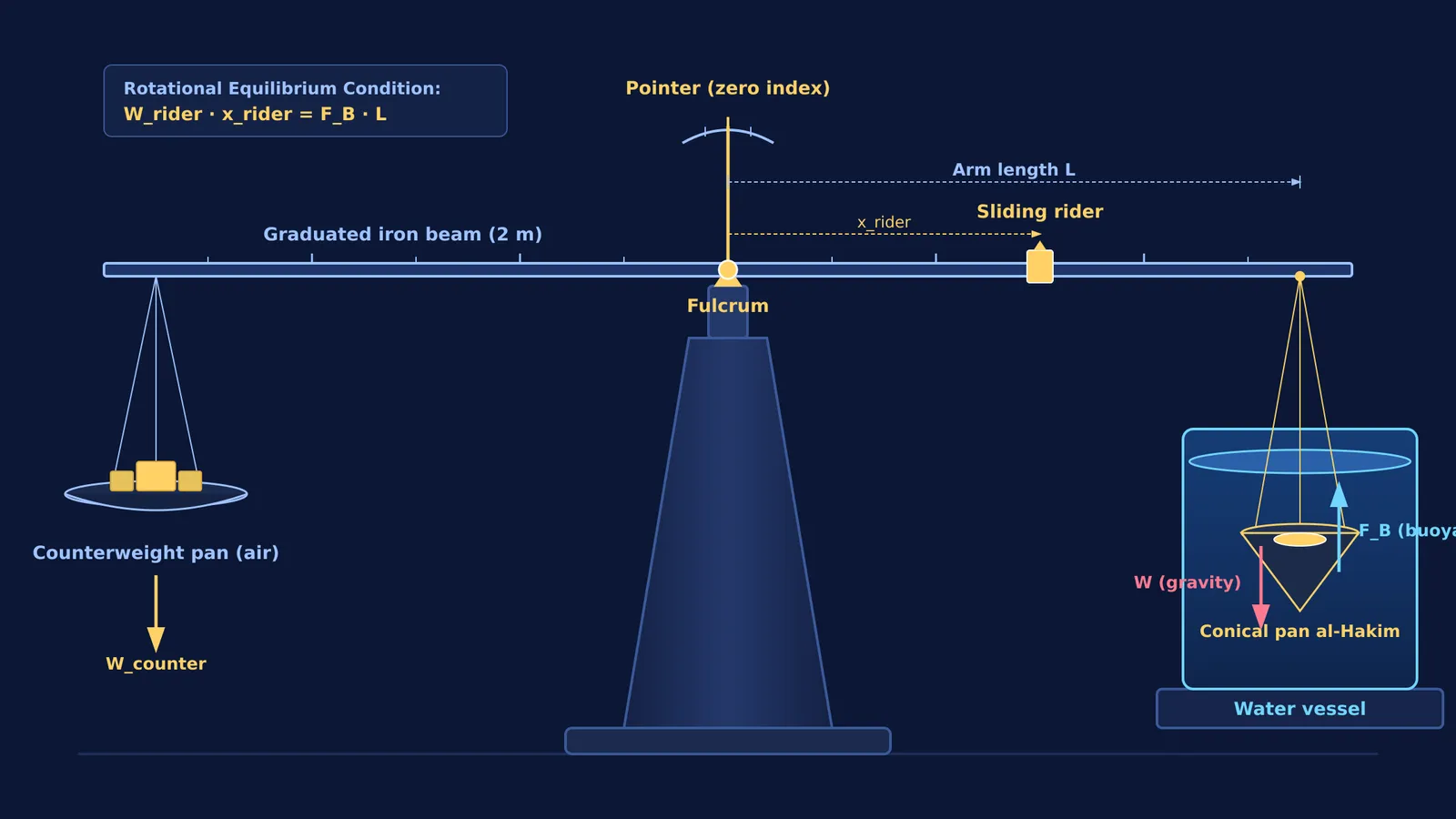
The balance featured an iron beam roughly 2 metres long suspended on a sharp steel knife-edge fulcrum to minimize friction. As documented in Nicholas Khanikoff's translation in the Journal of the American Oriental Society, it held five scale pans: two standard air pans at the beam ends, a conical pan called *al-hakim* ("the judge") with a pointed bottom designed to break water surface tension cleanly, a notched "winged" pan called *al-mujannah* that could slide along the beam without hitting neighboring pans, and a counterweight pan. In modern tests published in Nuncius, a reconstructed prototype confirmed its extraordinary sensitivity: detecting 1 habba (about 0.04 to 0.06 grams) on a 3-kilogram load, achieving an accuracy of 1 part in 60,000.
How did Al-Khazini measure density using water?
Al-Khazini applied Archimedes' principle: an object submerged in water experiences an upward buoyant force equal to the weight of displaced water. You can see how Archimedes approached buoyancy and levers in his early treatises. By weighing an object in air (W_air) and then in water (W_water), the buoyant loss is:
F_B = W_air − W_water
Dividing the weight in air by this buoyant loss isolates specific gravity:
Specific gravity = W_air / (W_air − W_water)
Al-Khazini compiled empirical density tables for 50 substances, as recorded in the Journal of the American Oriental Society. For liquid mercury, he measured 13.56 against modern 13.55 (differing by less than 0.1%). For lead, he found 11.32 (modern: 11.34, within 0.2%). He recorded cast gold at 19.05 (modern: 19.32), pure silver at 10.30 (modern: 10.49), and wrought iron at 7.74 (modern: 7.87).
He also accounted for environmental factors. Al-Khazini observed that hot water expands and becomes less dense than cold water, and noted that atmospheric air exerts an upward buoyant force on weights, requiring temperature and air corrections for true precision.
How did the balance detect counterfeit alloys?
Counterfeiters often melted gold with silver or copper, maintaining standard weight by slightly enlarging the coin's dimensions. Conventional scales could not catch the trick because both coins weighed the same in air.
Al-Khazini solved this by combining buoyancy with the principle of moments. High school physics students use this same relationship when calculating unknown masses using the principle of moments. Instead of balancing the submerged sample with dozens of tiny weights, Al-Khazini marked fine calibrations along the 2-metre beam and mounted a movable sliding weight (a rider). Sliding the rider until the pointer centered at zero let inspectors read an alloy's composition directly, as explained in Nuncius.
Understanding how buoyant lift scales with displaced volume helps students avoid common fluid mechanics and buoyancy mistakes. Because an adulterated coin with lower density has excess volume, it displaces more water and experiences greater buoyant lift, requiring the rider to move to a distinct position on the calibrated beam.
Worked example: how do you spot silver hidden in a gold coin?
Suppose the treasury tested a 100.0 g coin suspected of adulteration:
Weight in air: W_air = 100.0 g
Weight submerged in water: W_water = 93.6 g
Buoyant loss: F_B = 100.0 g − 93.6 g = 6.4 g (displacing 6.4 cm³ of water)
Measured density: ρ_alloy = 100.0 g / 6.4 cm³ = 15.625 g/cm³
Using standard densities (gold at 19.3 g/cm³ and silver at 10.5 g/cm³, as cited in the Journal of the American Oriental Society comparative tables), pure gold of mass 100.0 g would displace only 100.0 / 19.3 ≈ 5.18 cm³. Displacing 6.4 cm³ proves lower-density metal was added.
For a binary alloy, total volume is:
V_total = (m_gold / ρ_gold) + (m_silver / ρ_silver) = 6.4 cm³
Substituting m_gold = 100.0 − m_silver gives:
(100.0 − m_silver) / 19.3 + (m_silver / 10.5) = 6.4
Solving for m_silver yields 28.1 g.
The coin contains 28.1 g of silver (28.1% by mass) and 71.9 g of gold. Al-Khazini's algebraic formula gave this directly:
m_silver = W_air × [(1 / ρ_gold − 1 / ρ_alloy) / (1 / ρ_gold − 1 / ρ_silver)]
Plugging the measured specific gravity of 15.625 into his formula yields the identical 28.1% silver content without altering or scraping the coin.
What can modern physics students learn from Al-Khazini?
Al-Khazini's work shows that fluid statics tracks forces and rotational equilibrium together. In exams like JEE Main and Advanced, questions often combine buoyant forces with torque equations about a fulcrum.
When an object enters a fluid, gravity does not change; rather, upward pressure creates a buoyant force that reduces tension in the suspension wire.
If you struggle to visualize how buoyancy and center-of-gravity shifts interact, the Fermi Simulation Lab offers interactive simulations for the ideas that are easier to see than to read. To practice balancing torque equations and hydrostatic problems, the Fermi Problem Library provides worked problems with a step-by-step solver that explains the reasoning rather than printing an answer. For a complete foundation, the Fermi Concept Library covers every concept in physics, chemistry, biology, mathematics and computing, each with its own lesson and its place in the map.
Mastering fluid equilibrium from first principles turns difficult numerical problems into straightforward mechanical accounting.


