

On this page
The changes of state—such as ice melting in a glass or a puddle evaporating in the sun—are physical processes you see every day. In physics and chemistry, a phase transition is the physical process of changing between one state of a medium and another, typically among the basic states of matter: solid, liquid and gas.
Understanding the names for changes of state, and the conditions that cause them, is a foundational part of the science syllabus. Unlike chemical changes, which create entirely new substances, phase changes only alter how the molecules are arranged. The water molecules in solid ice are exactly the same as the water molecules in floating steam.
What are the names for changes of state?
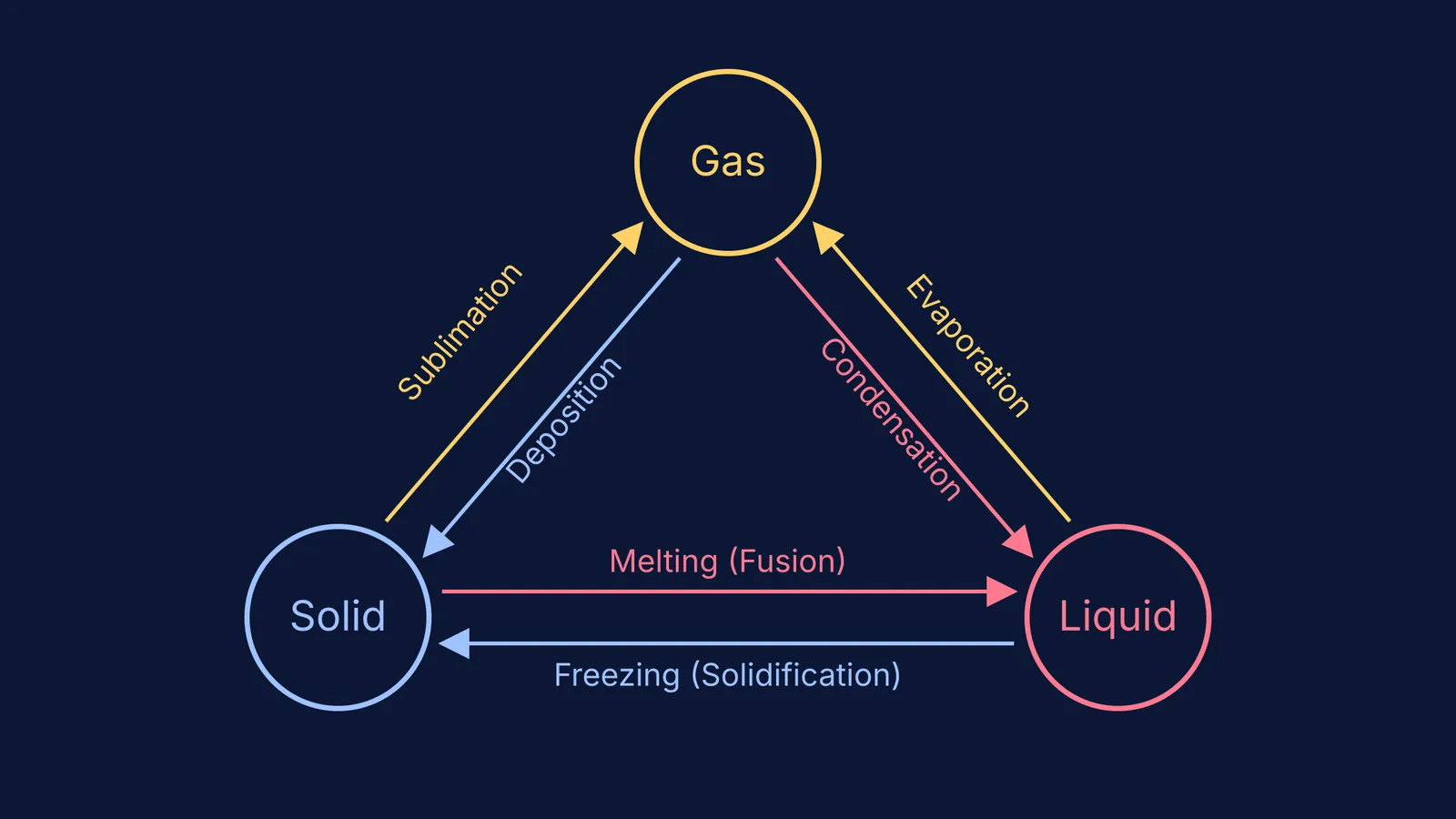
When matter gains or loses energy, it moves between the three basic states. The six names for these changes are:
Melting (or fusion): Solid to liquid.
Freezing (or solidification): Liquid to solid.
Evaporation (or boiling/vaporisation): Liquid to gas.
Condensation: Gas to liquid.
Sublimation: Solid to gas.
Deposition (or desublimation): Gas to solid.
You can observe condensation when humid air meets a cold surface. If you have wondered why a glass of cold water gets wet outside, it is because water vapour in the air loses energy and condenses into liquid droplets. Similarly, evaporation happens at any temperature, though factors like humidity can slow it down—which is why clothes take so long to dry in the monsoon.
Sublimation and deposition: Skipping the liquid phase?
Not every substance melts into a liquid before becoming a gas. Sublimation occurs when a solid gains enough energy to turn directly into a gas. Deposition) is the reverse process, where a gas transforms into a solid without ever passing through the liquid phase.
The most common example is dry ice, which is the solid form of carbon dioxide. Dry ice sublimates directly into carbon dioxide gas at −78.5 °C at standard Earth atmospheric pressure. Because it leaves no liquid residue, it is widely used for temporary refrigeration and theatrical fog effects.
If you are studying phase transitions and forget which term means what, the Fermi Concept Library contains every concept in physics and chemistry, each with its own lesson and its place in the map.
How does temperature affect phase transitions?
Temperature measures the average kinetic energy of the particles in a substance. When you heat a solid, you are transferring energy into it. Its particles vibrate faster against their bonds. Eventually, they break free from their fixed crystalline positions and begin to flow past one another, turning the solid into a liquid.
If you continue to heat the liquid, the particles gain even more kinetic energy, moving faster and colliding more forcefully. Once they gain enough energy to break their intermolecular bonds completely, the liquid reaches its boiling point. For example, water has a relatively high boiling point of 100 °C at normal atmospheric pressure, turning into water vapour. Cooling the substance reverses the entire process: as particles lose kinetic energy, they slow down and clump back together, settling into a rigid structure upon freezing.
How does pressure affect changes of state?
While temperature changes how fast particles move, pressure changes how closely they are packed. A phase diagram shows the exact conditions at which thermodynamically distinct phases occur and coexist at equilibrium.
Increasing the pressure on a gas forces its widely spaced particles closer together, encouraging condensation into a liquid or deposition into a solid. For most substances, high pressure also makes it harder to melt a solid into a liquid, effectively raising the melting point. Water is a famous exception to this rule: because solid ice is less dense than liquid water, applying intense pressure to ice actually lowers its melting point and forces it to melt.
There are specific conditions where a substance balances perfectly between all three states. In thermodynamics, the triple point is the precise temperature and pressure at which the gas, liquid, and solid phases of a substance coexist in equilibrium. For example, the triple point of water occurs at exactly 273.16 K (0.01 °C).
If you struggle with the numericals on ideal gas laws and phase diagrams, Fermi's AI tutor can help. Instead of just printing an answer, it builds a plan for the session and teaches through it—writing on a board, drawing the figure, running the simulation, and checking understanding as it goes.
A checklist for exam questions on phase changes
When revising the names for changes of state, a visual framework is always easier to remember than a list of definitions. Draw a large triangle on your page with Solid, Liquid, and Gas at the three corners, and use these rules to build your own phase diagram:
Draw the heating arrows in red: Point from Solid to Liquid (melting), Liquid to Gas (evaporation), and Solid to Gas (sublimation). These transitions all require an input of heat, meaning they are endothermic processes.
Draw the cooling arrows in blue: Point from Gas to Liquid (condensation), Liquid to Solid (freezing), and Gas to Solid (deposition). These transitions all release heat into their surroundings, meaning they are exothermic processes.
Check the axes: If an exam asks you to interpret a phase diagram graph, look carefully at whether the horizontal axis is temperature or pressure. Increasing the temperature drives matter towards the gaseous phase, while increasing the pressure drives it towards the solid phase (with the notable exception of water).
Identify the missing phase: When a question mentions sublimation or deposition, it is testing your awareness that the liquid phase has been entirely skipped. Always look for the pressure values in these questions, as low pressures often allow solids to sublimate before they can melt.


